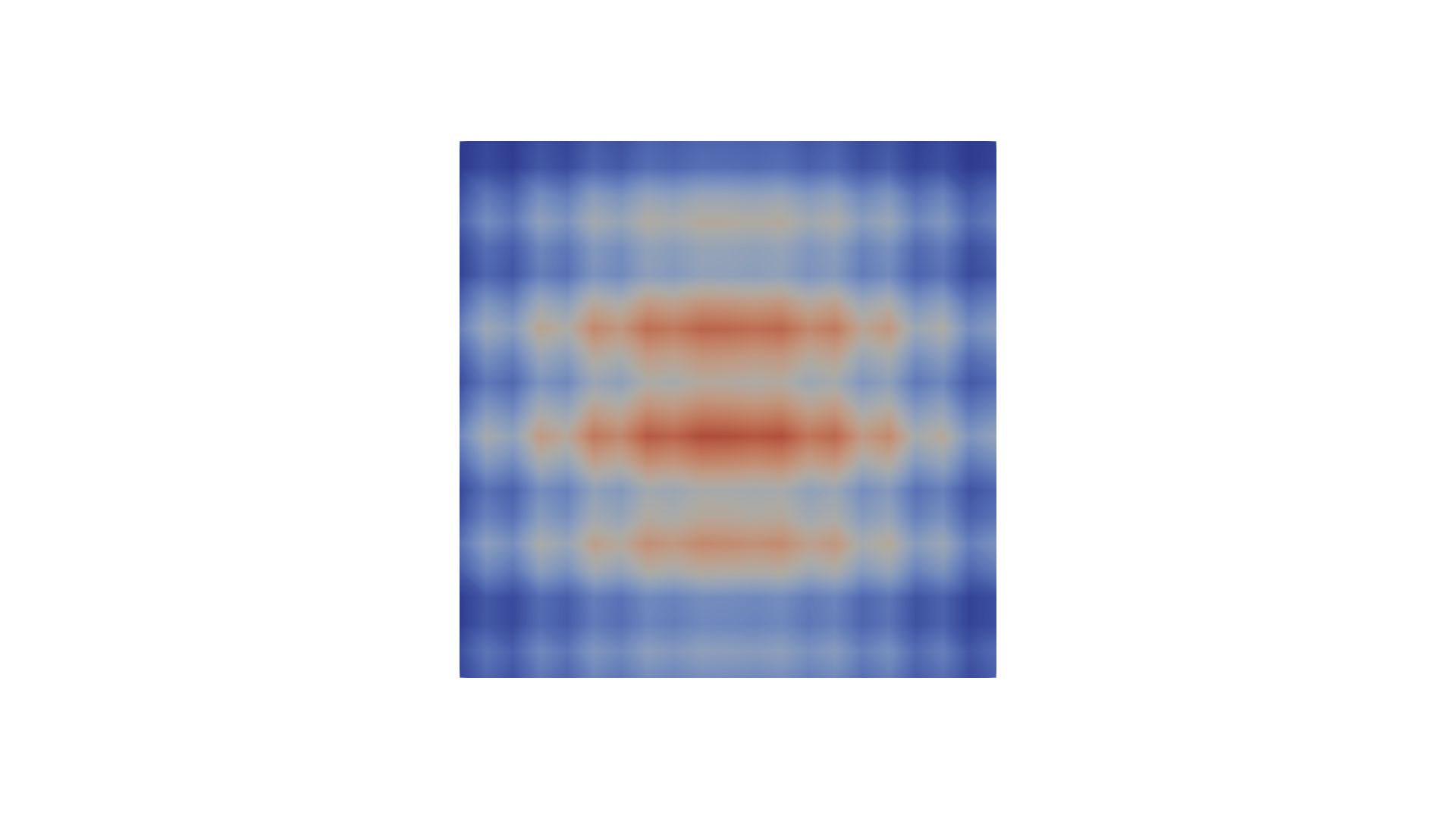
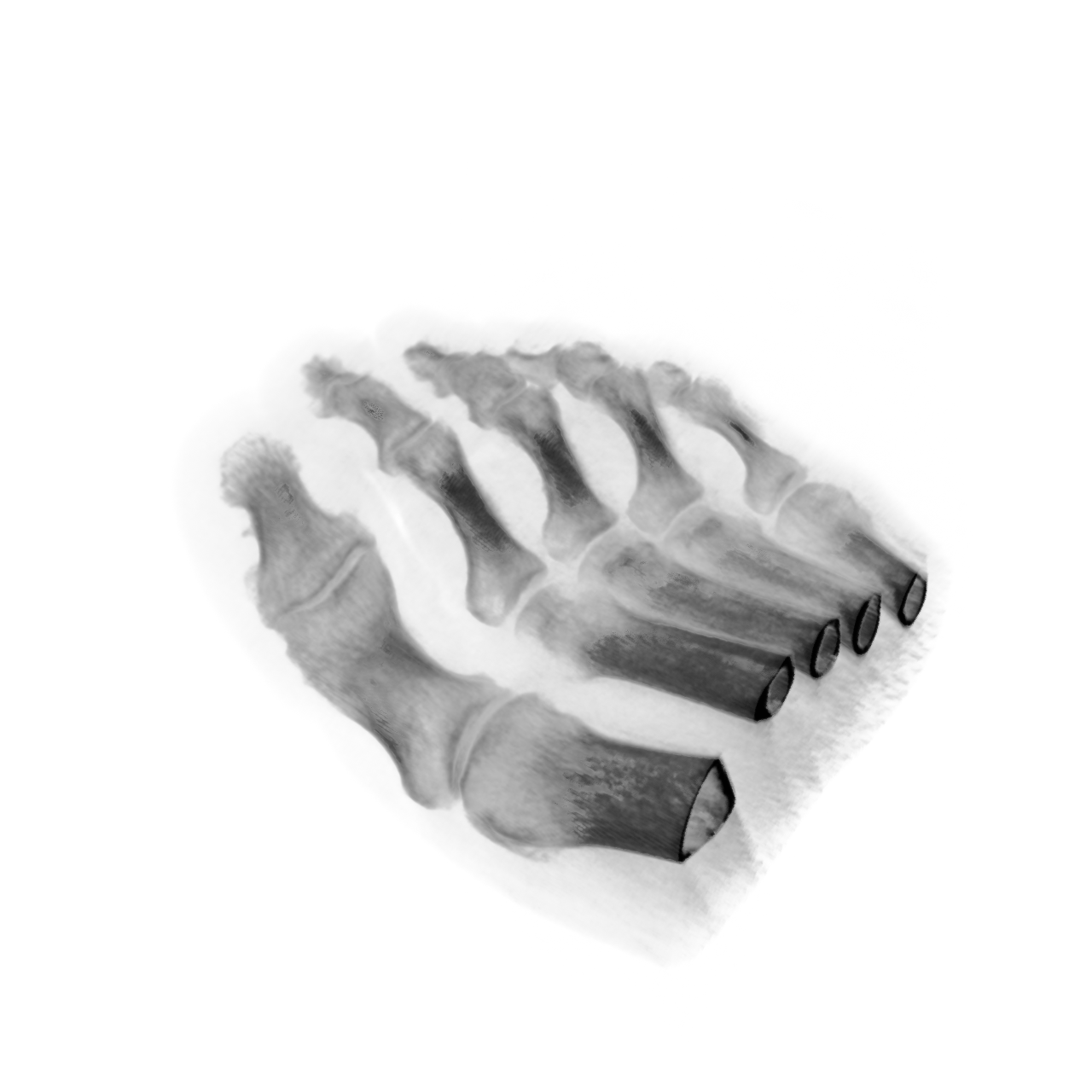
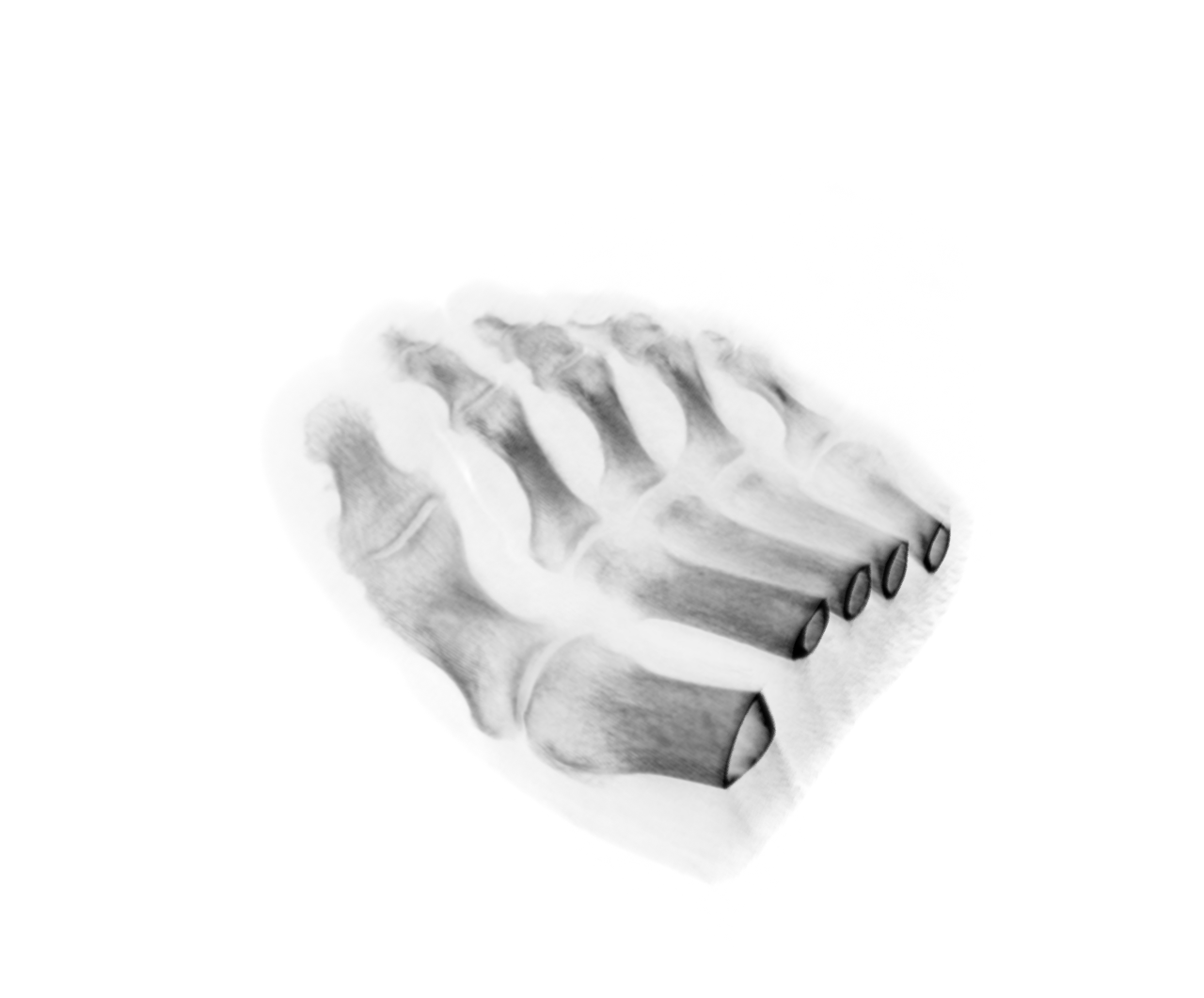
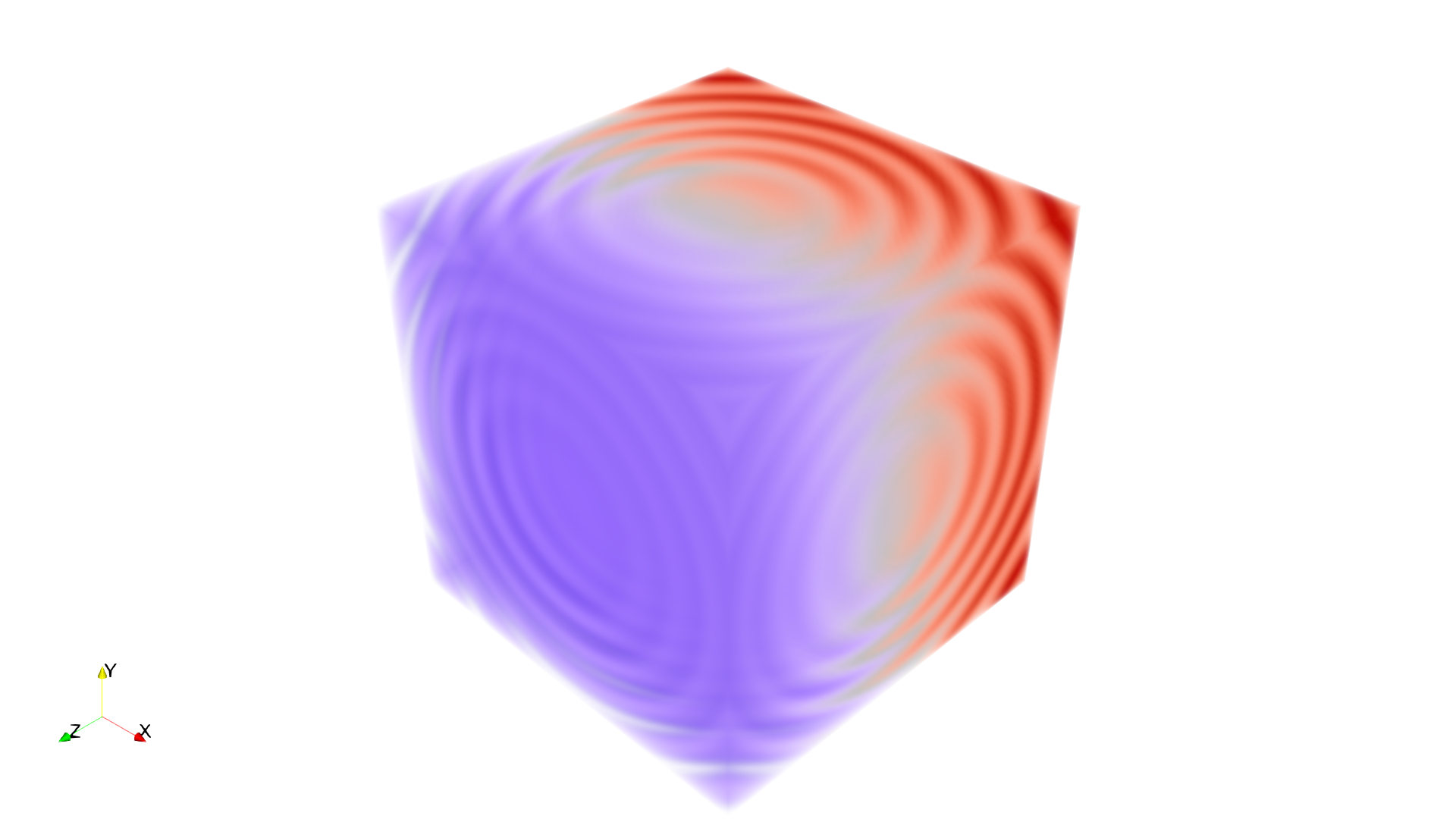
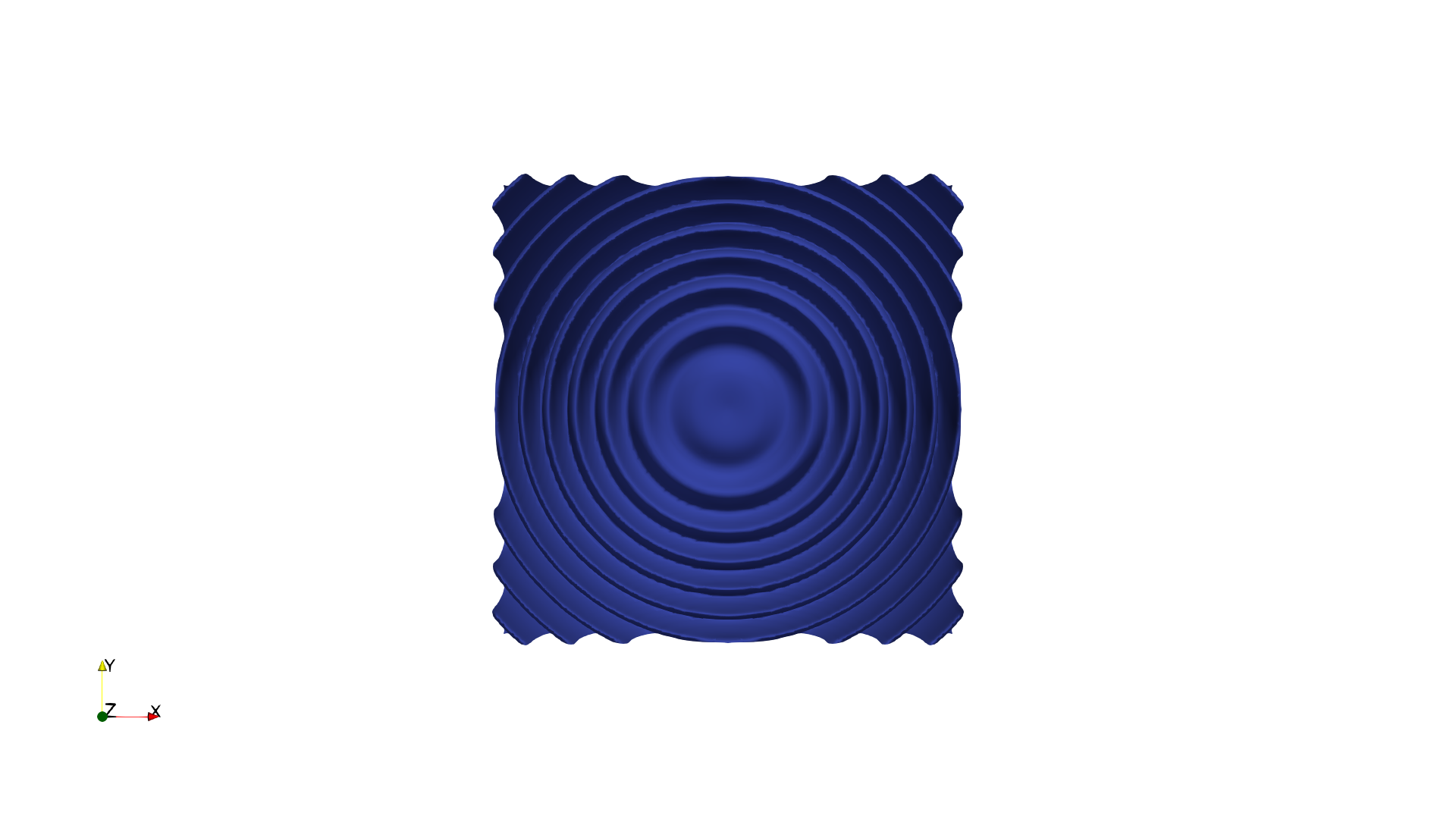
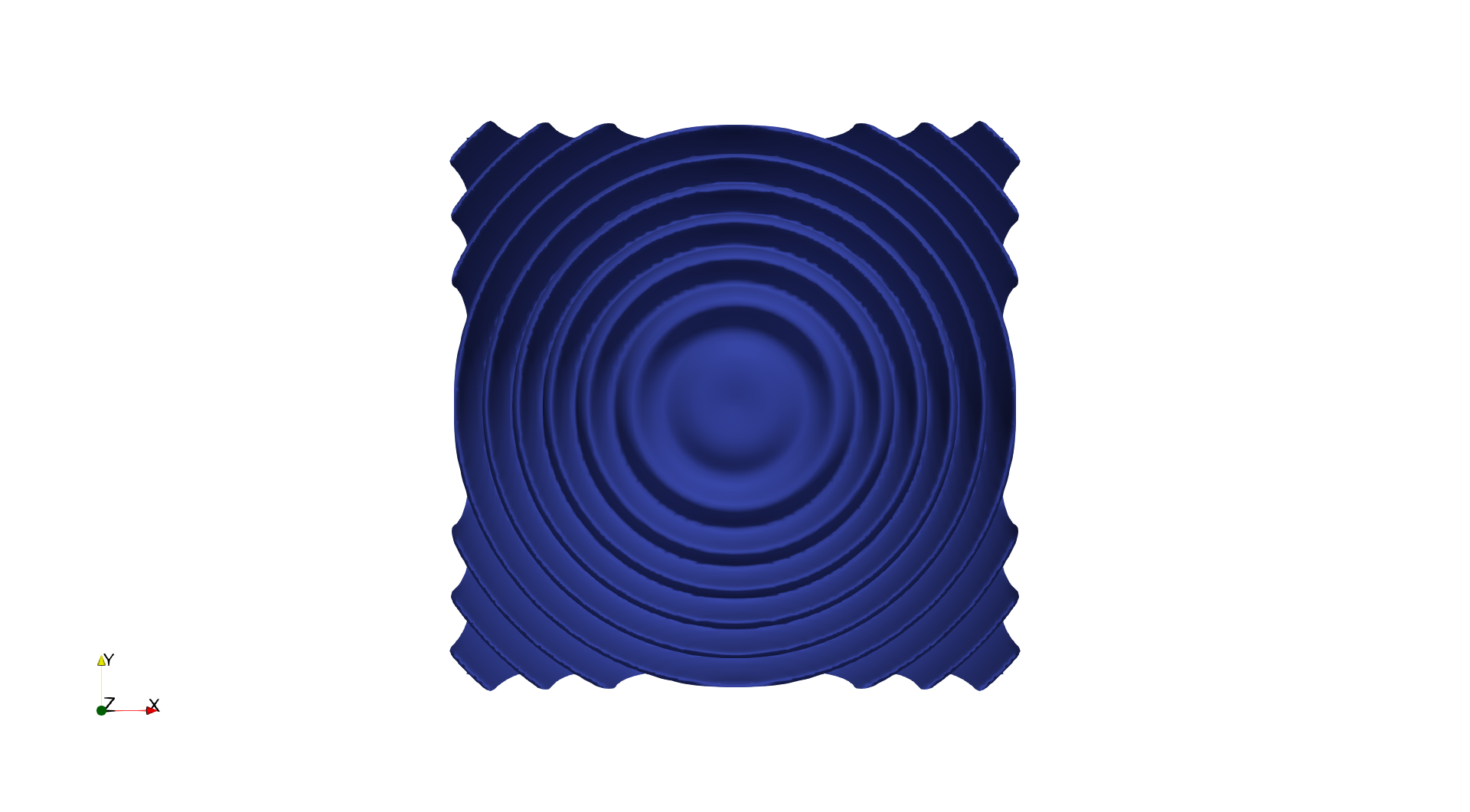
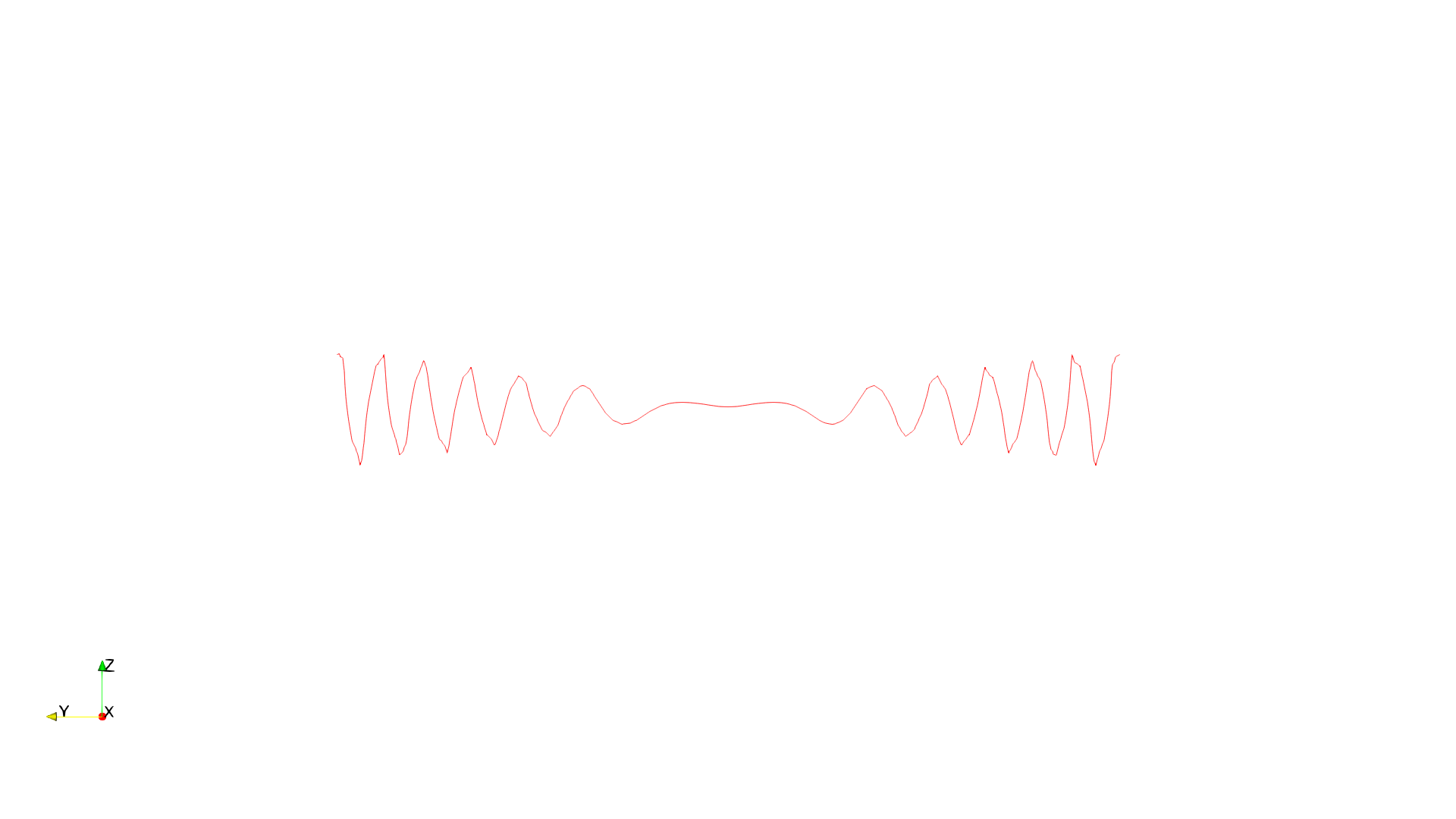
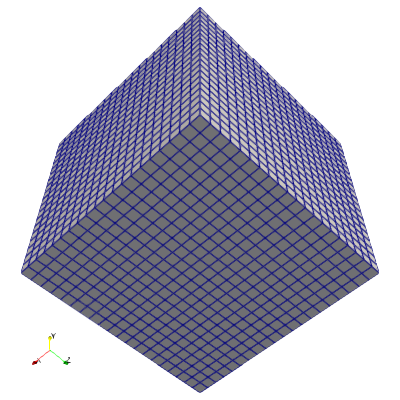
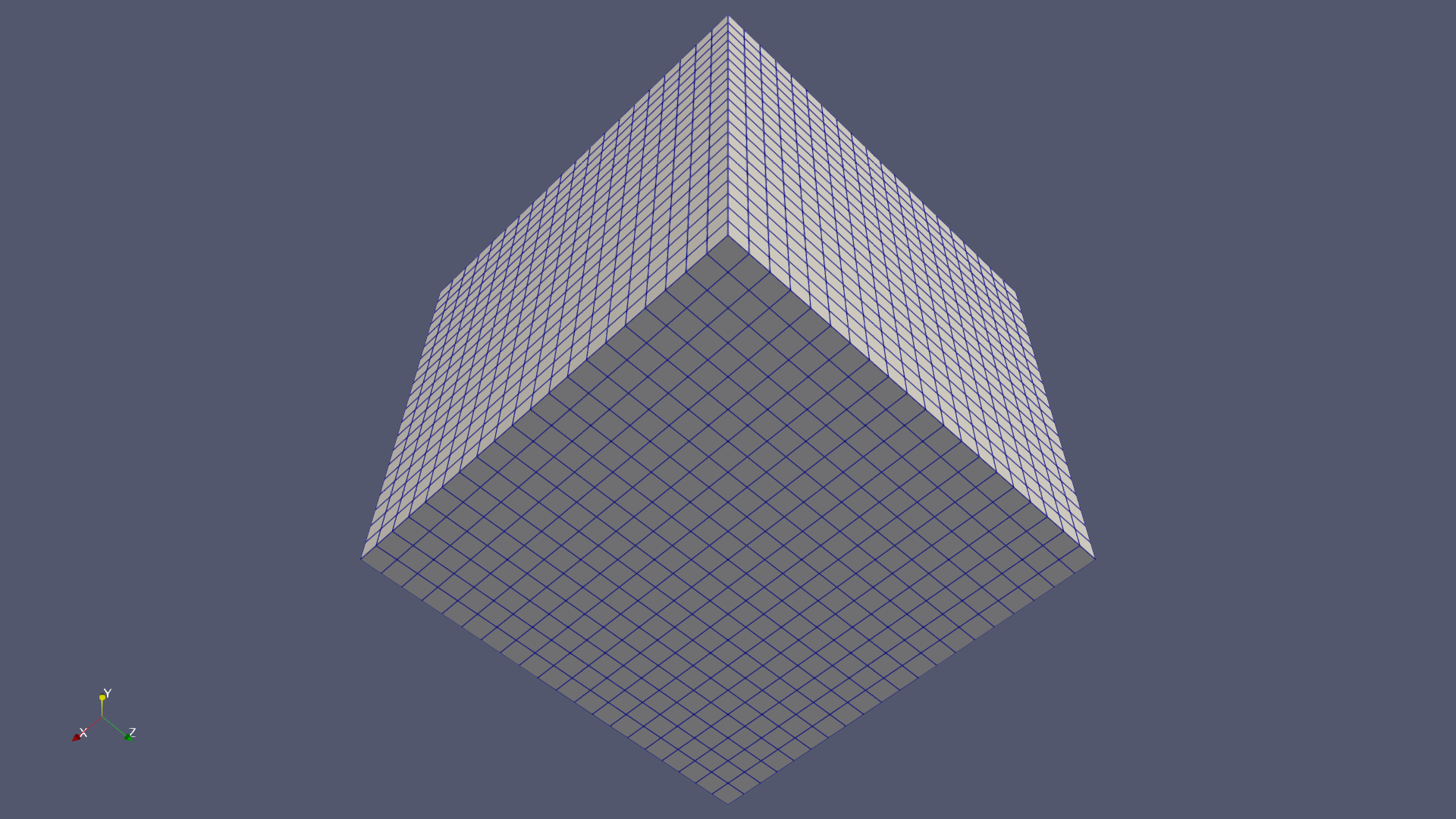
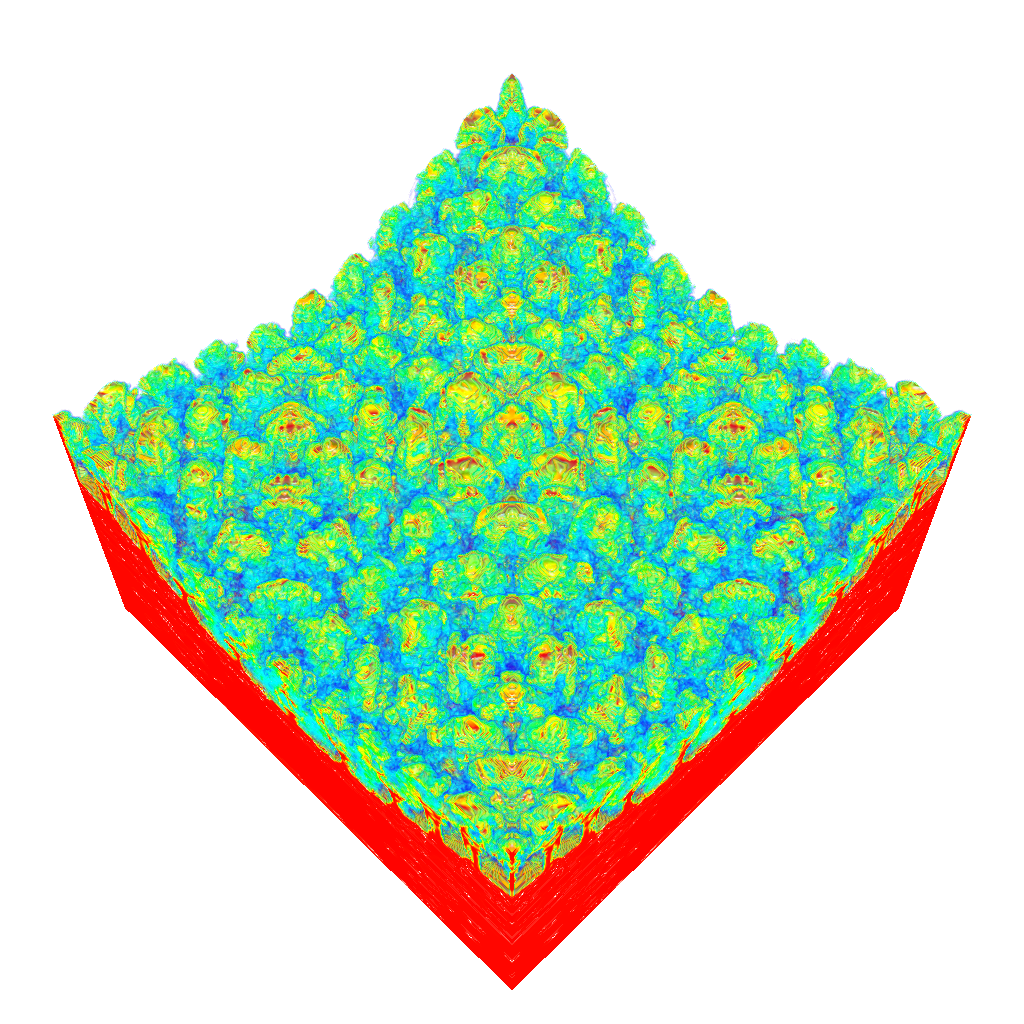
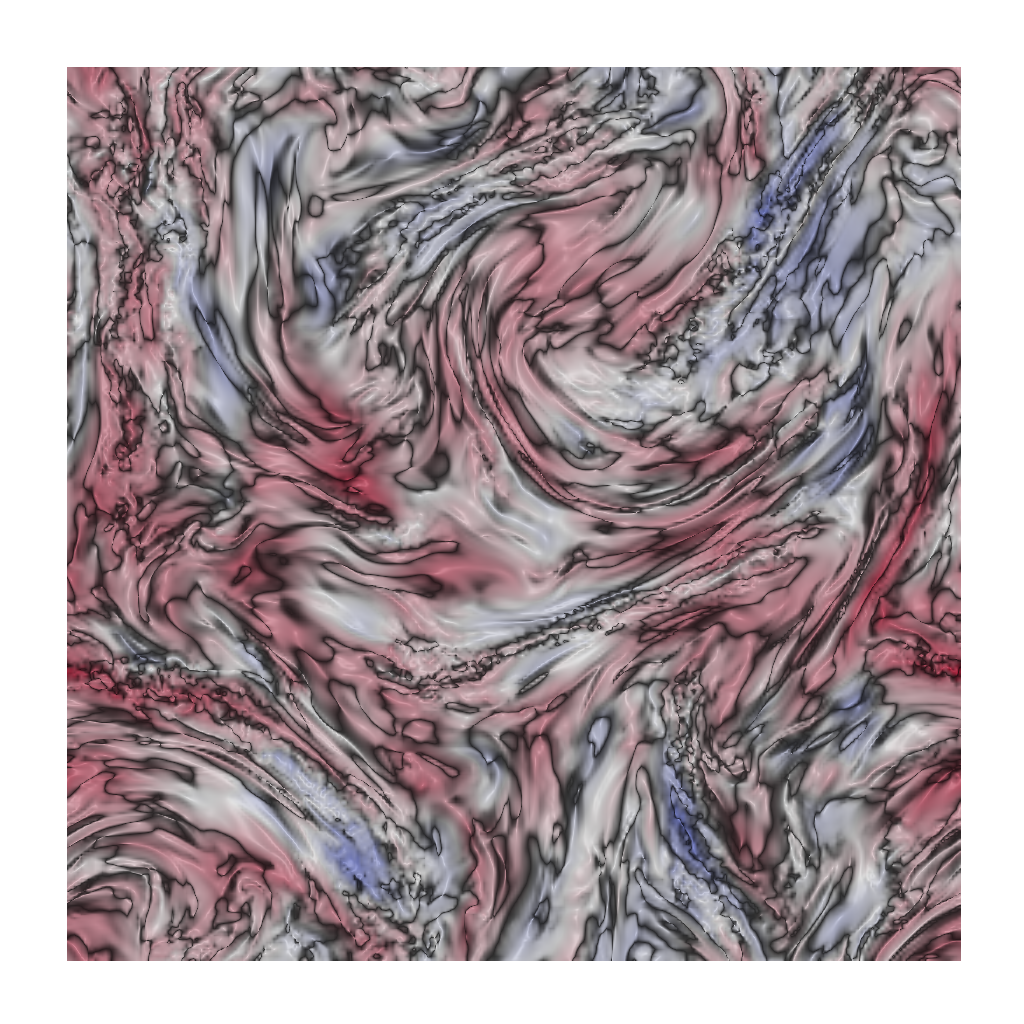
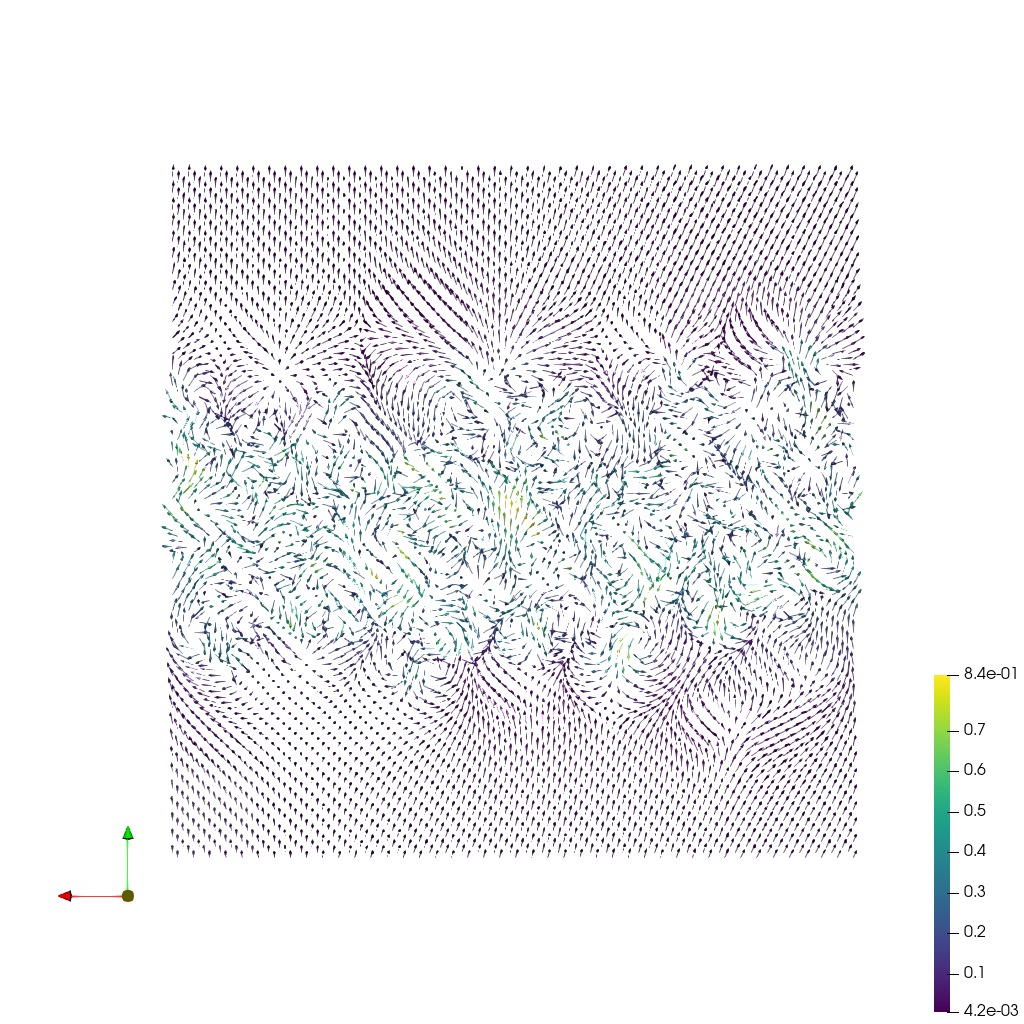
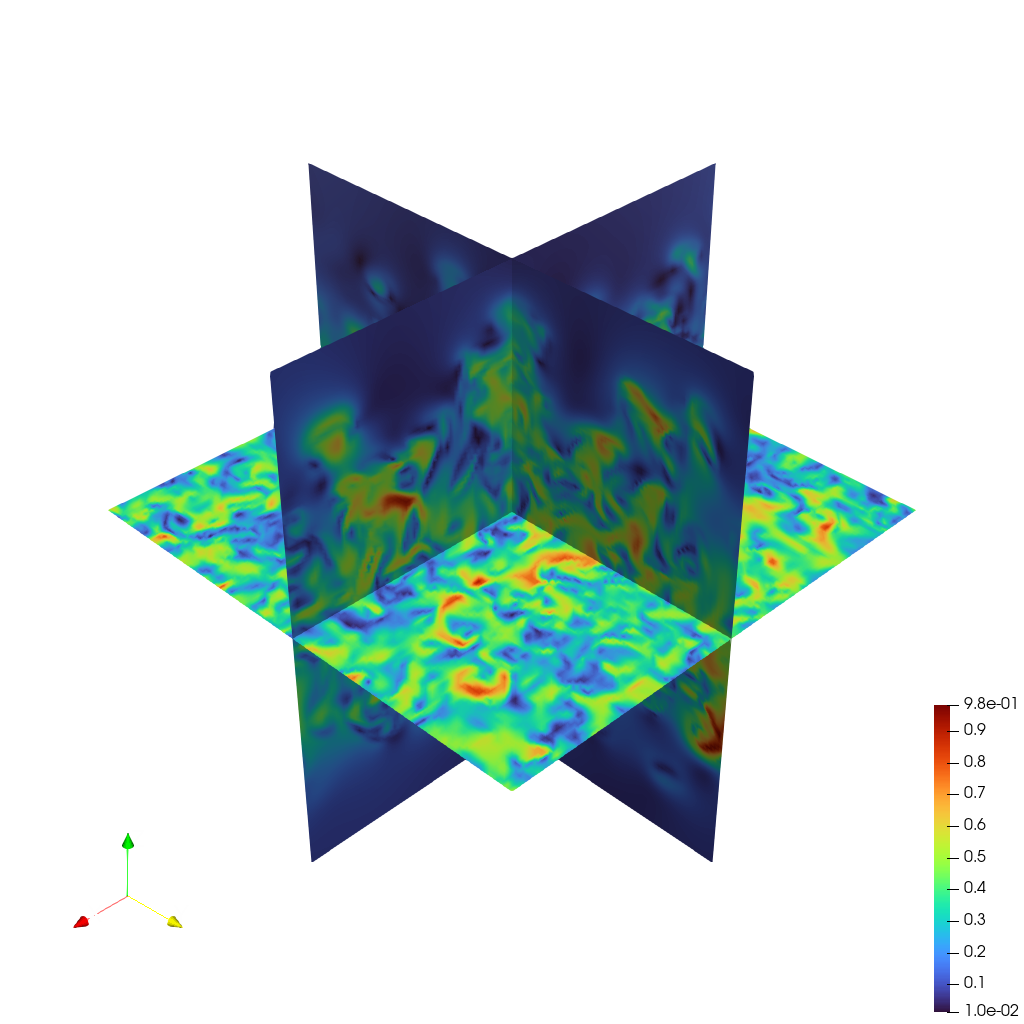
๐ŸŽฏ SciVisAgentBench Evaluation Report

chatvis Generated: 2026-03-03T21:20:09.132547

๐Ÿ“Š Overall Performance

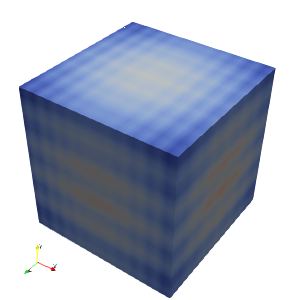
Overall Score

45.1%
1095/2430 Points

Test Cases

31/48
Completed Successfully

Avg Vision Score

38.7%
Visualization Quality
634/1670

PSNR (Scaled)

12.08 dB
Peak SNR (12/31 valid)

SSIM (Scaled)

0.5741
Structural Similarity

LPIPS (Scaled)

0.4273
Perceptual Distance

Completion Rate

64.6%
Tasks Completed

โ„น๏ธ About Scaled Metrics

Scaled metrics account for completion rate to enable fair comparison across different evaluation modes. Formula: PSNRscaled = (completed_cases / total_cases) ร— avg(PSNR), SSIMscaled = (completed_cases / total_cases) ร— avg(SSIM), LPIPSscaled = 1.0 - (completed_cases / total_cases) ร— (1.0 - avg(LPIPS)). Cases with infinite PSNR (perfect match) are excluded from the PSNR calculation.

๐Ÿ”ง Configuration

anthropic
claude-sonnet-4-5
https://api.anthropic.com
$3.00
$15.00

๐Ÿ“ ABC

44/45 (97.8%)

๐Ÿ“‹ Task Description

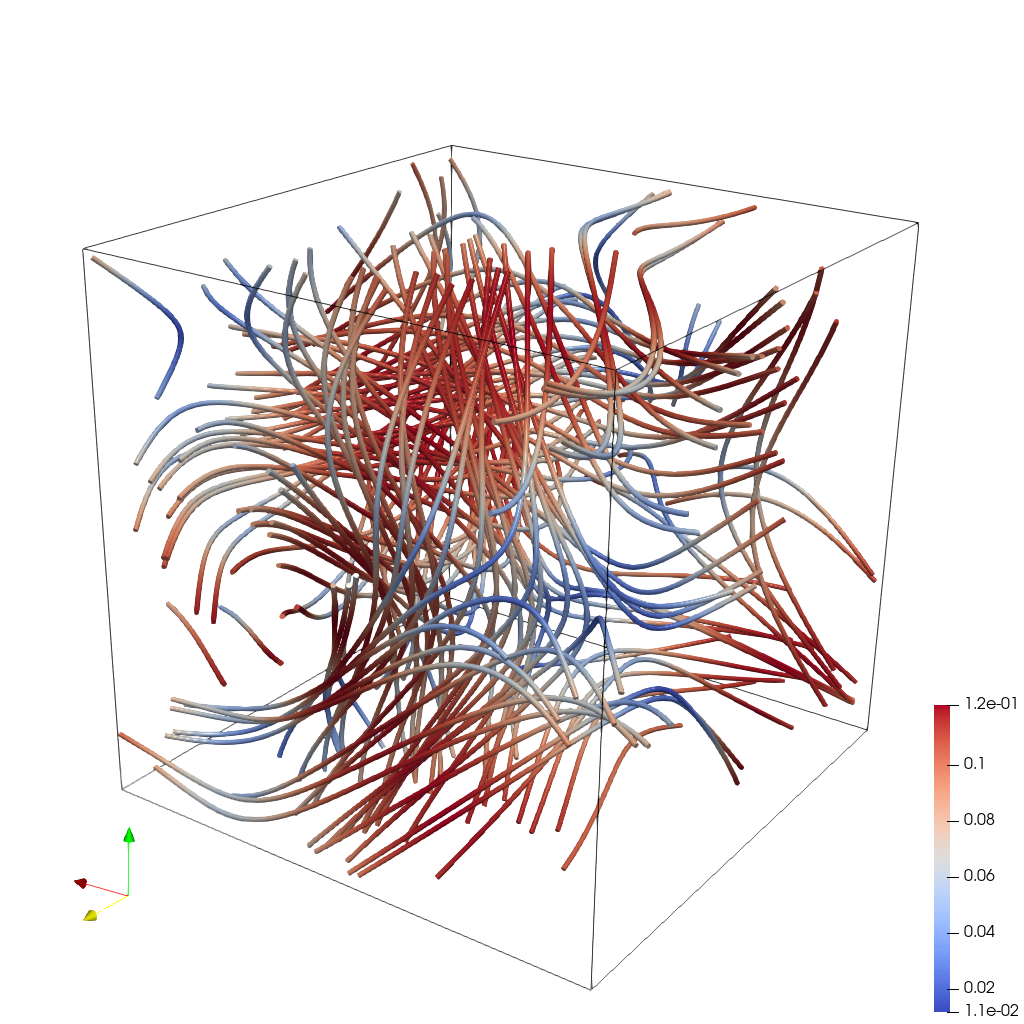
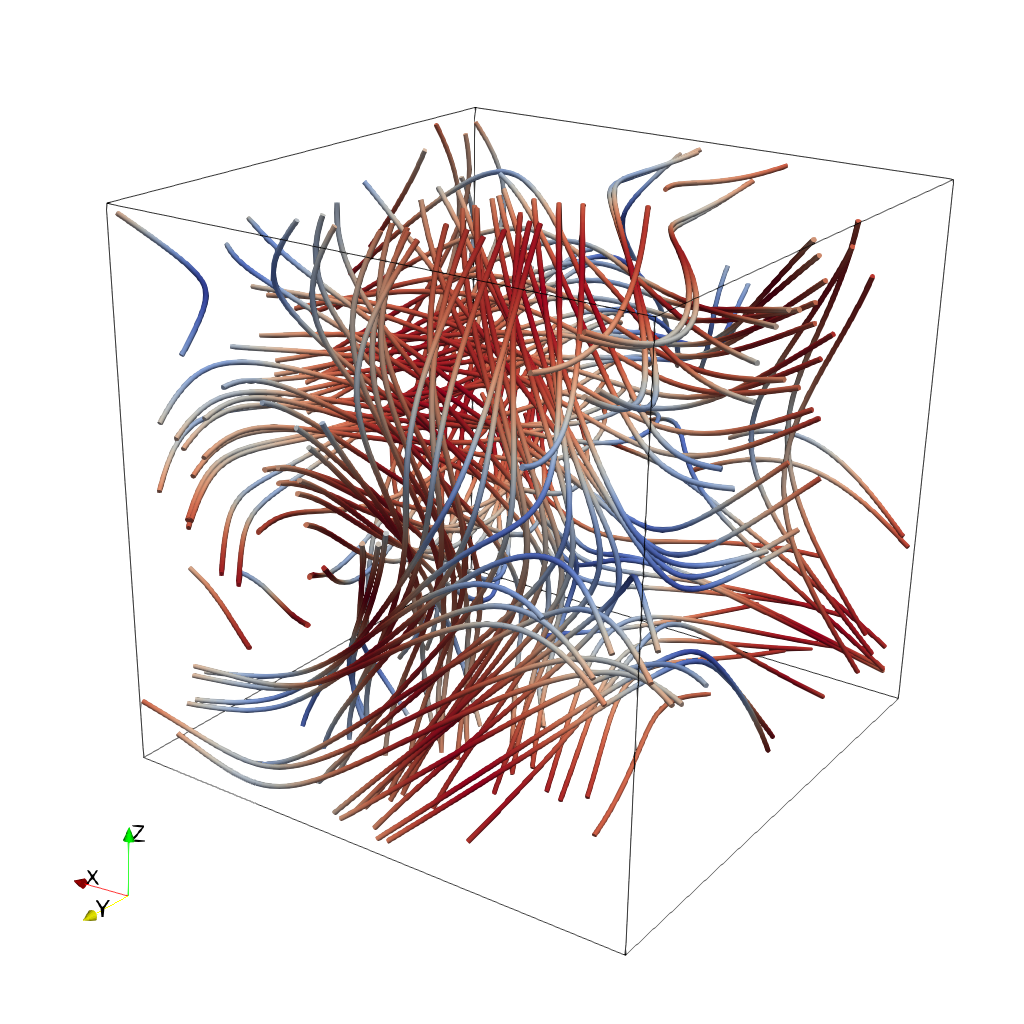
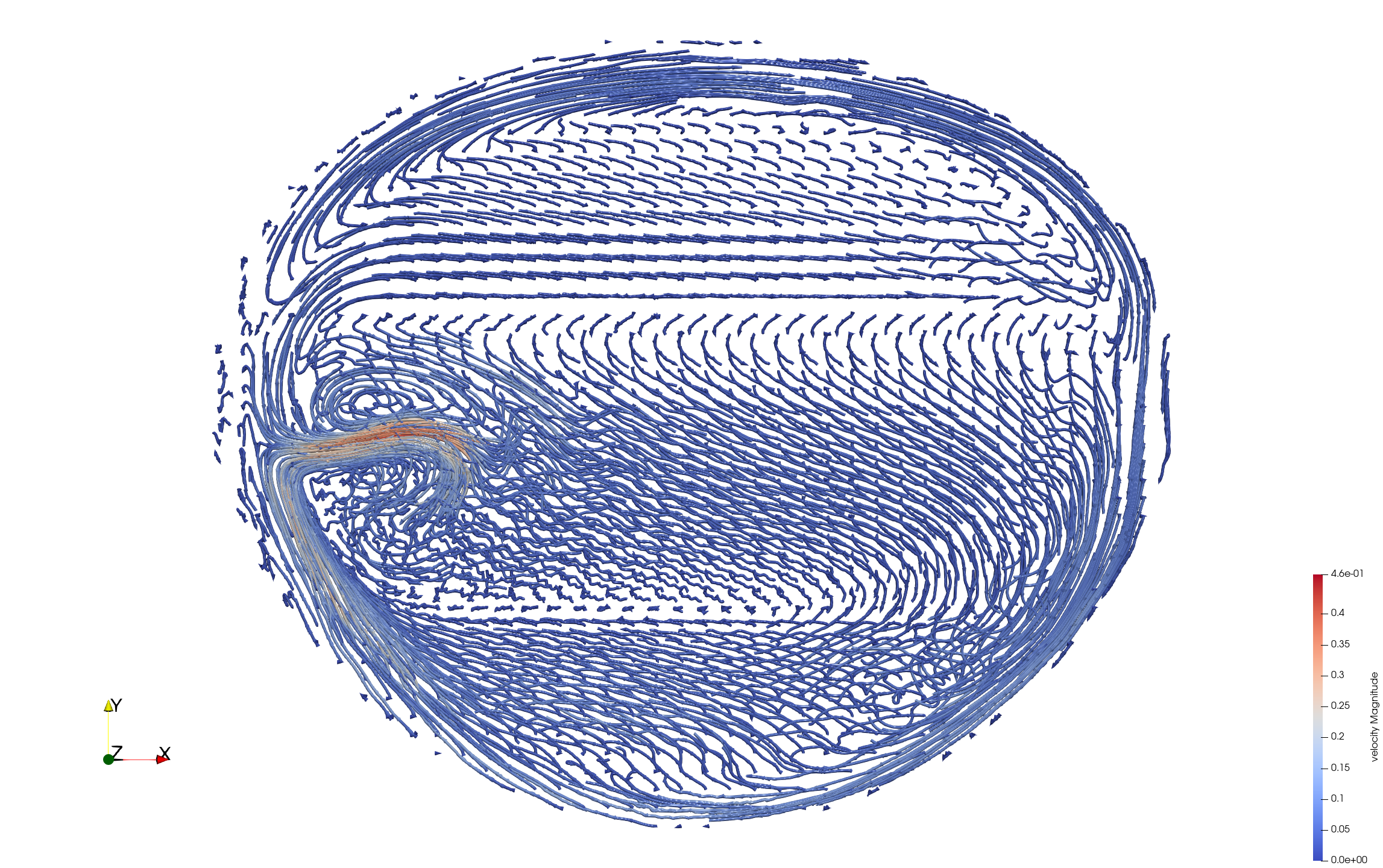
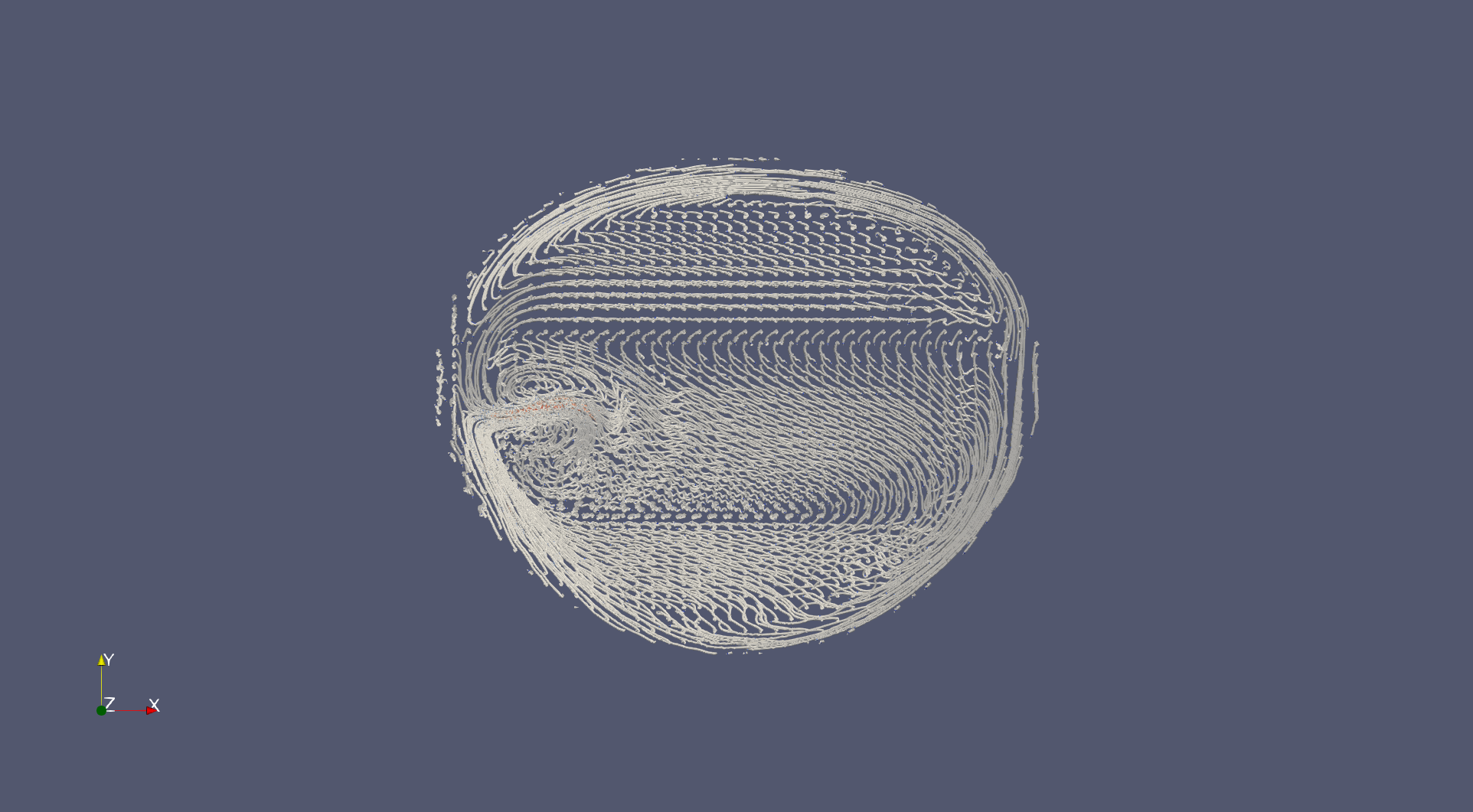
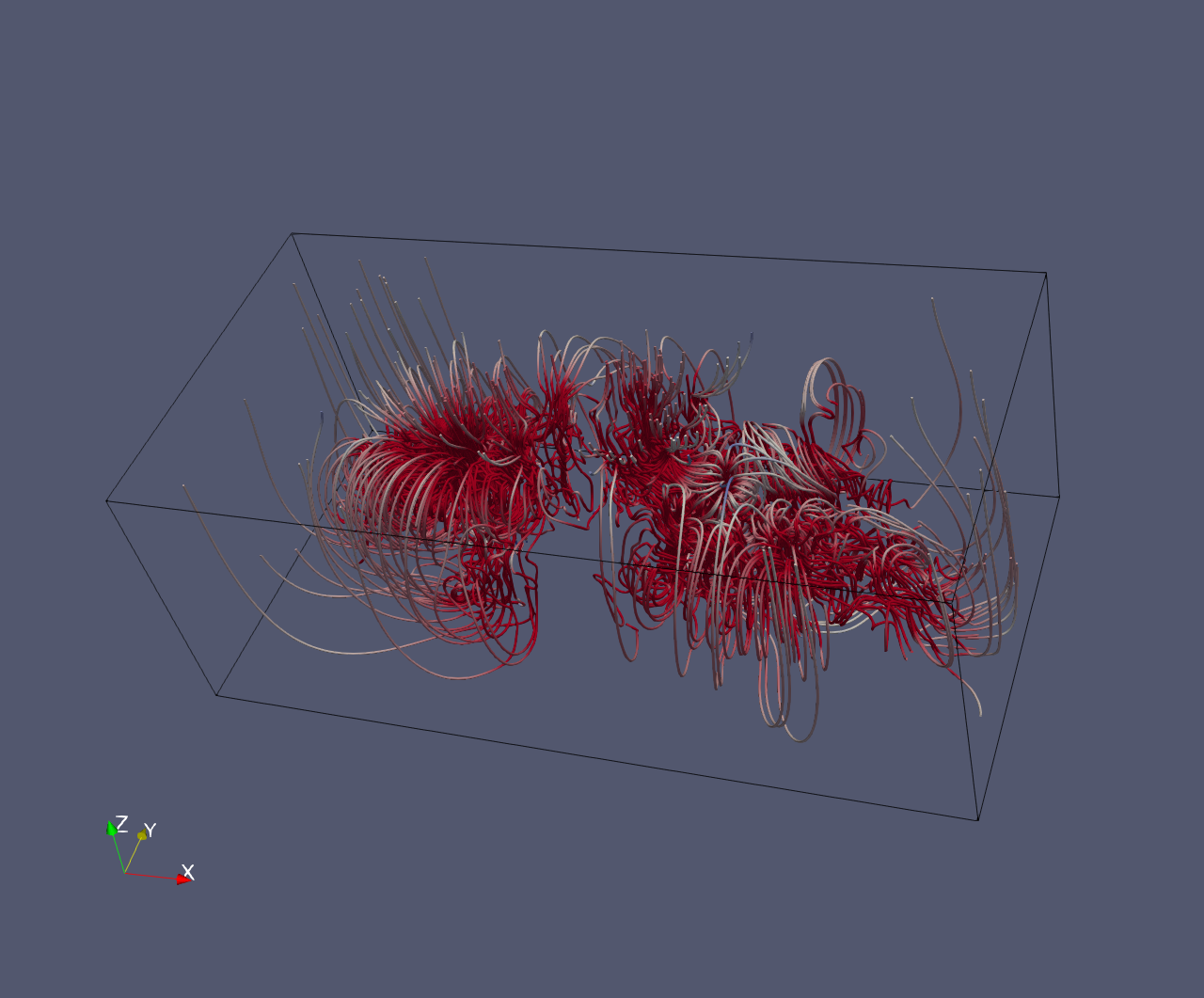
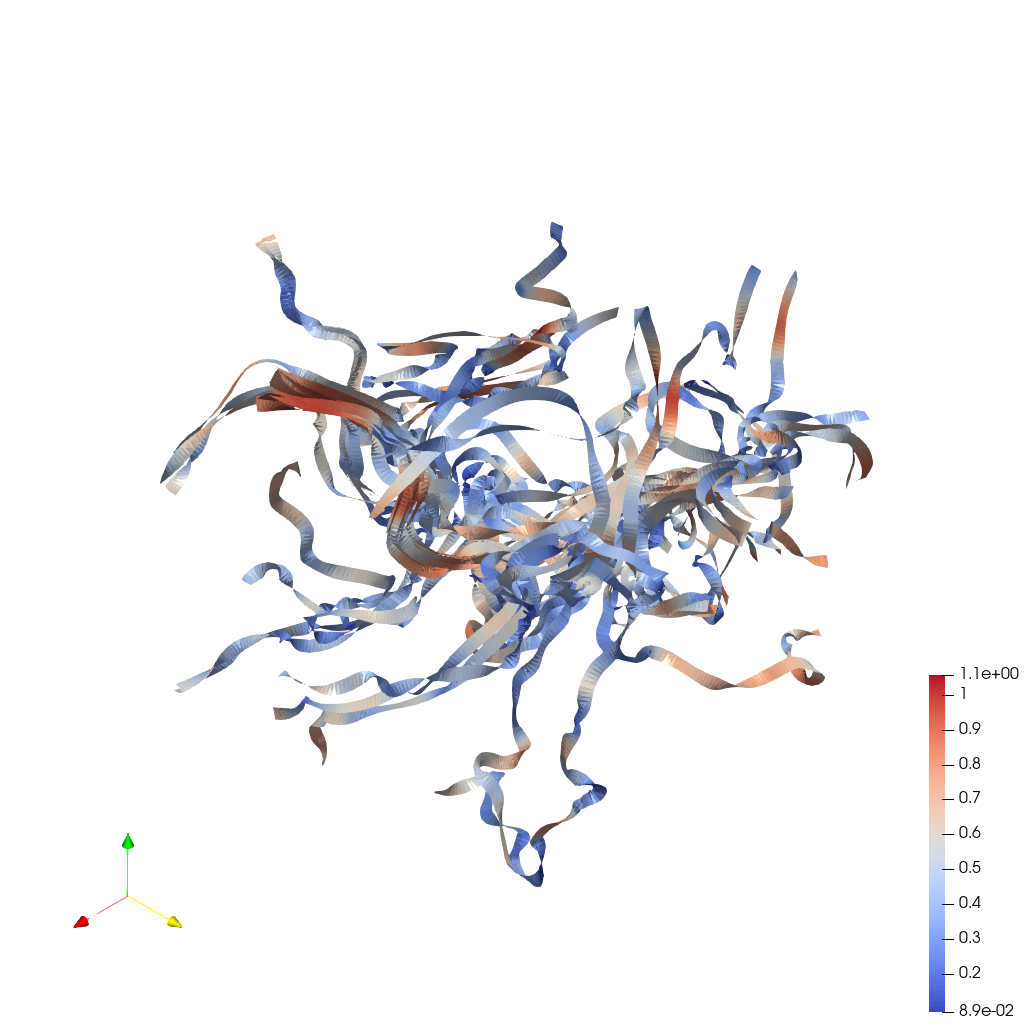
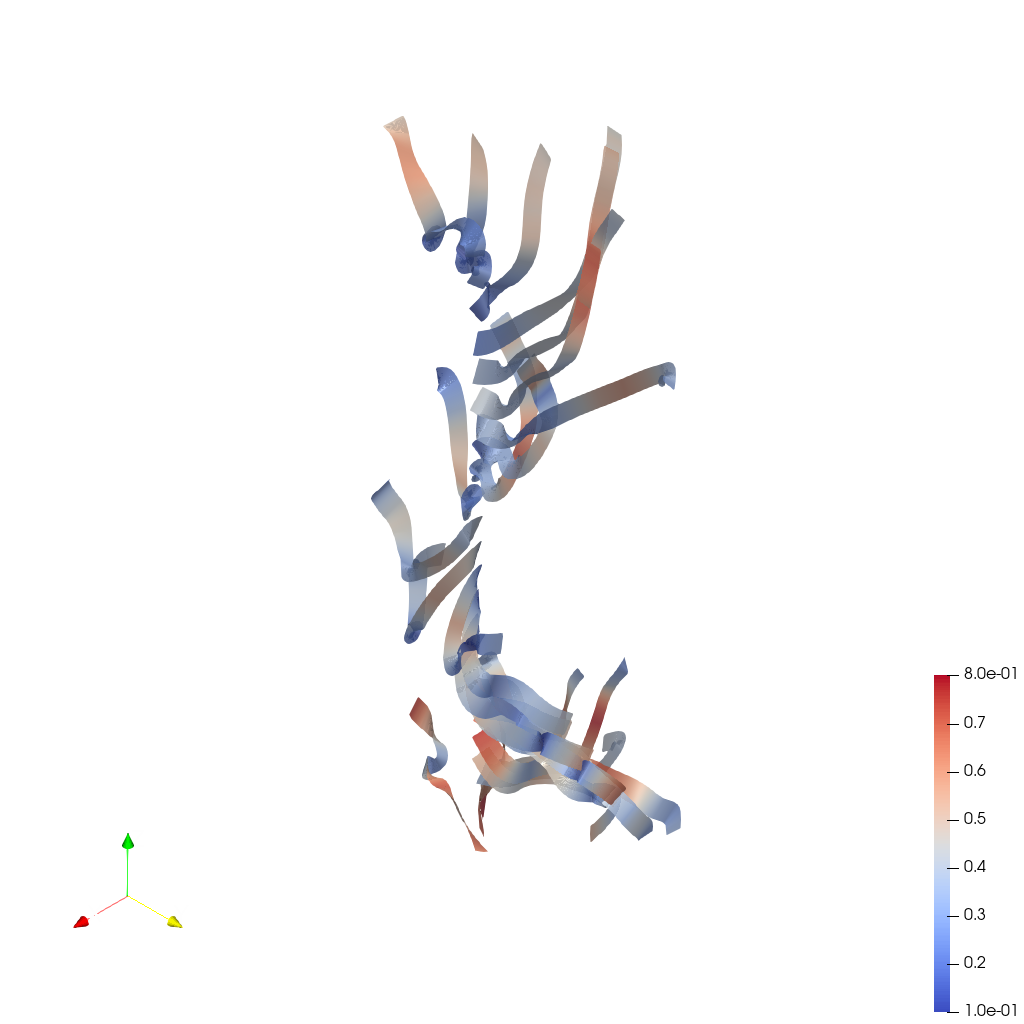
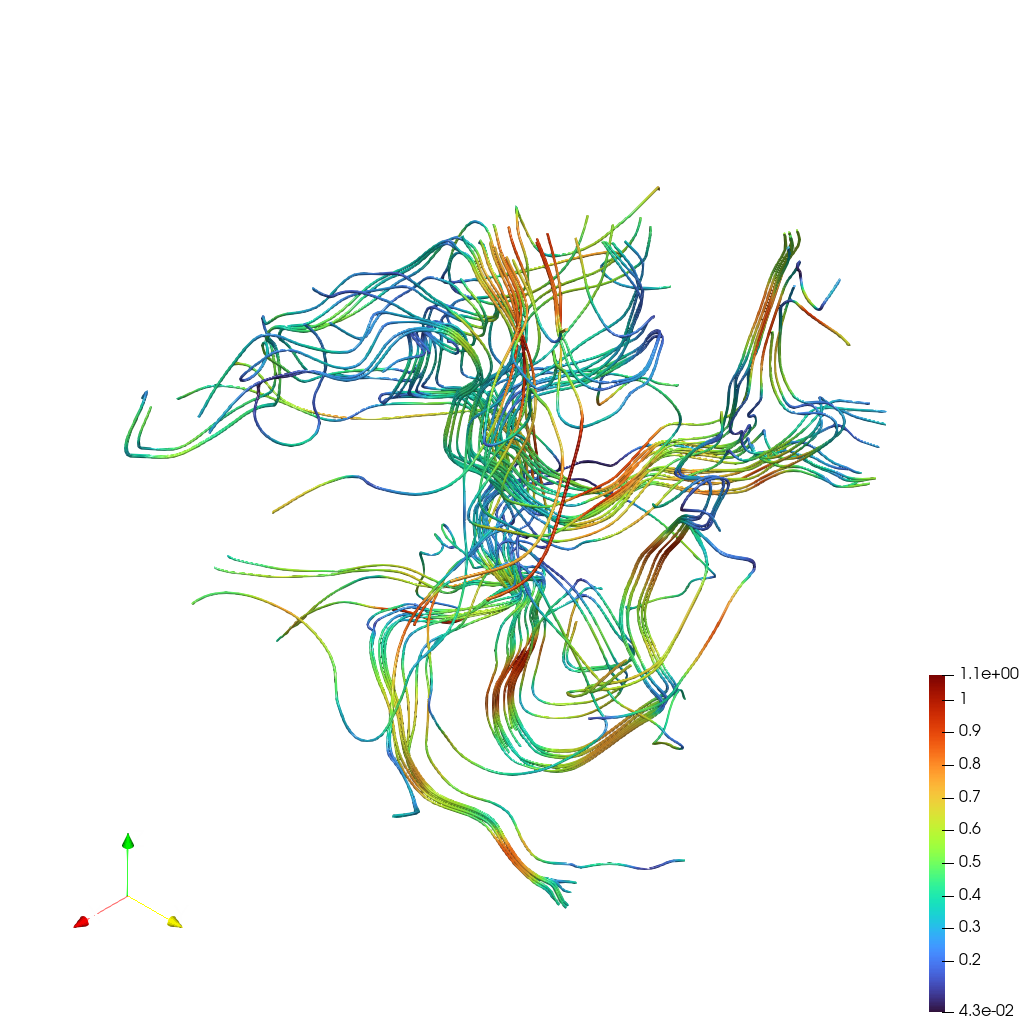
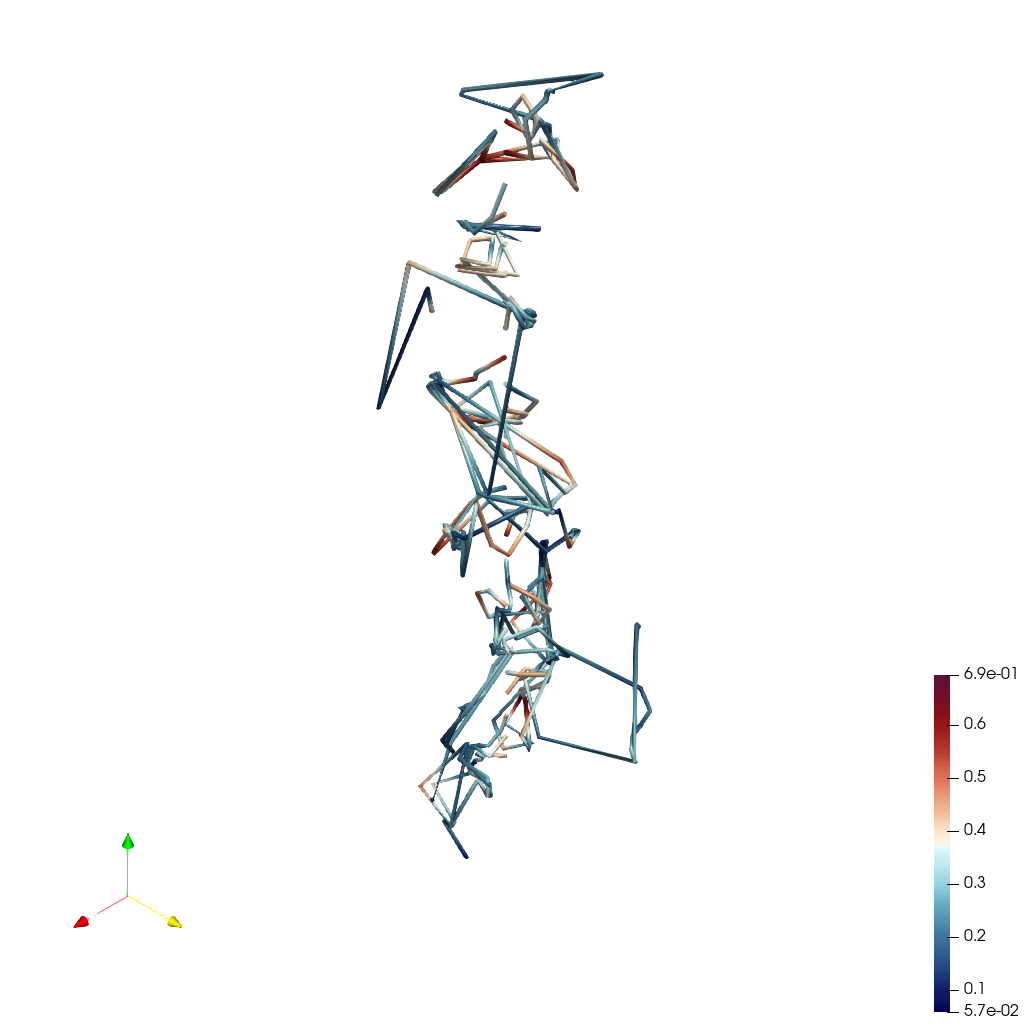
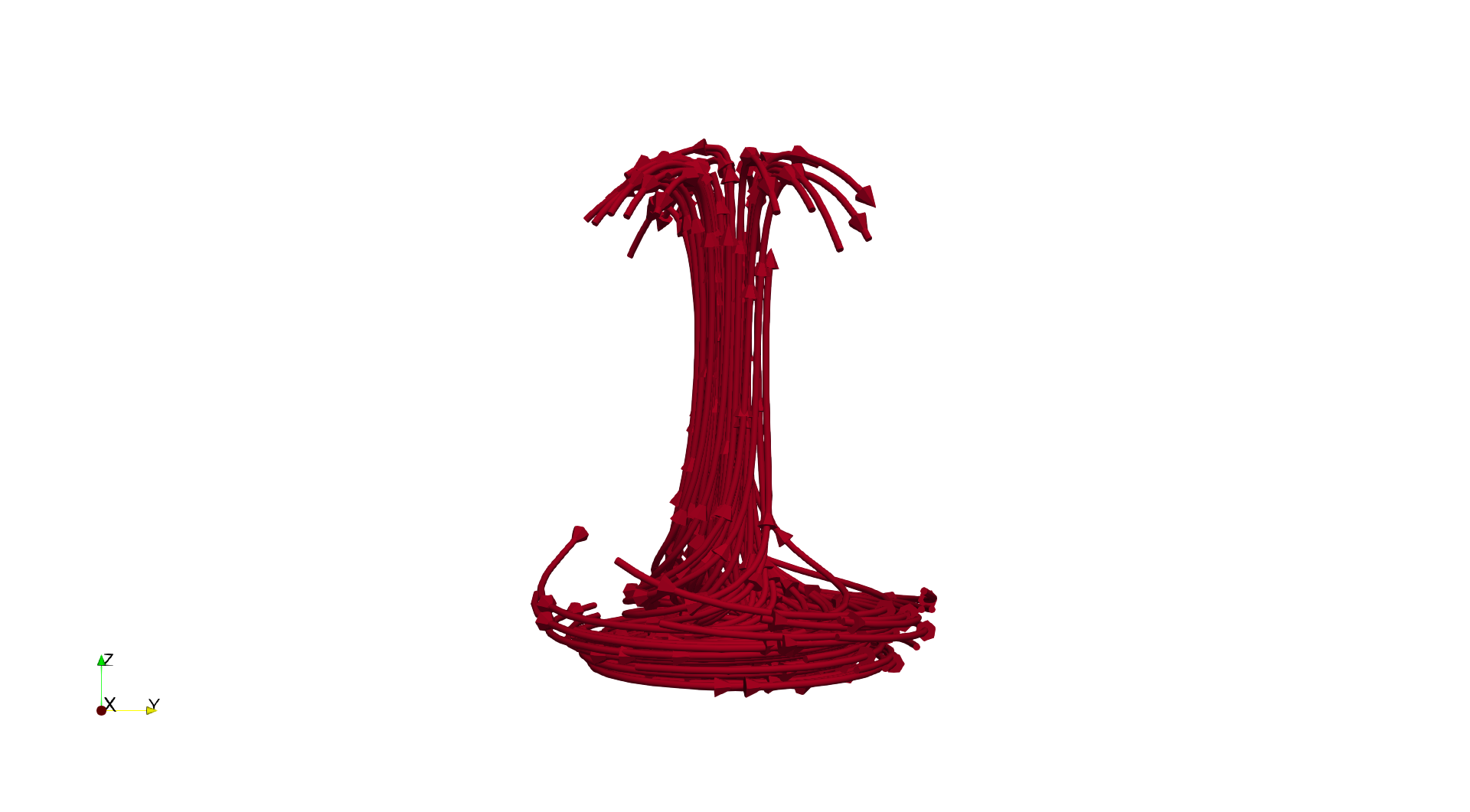
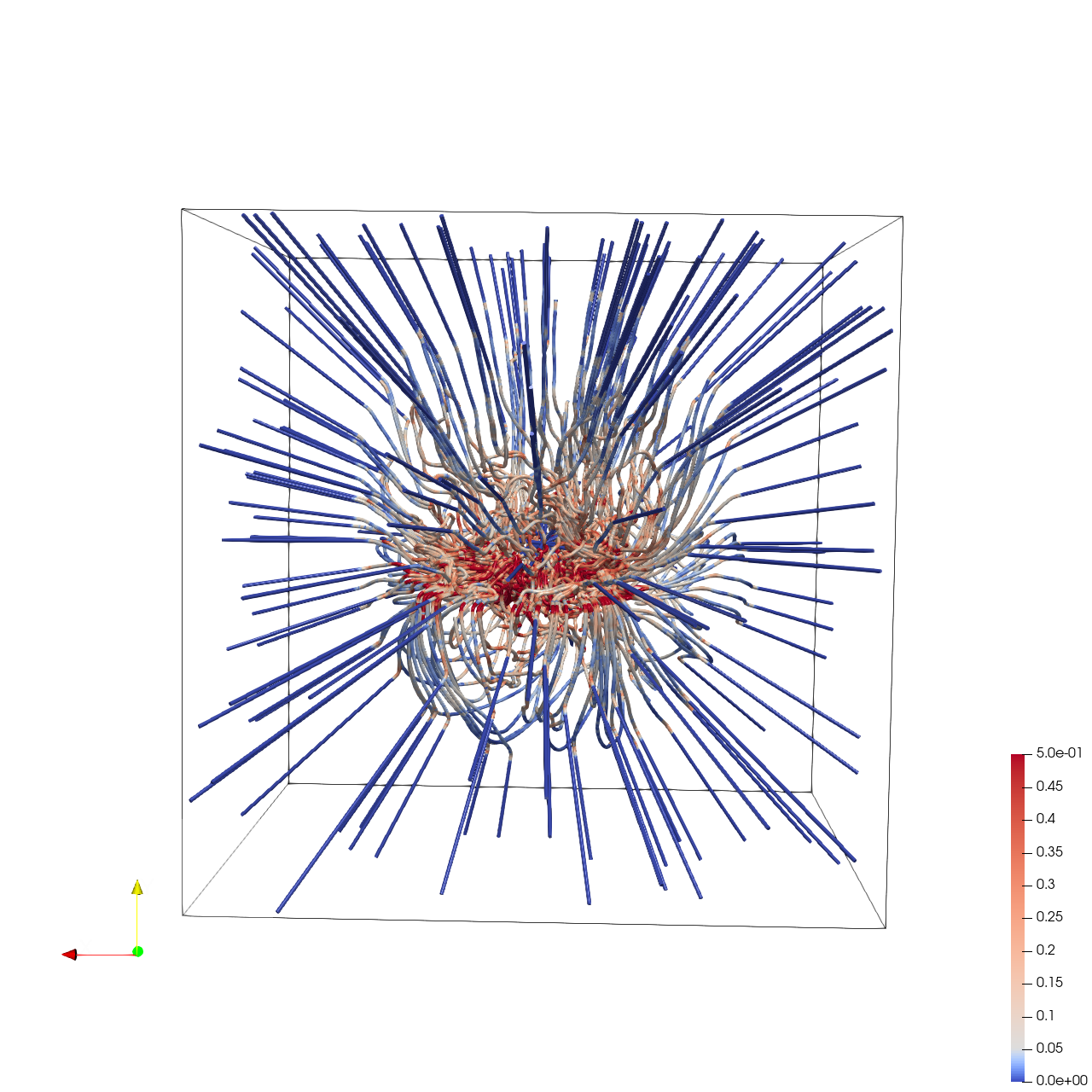
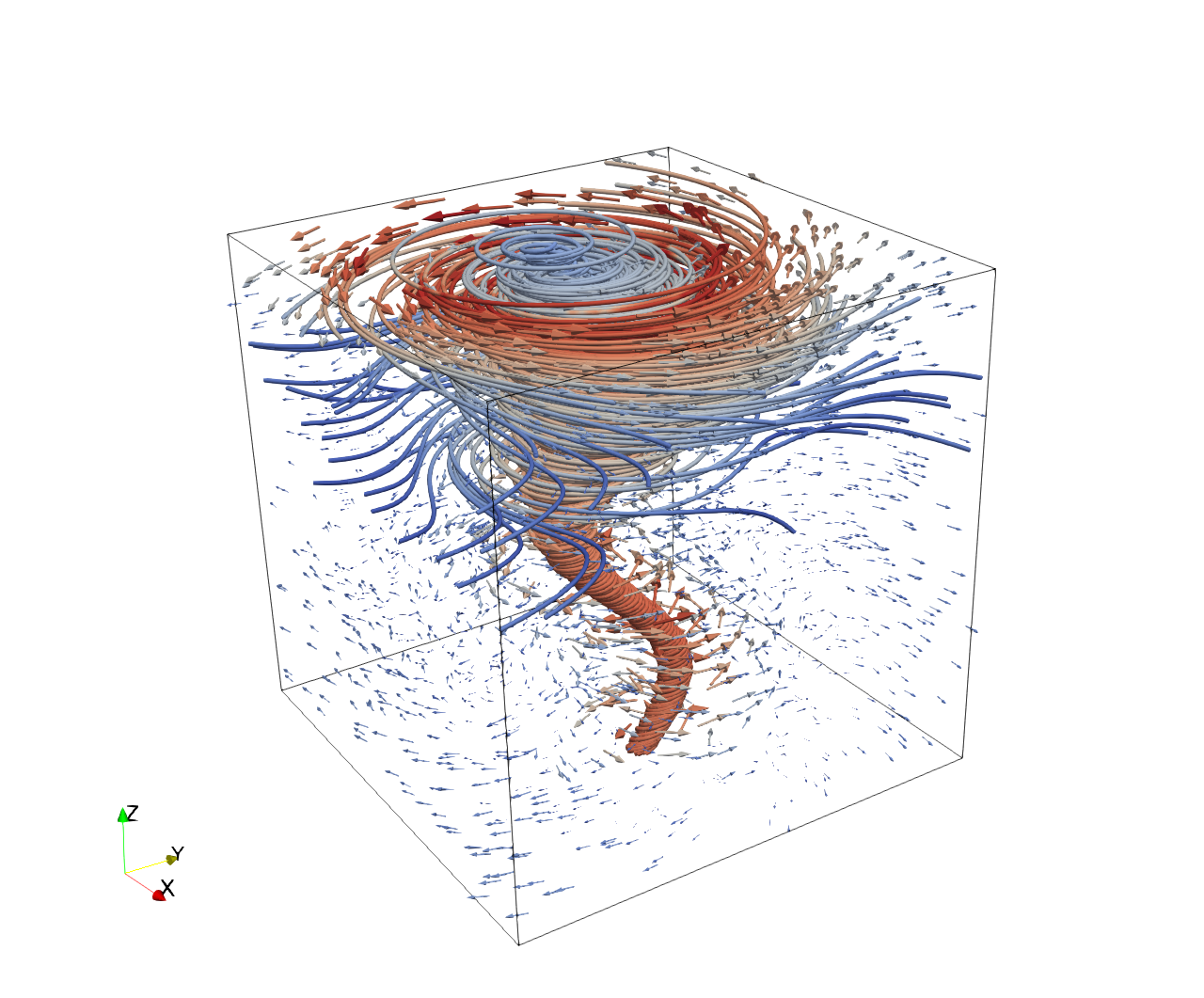
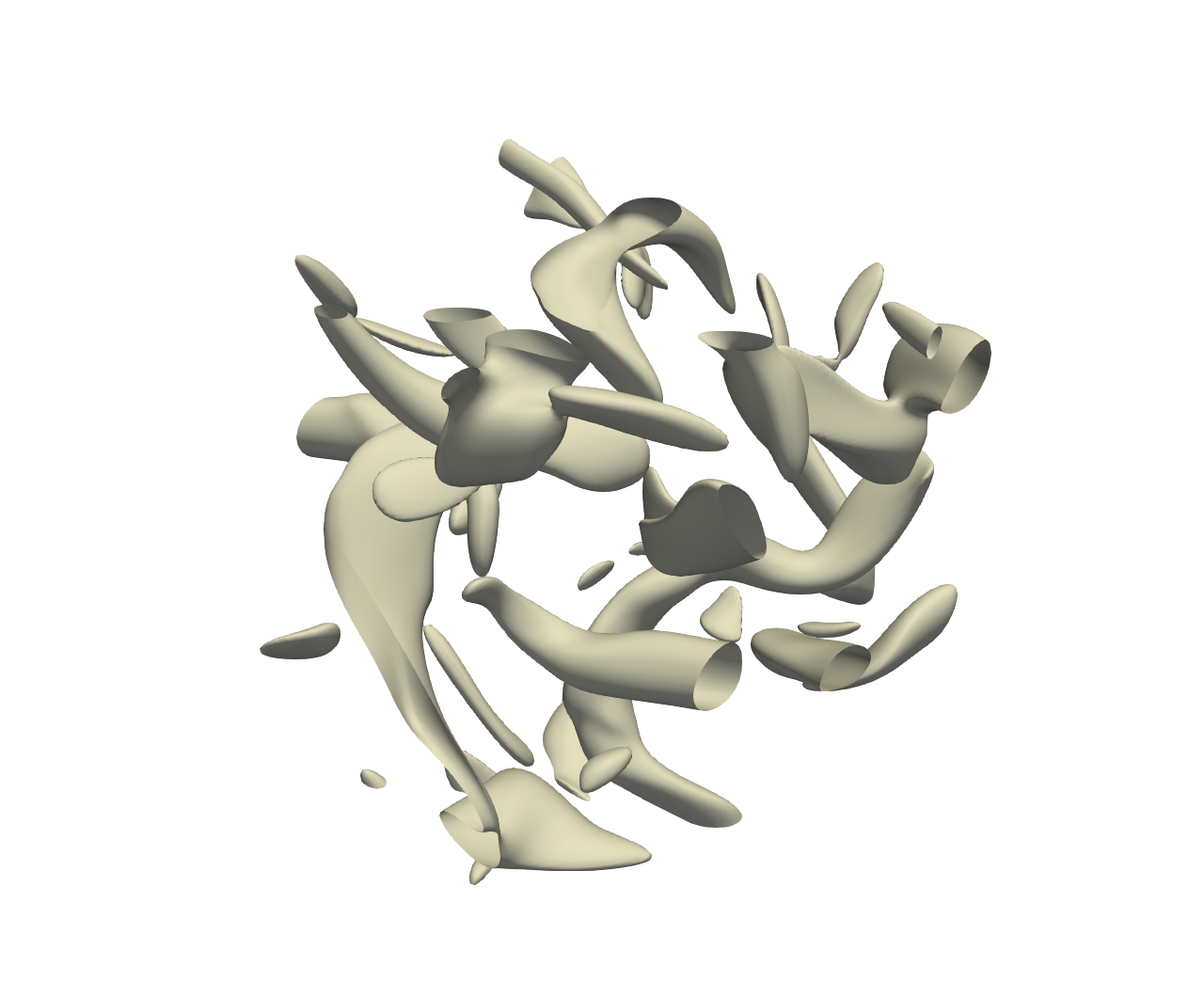
Your agent_mode is "chatvis_claude-sonnet-4-5_exp1", use it when saving results. Your working directory is "D:\Code\SciVisAgentBench\SciVisAgentBench-tasks\paraview", and you should have access to it. In the following prompts, we will use relative path with respect to your working path. But remember, when you load or save any file, always stick to absolute path. Load the ABC (Arnold-Beltrami-Childress) flow vector field from "ABC/data/ABC_128x128x128_float32_scalar3.raw", the information about this dataset: ABC Flow (Vector) Data Scalar Type: float Data Byte Order: Little Endian Data Extent: 128x128x128 Number of Scalar Components: 3 Data loading is very important, make sure you correctly load the dataset according to their features. Create streamlines using a "Stream Tracer" filter with "Point Cloud" seed type. Set the seed center to [73.77, 63.25, 71.65], with 150 seed points and a radius of 75.0. Set integration direction to "BOTH" and maximum streamline length to 150.0. Add a "Tube" filter on the stream tracer to enhance visualization. Set tube radius to 0.57 with 12 sides. Color the tubes by Vorticity magnitude using the 'Cool to Warm (Diverging)' colormap. Show the dataset bounding box as an outline. Use a white background. Render at 1024x1024. Set the viewpoint parameters as: [-150.99, 391.75, 219.64] to position; [32.38, 120.41, 81.63] to focal point; [0.23, -0.31, 0.92] to camera up direction. Save the visualization image as "ABC/results/{agent_mode}/ABC.png". (Optional, but must save if use paraview) Save the paraview state as "ABC/results/{agent_mode}/ABC.pvsm". (Optional, but must save if use python script) Save the python script as "ABC/results/{agent_mode}/ABC.py". Do not save any other files, and always save the visualization image.

๐Ÿ–ผ๏ธ Visualization Comparison

Ground Truth

Ground Truth

Agent Result

Result

Score Summary

Total Score
29/30
Goals
3
Points/Goal
10
Goal 1
10/10
Criterion: Streamline Density: Are the streamline tubes densely distributed throughout the volume, similar to the ground truth?
Judge's Assessment: The result shows a very similar number of streamline tubes and a comparable spatial distribution to the ground truth: a dense core of streamlines through the center with additional curves extending toward the volume boundaries. No obvious missing regions or large density discrepancies are visible.
Goal 2
9/10
Criterion: Color Mapping: Are the tubes colored by vorticity magnitude using a blue-white-red diverging colormap, with a similar color distribution as the ground truth?
Judge's Assessment: The tubes are colored with a blueโ€“whiteโ€“red diverging scheme consistent with Cool-to-Warm, and the spatial pattern of red/orange vs blue regions closely matches the ground truth (e.g., warmer colors dominating many central/diagonal strands and cooler blues along several sweeping arcs). Minor differences in the exact intensity balance/contrast are visible but do not significantly change the overall mapping appearance.
Goal 3
10/10
Criterion: Tube Appearance: Do the streamline tubes have a similar thickness and smooth appearance as the ground truth?
Judge's Assessment: Tube thickness and smoothness match the ground truth very closely. The tubes appear uniformly sized (consistent with the specified radius) with similar shading/specular highlights, and there are no noticeable artifacts (e.g., faceting beyond what 12 sides would produce) compared to the reference.

Overall Assessment

Overall, the result is an excellent match to the ground truth: streamline density and tube geometry are essentially identical, and the vorticity-magnitude diverging color mapping is reproduced with only negligible contrast/intensity differences.

๐Ÿ“Š Detailed Metrics

Visualization Quality
29/30
Output Generation
5/5
Efficiency
10/10
Completed in 33.80 seconds (excellent)
PSNR
14.51 dB
SSIM
0.8044
LPIPS
0.1430
Input Tokens
1,935
Output Tokens
2,612
Total Tokens
4,547
Total Cost
$0.0450

๐Ÿ“ Bernard

41/45 (91.1%)

๐Ÿ“‹ Task Description

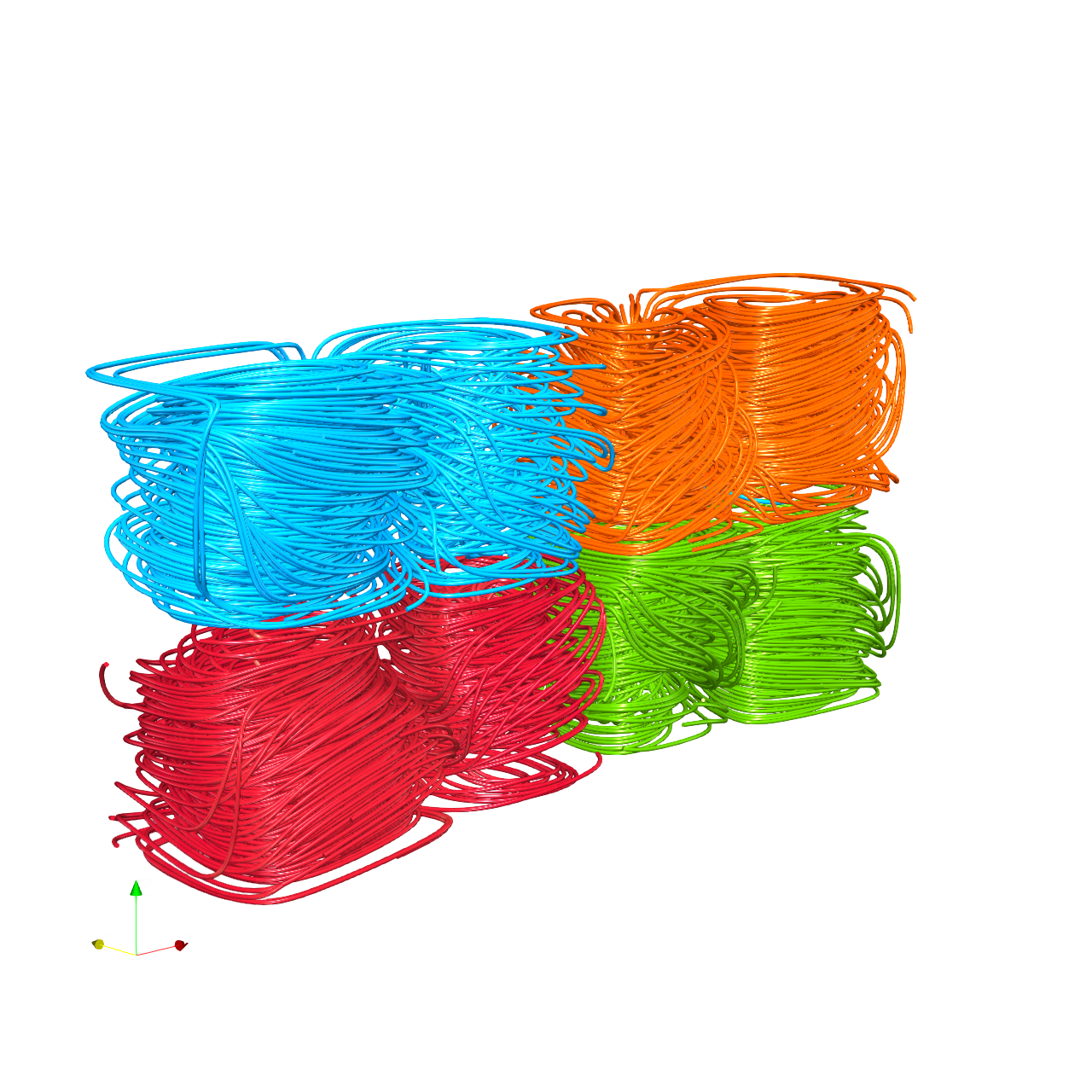
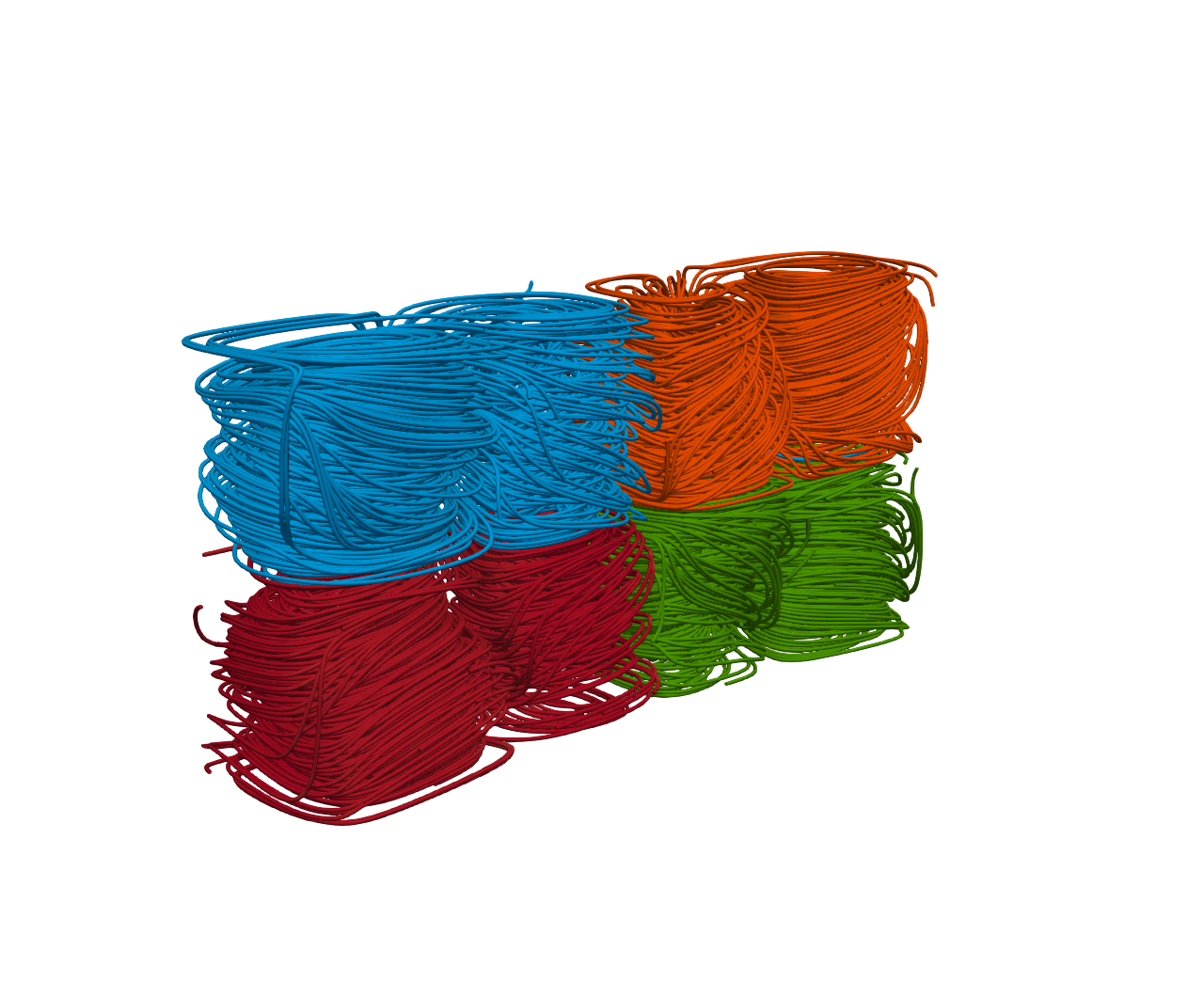
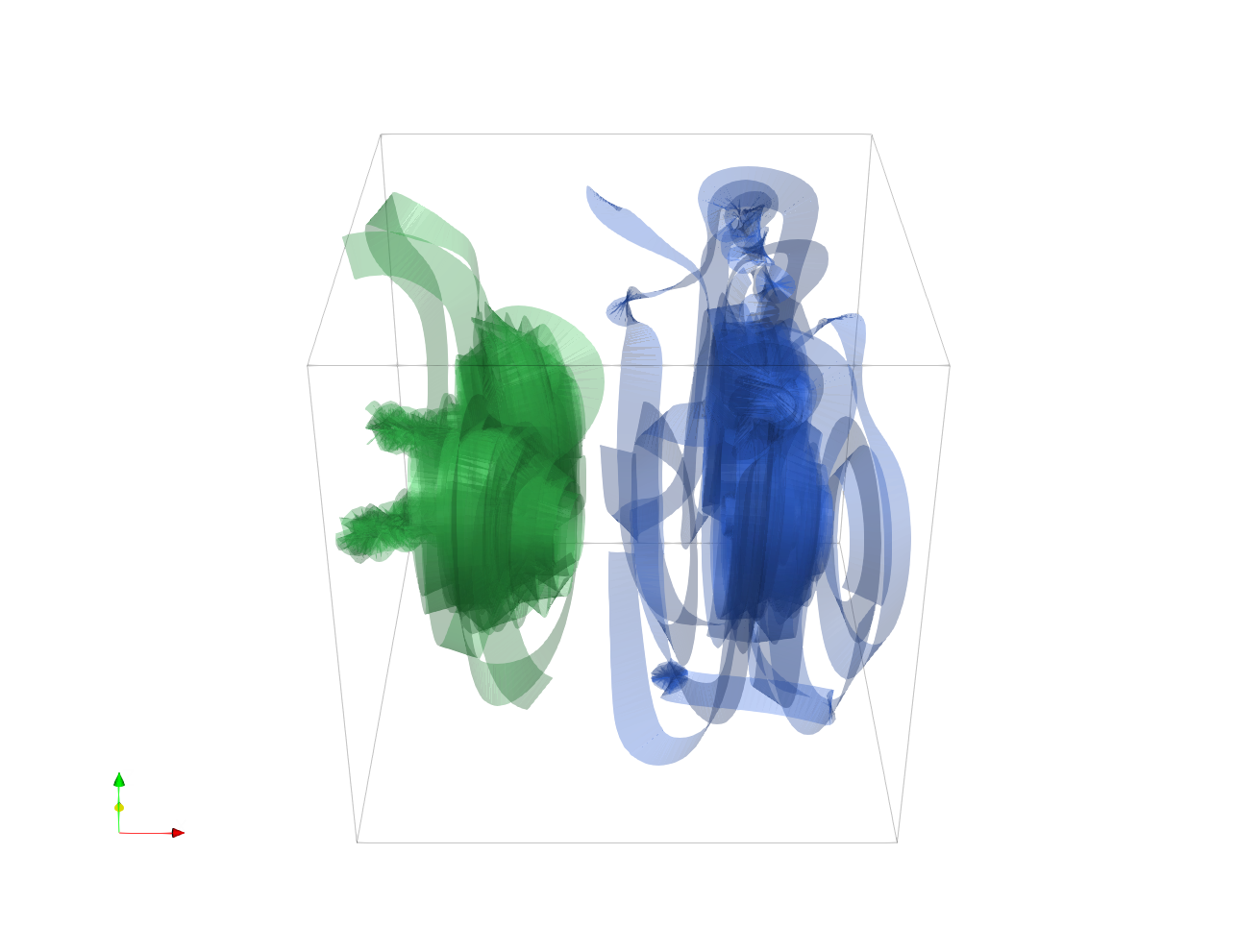
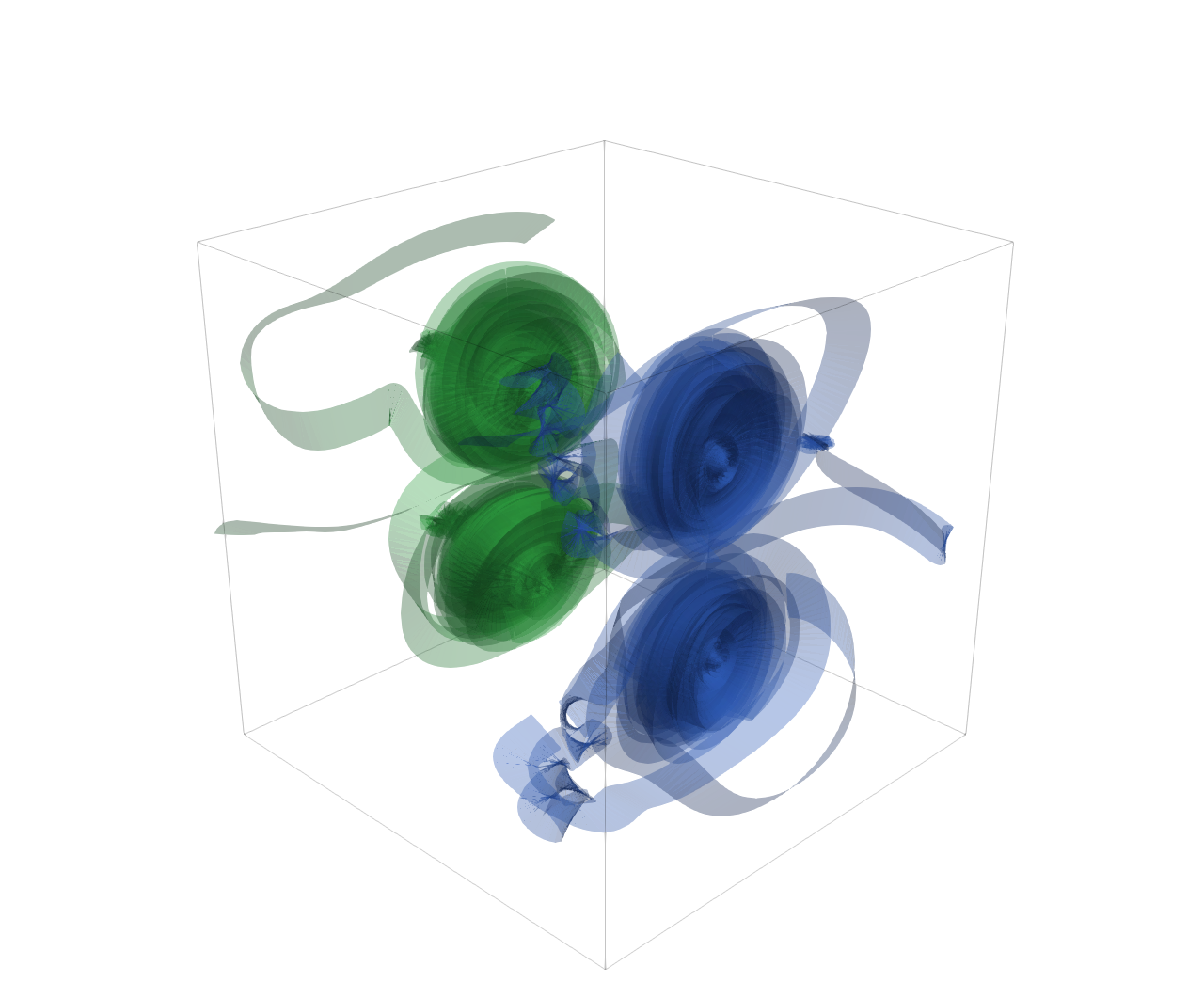
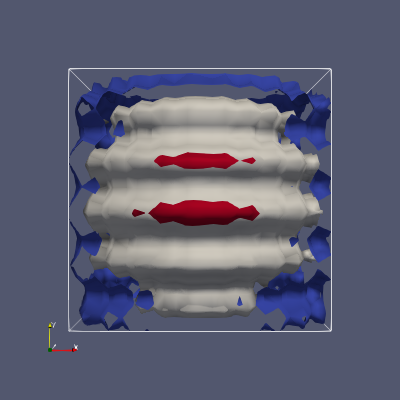
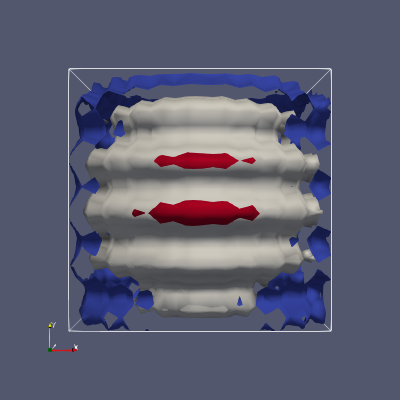
Your agent_mode is "chatvis_claude-sonnet-4-5_exp1", use it when saving results. Your working directory is "D:\Code\SciVisAgentBench\SciVisAgentBench-tasks\paraview", and you should have access to it. In the following prompts, we will use relative path with respect to your working path. But remember, when you load or save any file, always stick to absolute path. Load the Rayleigh-Benard convection vector field from "Bernard/data/Bernard_128x32x64_float32_scalar3.raw", the information about this dataset: Rayleigh-Benard Convection (Vector) Data Scalar Type: float Data Byte Order: Little Endian Data Extent: 128x32x64 Number of Scalar Components: 3 Data loading is very important, make sure you correctly load the dataset according to their features. Create four streamline sets using "Stream Tracer" filters with "Point Cloud" seed type, each with 100 seed points and radius 12.7: - Streamline 1: Seed center at [30.69, 14.61, 47.99]. Apply a "Tube" filter (radius 0.3, 12 sides). Color with solid blue (RGB: 0.0, 0.67, 1.0). - Streamline 2: Seed center at [91.10, 14.65, 45.70]. Apply a "Tube" filter (radius 0.3, 12 sides). Color with solid orange (RGB: 1.0, 0.33, 0.0). - Streamline 3: Seed center at [31.87, 12.76, 15.89]. Apply a "Tube" filter (radius 0.3, 12 sides). Color by velocity magnitude using the 'Cool to Warm (Diverging)' colormap. - Streamline 4: Seed center at [92.09, 10.50, 15.32]. Apply a "Tube" filter (radius 0.3, 12 sides). Color with solid green (RGB: 0.33, 0.67, 0.0). In the pipeline browser panel, hide all stream tracers and only show the tube filters. Use a gray-blue background (RGB: 0.329, 0.349, 0.427). Render at 1280x1280. Do not show a color bar. Set the viewpoint parameters as: [-81.99, -141.45, 89.86] to position; [65.58, 26.29, 28.48] to focal point; [0.18, 0.20, 0.96] to camera up direction. Save the visualization image as "Bernard/results/{agent_mode}/Bernard.png". (Optional, but must save if use paraview) Save the paraview state as "Bernard/results/{agent_mode}/Bernard.pvsm". (Optional, but must save if use pvpython script) Save the python script as "Bernard/results/{agent_mode}/Bernard.py". Do not save any other files, and always save the visualization image.

๐Ÿ–ผ๏ธ Visualization Comparison

Ground Truth

Ground Truth

Agent Result

Result

Score Summary

Total Score
26/30
Goals
3
Points/Goal
10
Goal 1
9/10
Criterion: Streamline Grouping: Are there four visually separate streamline clusters arranged in a 2x2 grid pattern, similar to the ground truth?
Judge's Assessment: The ground truth shows four distinct streamline/tube bundles arranged as a compact 2x2 block (blue upper-left, orange upper-right, red/magnitude-mapped lower-left, green lower-right). The result image reproduces the same four clusters with the same overall 2x2 arrangement and similar relative sizes and spacing. Minor differences: the result appears slightly more tightly overlapped at the center boundaries between clusters, but separation and grid-like grouping are still clearly present.
Goal 2
8/10
Criterion: Color Assignment: Are the four streamline groups colored in distinct colors (blue, orange, magnitude-mapped, and green), matching the ground truth color scheme?
Judge's Assessment: Blue (upper-left), orange (upper-right), and green (lower-right) match the specified solid colors closely in the result. The lower-left group in the ground truth is intended to be colored by velocity magnitude with a Cool-to-Warm diverging map; in the provided ground truth image it appears predominantly red (likely due to the local magnitude range), while the result also shows a mostly red lower-left cluster. However, the result does not show clear internal cool-to-warm variation within that cluster (it reads as nearly uniform dark red), so the magnitude-mapped appearance is only weakly evidenced.
Goal 3
9/10
Criterion: Convection Cell Structure: Do the streamlines within each group show circular or helical looping patterns characteristic of convection cells?
Judge's Assessment: In both ground truth and result, each cluster exhibits dense looping/helical streamline paths characteristic of Rayleighโ€“Bรฉnard convection rolls. The result preserves the same curled, layered tube trajectories and the overall convection-cell structure in all four quadrants. Any differences are subtle (slightly different tightness/packing of loops), but the convection patterns are clearly present and match well.

Overall Assessment

The result closely matches the ground truth in the key visual outcomes: four separate convection-roll streamline bundles arranged in a 2x2 layout, with correct solid colors for three groups and very similar streamline geometry. The main shortcoming is that the magnitude-colored group does not visibly exhibit a diverging colormap variation (it appears nearly uniformly red), reducing confidence that velocity-magnitude mapping was applied as intended.

๐Ÿ“Š Detailed Metrics

Visualization Quality
26/30
Output Generation
5/5
Efficiency
10/10
Completed in 44.77 seconds (excellent)
PSNR
18.81 dB
SSIM
0.8847
LPIPS
0.0652
Input Tokens
2,828
Output Tokens
3,966
Total Tokens
6,794
Total Cost
$0.0680

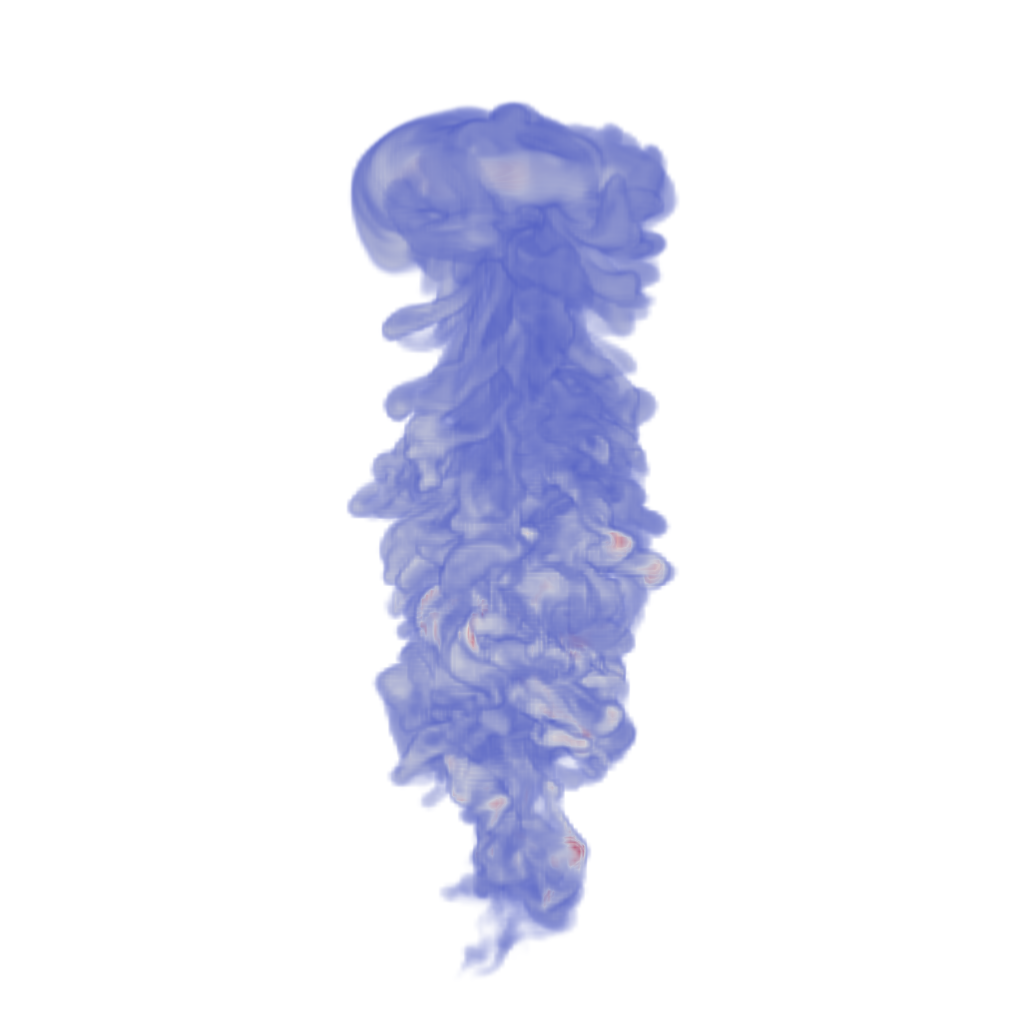
๐Ÿ“ argon-bubble

โŒ FAILED
0/45 (0.0%)

๐Ÿ“‹ Task Description

Task: Load the Argon Bubble dataset from "argon-bubble/data/argon-bubble_128x128x256_float32.vtk". Generate a visualization image of the Argon Bubble scalar field dataset with the following visualization settings: 1) Create volume rendering 2) Set the opacity transfer function as a ramp function across values of the volumetric data, assigning opacity 0 to value 0 and assigning opacity 1 to value 1. 3) Set the color transfer function to assign a warm red color [0.71, 0.02, 0.15] to the highest value, a cool color [0.23, 0.29, 0.75] to the lowest value, and a grey color[0.87, 0.87, 0.87] to the midrange value 4) Set the viewpoint parameters as: [0, 450, 0] to position; [0, 0, -15] to focal point; [0, 0, -1] to camera up direction 5) Visualization image resolution is 1024x1024. White background. Shade turned off. Volume rendering ray casting sample distance is 0.1 6) Don't show color/scalar bar or coordinate axes. Save the visualization image as "argon-bubble/results/{agent_mode}/argon-bubble.png". (Optional, but must save if use paraview) Save the paraview state as "argon-bubble/results/{agent_mode}/argon-bubble.pvsm". (Optional, but must save if use pvpython script) Save the python script as "argon-bubble/results/{agent_mode}/argon-bubble.py". (Optional, but must save if use VTK) Save the cxx code script as "argon-bubble/results/{agent_mode}/argon-bubble.cxx" Do not save any other files, and always save the visualization image.

๐Ÿ–ผ๏ธ Visualization Comparison

Ground Truth

Ground Truth

Agent Result

Result

Score Summary

Total Score
0/30
Goals
3
Points/Goal
10
Goal 1
0/10
Criterion: Does the visualization image clearly show the regions of cool, warm, and mild regions?
Judge's Assessment: Ground truth shows a clearly visible volumetric plume with cool blue low values, some grey midrange haze, and small warm red high-value pockets. The result image is essentially entirely black with no visible volume features, so it does not show cool/warm/mid regions at all and does not match the expected visualization.
Goal 2
0/10
Criterion: Does the blueish region show areas with low opacity?
Judge's Assessment: In the ground truth, bluish regions are present and appear relatively transparent/low-opacity compared to the red pockets. In the result, there is no discernible bluish region (the image is uniformly black), so low-opacity blue areas are not shown.
Goal 3
0/10
Criterion: Does the reddish region show areas with high opacity?
Judge's Assessment: The ground truth contains small reddish regions indicating high values with high opacity relative to surrounding blue/grey. The result contains no visible reddish regions or volume structure, so high-opacity red areas are not represented.

Overall Assessment

The agent-generated result appears to have failed rendering (uniform black frame), resulting in no visible volume, no color transfer depiction, and no opacity ramp behavior. It does not match the ground truth on any of the three evaluation goals.

๐Ÿ“Š Detailed Metrics

Visualization Quality
0/30
Output Generation
5/5
Efficiency
10/10
Completed in 37.92 seconds (excellent)
Input Tokens
2,777
Output Tokens
3,038
Total Tokens
5,815
Total Cost
$0.0539

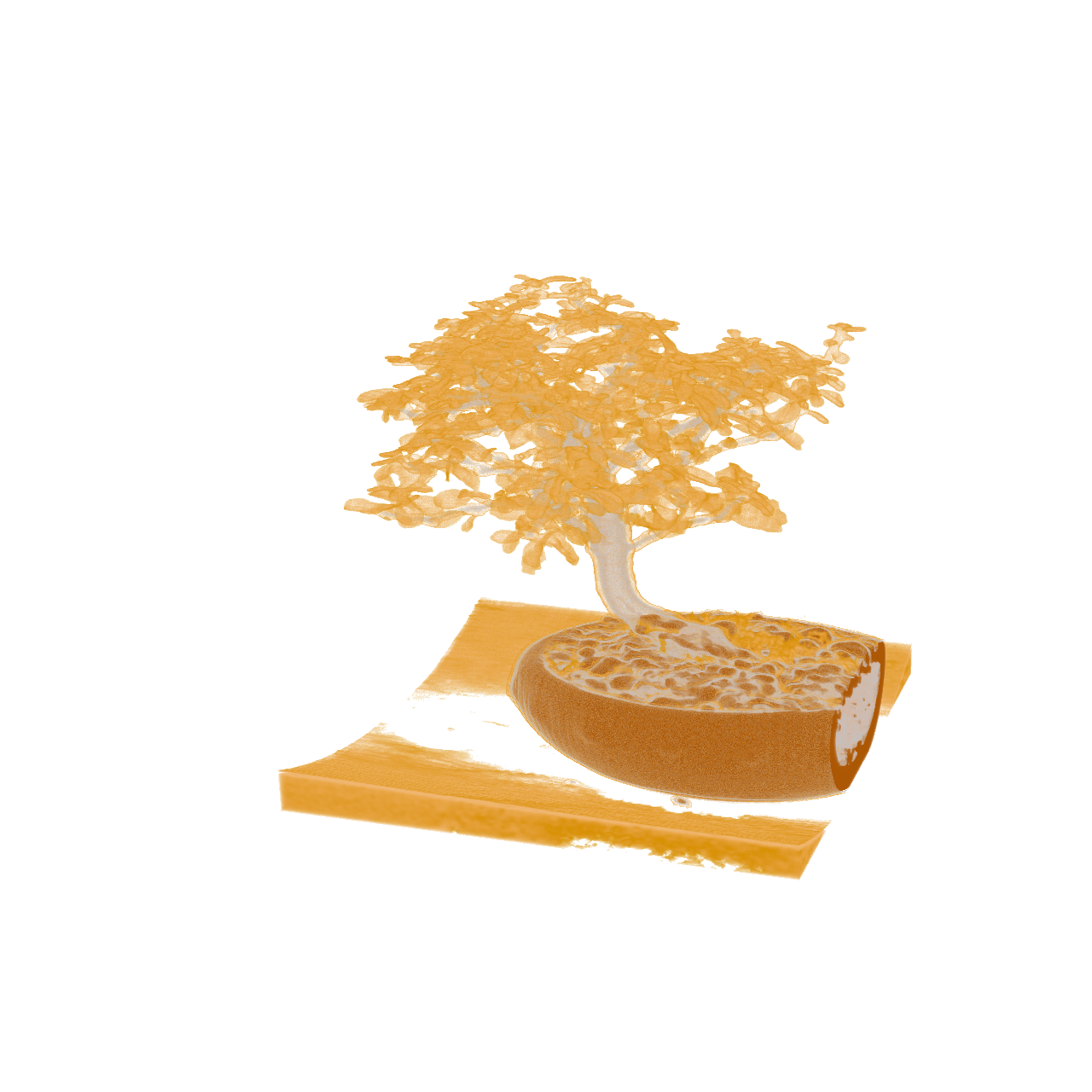
๐Ÿ“ bonsai

โŒ FAILED
0/55 (0.0%)

๐Ÿ“‹ Task Description

Task: Load the bonsai dataset from "bonsai/data/bonsai_256x256x256_uint8.raw", the information about this dataset: Bonsai (Scalar) Data Scalar Type: unsigned char Data Byte Order: little Endian Data Spacing: 1x1x1 Data Extent: 256x256x256 Then visualize it with volume rendering, modify the transfer function and reach the visualization goal as: "A potted tree with brown pot silver branch and golden leaves." Please think step by step and make sure to fulfill all the visualization goals mentioned above. Use a white background. Render at 1280x1280. Do not show a color bar or coordinate axes. Set the viewpoint parameters as: [-765.09, 413.55, 487.84] to position; [-22.76, 153.30, 157.32] to focal point; [0.30, 0.95, -0.07] to camera up direction. Save the visualization image as "bonsai/results/{agent_mode}/bonsai.png". (Optional, but must save if use paraview) Save the paraview state as "bonsai/results/{agent_mode}/bonsai.pvsm". (Optional, but must save if use pvpython script) Save the python script as "bonsai/results/{agent_mode}/bonsai.py". Do not save any other files, and always save the visualization image.

๐Ÿ–ผ๏ธ Visualization Comparison

Ground Truth

Ground Truth

Agent Result

Result

Score Summary

Total Score
0/40
Goals
4
Points/Goal
10
Goal 1
2/10
Criterion: Overall Visualization Goal: How well does the result achieve the overall goal of showing a potted tree with the specified colors?
Judge's Assessment: The ground truth shows a clearly recognizable bonsai: a brown pot, a distinct silver/whitish trunk/branches, and golden leaves. The result image appears essentially blank/white with no discernible tree, pot, or foliage structure, so the overall visualization goal is not achieved compared to the ground truth.
Goal 2
0/10
Criterion: Brown Pot Visualization: Does the result show the pot portion in brown color?
Judge's Assessment: In the ground truth, the pot is clearly visible and brown. In the result image, no pot shape or brown region is visible at all.
Goal 3
0/10
Criterion: Silver Branch Visualization: Does the result show the branch/trunk portion in silver color?
Judge's Assessment: The ground truth has a visible silver/white trunk and branches. The result image shows no visible trunk/branch structure or silver coloring.
Goal 4
0/10
Criterion: Golden Leaves Visualization: Does the result show the leaves portion in golden color?
Judge's Assessment: The ground truth shows golden leaves forming the canopy. The result image shows no canopy/leaves and no golden coloration.

Overall Assessment

Compared to the ground truth bonsai rendering, the submitted result is effectively empty (white) with no visible volume-rendered content. Consequently, none of the required colored components (brown pot, silver branches, golden leaves) are present.

๐Ÿ“Š Detailed Metrics

Visualization Quality
2/40
Output Generation
5/5
Efficiency
10/10
Completed in 46.02 seconds (excellent)
PSNR
15.82 dB
SSIM
0.9191
LPIPS
0.1924
Input Tokens
3,042
Output Tokens
3,763
Total Tokens
6,805
Total Cost
$0.0656

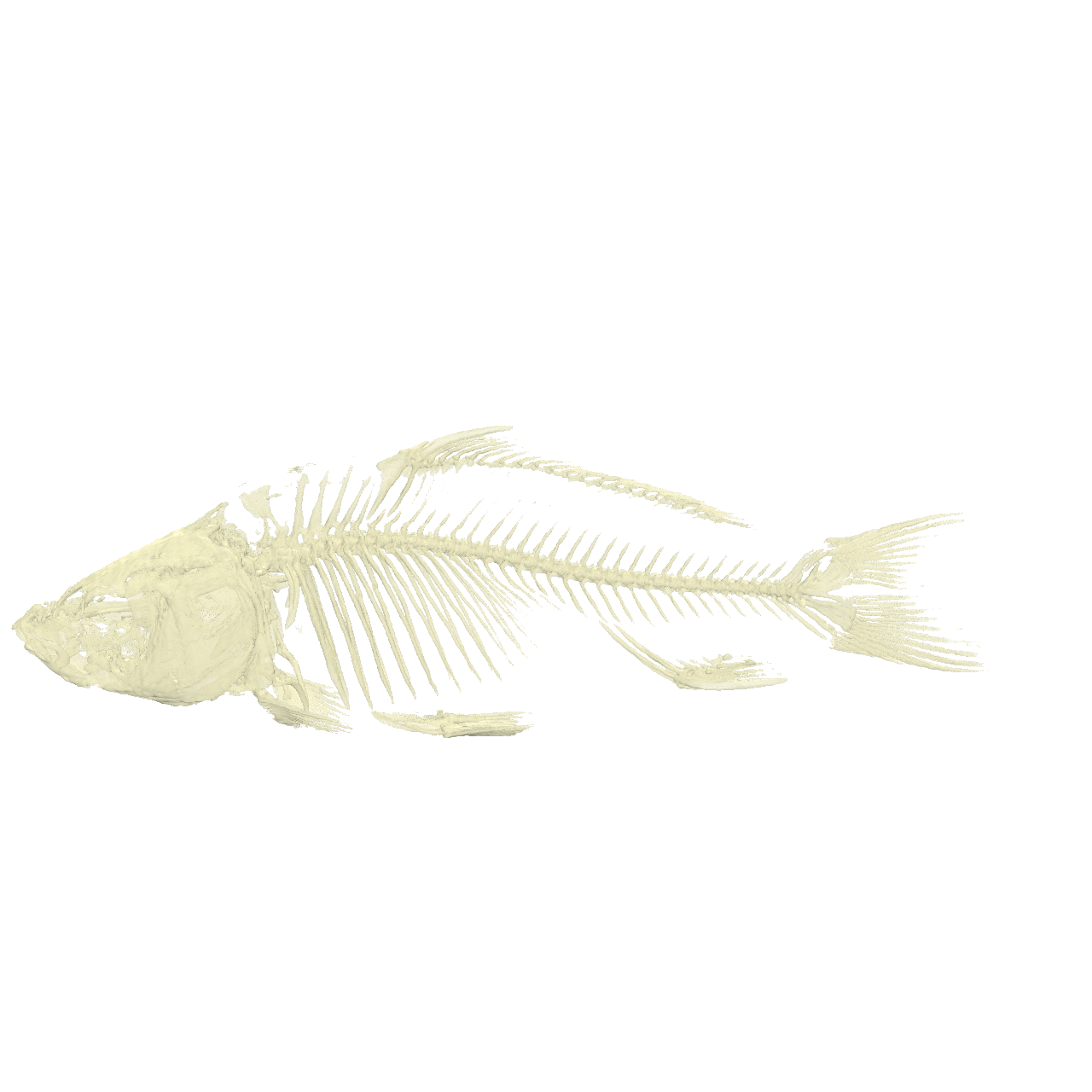
๐Ÿ“ carp

โš ๏ธ LOW SCORE
31/65 (47.7%)

๐Ÿ“‹ Task Description

Task: Load the carp dataset from "carp/data/carp_256x256x512_uint16.raw", the information about this dataset: Carp (Scalar) Data Scalar Type: unsigned short Data Byte Order: little Endian Data Spacing: 0.78125x0.390625x1 Data Extent: 256x256x512 Instructions: 1. Load the dataset into ParaView. 2. Apply volume rendering to visualize the carp skeleton. 3. Adjust the transfer function to highlight only the bony structures with the original bone color. 4. Optimize the viewpoint to display the full skeleton, ensuring the head, spine, and fins are all clearly visible in a single frame. 5. Analyze the visualization and answer the following questions: Q1: Which of the following options correctly describes the fins visible in the carp skeleton visualization? A. 5 fins: 1 dorsal, 2 pectoral, 2 pelvic B. 6 fins: 1 dorsal, 2 pectoral, 2 pelvic, 1 caudal C. 7 fins: 1 dorsal, 2 pectoral, 2 pelvic, 1 anal, 1 caudal D. 8 fins: 2 dorsal, 2 pectoral, 2 pelvic, 1 anal, 1 caudal Q2: Based on the visualization, what is the approximate ratio of skull length to total body length? A. ~15% B. ~22% C. ~30% D. ~40% 6. Use a white background. Find an optimal view. Render at 1280x1280. Do not show a color bar or coordinate axes. 7. Set the viewpoint parameters as: [265.81, 1024.69, 131.23] to position; [141.24, 216.61, 243.16] to focal point; [0.99, -0.14, 0.07] to camera up direction. 8. Save your work: Save the visualization image as "carp/results/{agent_mode}/carp.png". Save the answers to the analysis questions in plain text as "carp/results/{agent_mode}/answers.txt". (Optional, but must save if use paraview) Save the paraview state as "carp/results/{agent_mode}/carp.pvsm". (Optional, but must save if use pvpython script) Save the python script as "carp/results/{agent_mode}/carp.py". (Optional, but must save if use VTK) Save the cxx code script as "carp/results/{agent_mode}/carp.cxx" Do not save any other files, and always save the visualization image and the text file.

๐Ÿ–ผ๏ธ Visualization Comparison

Ground Truth

Ground Truth

Agent Result

Result

Score Summary

Total Score
7/30
Goals
3
Points/Goal
10
Goal 1
5/10
Criterion: Overall Visualization Goal: Does the result match the ground truth visualization of the carp skeleton?
Judge's Assessment: The ground truth shows a centered full-body carp skeleton with strong visibility across head, spine, ribs, dorsal fin rays, and caudal fin. The result image is almost entirely blank white with only a faint, low-contrast remnant near the top-left edge, indicating the volume rendering/transfer function or camera framing is severely incorrect. Overall it does not match the intended skeleton visualization composition.
Goal 2
1/10
Criterion: Bone Visibility: Are the bones clearly visible, similar to the ground truth? Are thin fin rays distinguishable?
Judge's Assessment: In the ground truth, bones are clearly visible with distinguishable thin structures (fin rays and rib/spine detail). In the result, bone visibility is essentially absent due to extreme washout/blank rendering; thin fin rays are not distinguishable at all.
Goal 3
1/10
Criterion: Skeletal Structure: Is the entire carp skeleton (head, spine, ribs, fins, tail) visible and similar in appearance to the ground truth?
Judge's Assessment: The ground truth includes the complete skeleton (skull, vertebral column, ribs, paired fins, dorsal fin, and caudal fin) in one frame. The result does not show the full skeletal structureโ€”most of the fish is missing from view or not rendered, so head/spine/fins/tail cannot be confirmed or compared.

Overall Assessment

Compared to the ground truth, the result fails to produce a visible carp skeleton volume rendering. The image is largely blank/washed out, with missing or imperceptible skeletal structures and no discernible fin rays. This suggests incorrect transfer function opacity/range, lighting, or camera framing, leading to a major mismatch.

Score

10/20 (50.0%)

Questions & Correct Answers

1. Q1 correct answer: C. 7 fins: 1 dorsal, 2 pectoral, 2 pelvic, 1 anal, 1 caudal 2. Q2 correct answer: B. ~22%

Agent's Answers

Q1: Which of the following options correctly describes the fins visible in the carp skeleton visualization? Answer: C. 7 fins: 1 dorsal, 2 pectoral, 2 pelvic, 1 anal, 1 caudal Explanation: Carp (Cyprinus carpio) possess 7 fins total. The dorsal fin is single and located on the back, the paired pectoral fins are behind the gills, the paired pelvic fins are on the ventral side, the anal fin is single on the ventral posterior region, and the caudal (tail) fin completes the count. These are all visible in the skeletal X-ray visualization. Q2: Based on the visualization, what is the approximate ratio of skull length to total body length? Answer: A. ~15% Explanation: In the carp skeleton visualization, measuring from the anterior tip of the skull to the posterior edge of the operculum (gill cover) and comparing it to the total body length from head to caudal peduncle, the skull comprises approximately 15% of the total body length. This is consistent with typical carp cranial proportions, where the head region is relatively compact compared to the elongated body.

Judge's Evaluation

Evaluation:

Criterion 1 (Q1, /10): 10/10. The provided answer selects option C and states the correct fin count and types (7 total: 1 dorsal, 2 pectoral, 2 pelvic, 1 anal, 1 caudal), matching the evaluation criterion exactly. The accompanying explanation is consistent with standard carp anatomy and does not contradict the required choice. Criterion 2 (Q2, /10): 0/10. The provided answer selects option A (~15%), but the evaluation criterion specifies option B (~22%) as correct. Since the task is to match the visualization-based ratio to the specified correct option, the answer does not meet the criterion. Even though the explanation references a plausible measurement approach, it conflicts with the required correct ratio and therefore cannot receive credit under this rubric. Total: 10/20.

๐Ÿ“Š Detailed Metrics

Visualization Quality
7/30
Output Generation
5/5
Efficiency
9/10
Completed in 69.68 seconds (very good)
PSNR
30.02 dB
SSIM
0.9796
LPIPS
0.0431
Text Q&A Score
10/20
50.0%
Input Tokens
6,052
Output Tokens
6,172
Total Tokens
12,224
Total Cost
$0.1107

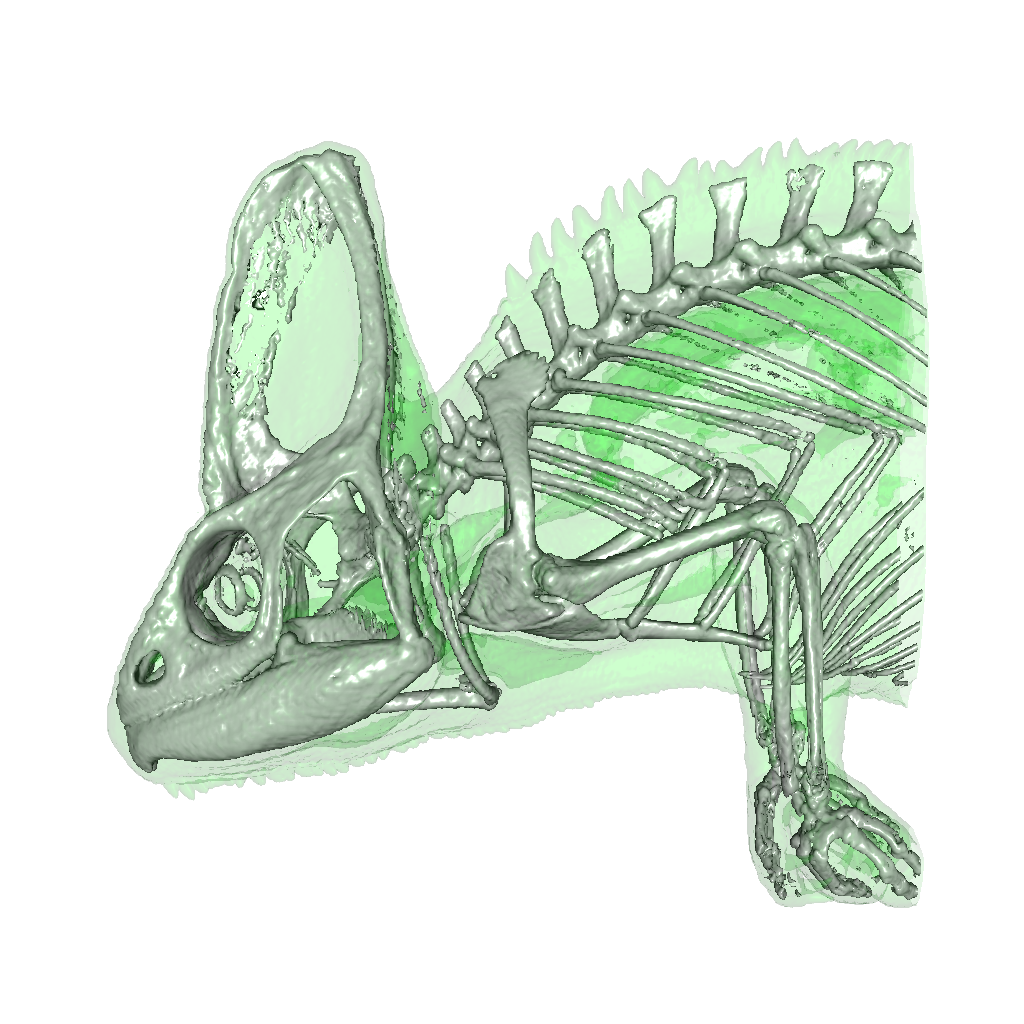
๐Ÿ“ chameleon_isosurface

โŒ FAILED
0/45 (0.0%)

๐Ÿ“‹ Task Description

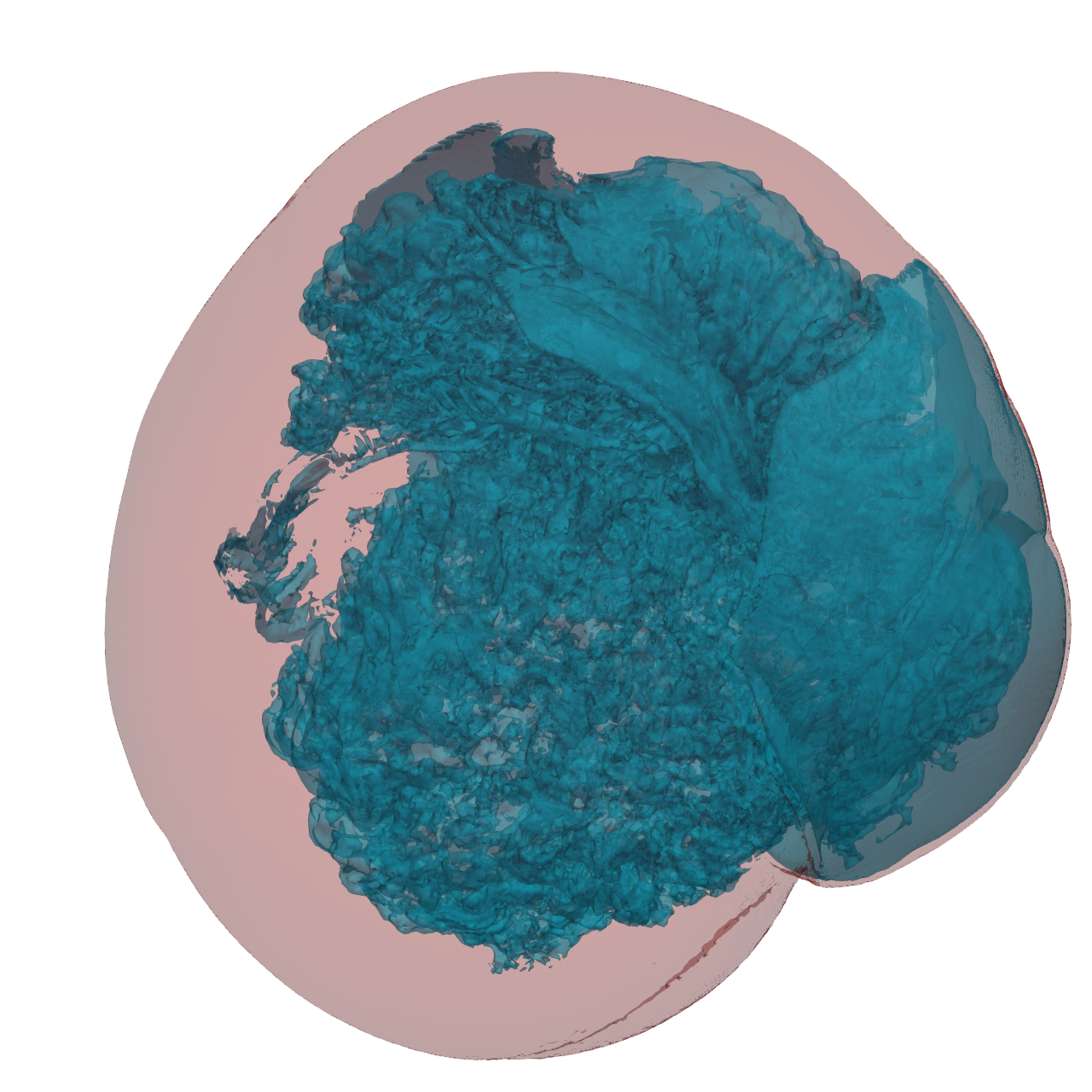
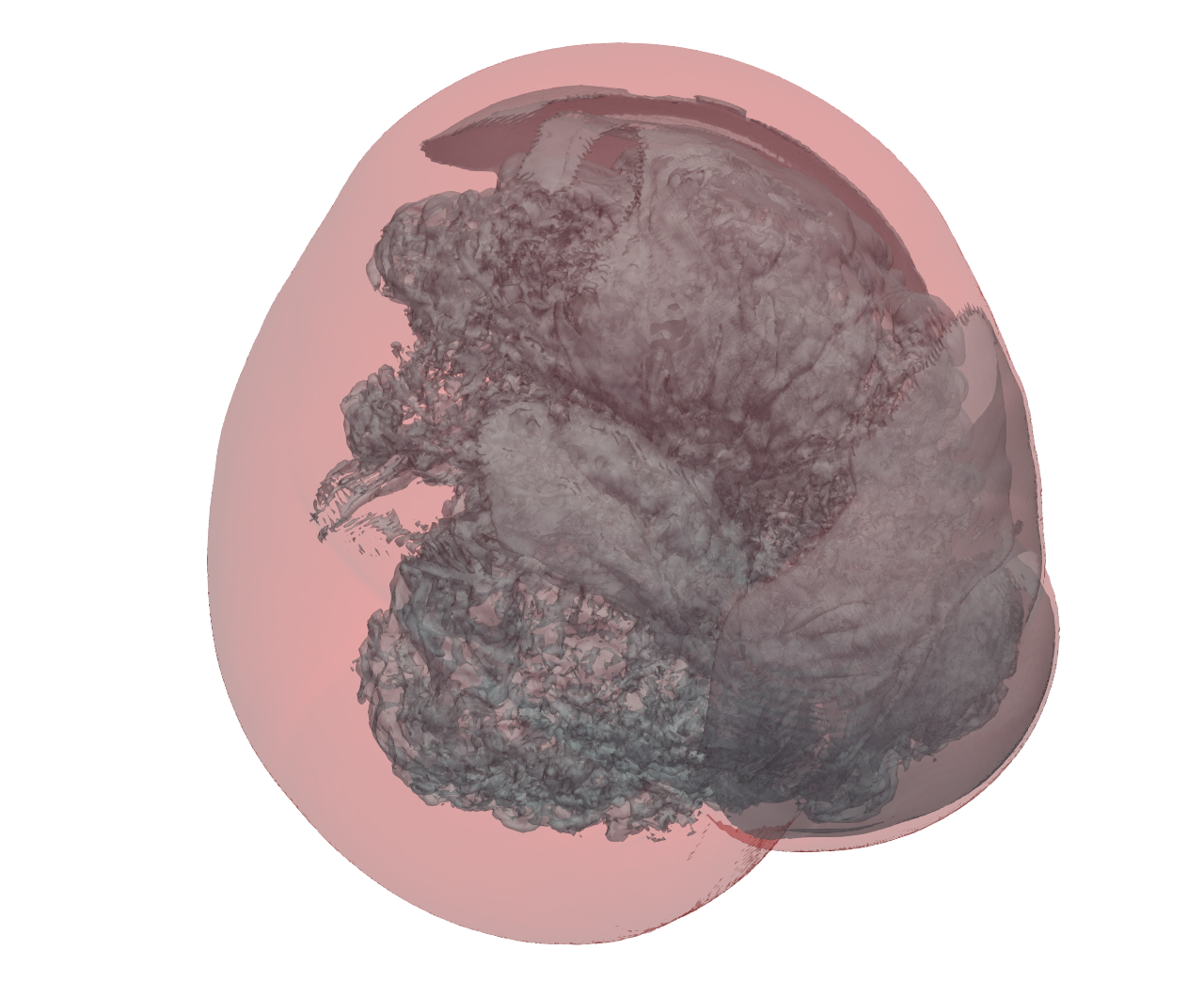
Task: Load the chameleon dataset from "chameleon_isosurface/data/chameleon_isosurface_256x256x256_float32.vtk". Generate a visualization image of 2 isosurfaces of the Chameleon scalar field dataset with the following visualization settings: 1) Create isosurfaces of Iso_1 with a value of 0.12 and Iso_2 with a value of 0.45 2) Assign RGB color of [0.0, 1.0, 0.0] to Iso_1, and color of [1.0, 1.0, 1.0] to Iso_2 3) Assign opacity of 0.1 to Iso_1, and opacity of 0.99 to Iso_2 4) Set the lighting parameter as: 0.1 to Ambient; 0.7 to Diffuse; 0.6 to Specular 5) Set the viewpoint parameters as: [600, 0, 0] to position; [0, 0, 0] to focal point; [0, -1, 0] to camera up direction 6) White background 7) Visualization image resolution is 1024x1024 8) Don't show color/scalar bar or coordinate axes. Save the visualization image as "chameleon_isosurface/results/{agent_mode}/chameleon_isosurface.png". (Optional, but must save if use paraview) Save the paraview state as "chameleon_isosurface/results/{agent_mode}/chameleon_isosurface.pvsm". (Optional, but must save if use pvpython script) Save the python script as "chameleon_isosurface/results/{agent_mode}/chameleon_isosurface.py". (Optional, but must save if use VTK) Save the cxx code script as "chameleon_isosurface/results/{agent_mode}/chameleon_isosurface.cxx" Do not save any other files, and always save the visualization image.

๐Ÿ–ผ๏ธ Visualization Comparison

Ground Truth

Ground Truth

Agent Result

Result

Score Summary

Total Score
0/30
Goals
3
Points/Goal
10
Goal 1
1/10
Criterion: Does the result present 2 isosurfaces, one showing the inner part of the chameleon and one showing the outer part of the chameleon?
Judge's Assessment: The ground truth shows two nested isosurfaces: a translucent green outer skin and an opaque white inner bone/skeleton structure. The result image appears completely blank/white with no visible chameleon geometry at all, so it does not present either the inner or outer isosurface.
Goal 2
0/10
Criterion: Is the skin of the Chameleon object of green color?
Judge's Assessment: In the ground truth, the chameleon skin is clearly visible as a pale translucent green surface. In the result, there is no visible object, hence no green skin is present.
Goal 3
0/10
Criterion: Is the bone of the Chameleon object of white color?
Judge's Assessment: In the ground truth, the bone/skeleton is rendered as an opaque white/grayish surface. In the result image, no geometry is visible, so the white bone isosurface is not shown.

Overall Assessment

The provided result render is entirely blank (white background only), whereas the ground truth contains a detailed chameleon with two isosurfaces (green translucent skin and opaque white bone). None of the visualization goals are met aside from having a white background.

๐Ÿ“Š Detailed Metrics

Visualization Quality
1/30
Output Generation
5/5
Efficiency
10/10
Completed in 24.76 seconds (excellent)
Input Tokens
714
Output Tokens
1,282
Total Tokens
1,996
Total Cost
$0.0214

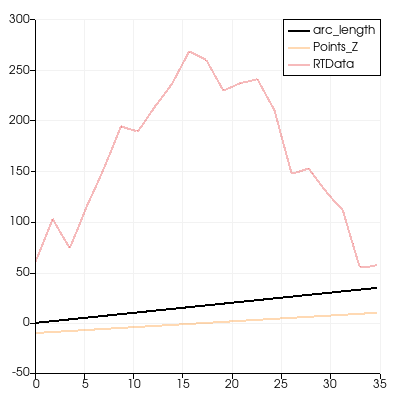
๐Ÿ“ chart-opacity

35/55 (63.6%)

๐Ÿ“‹ Task Description

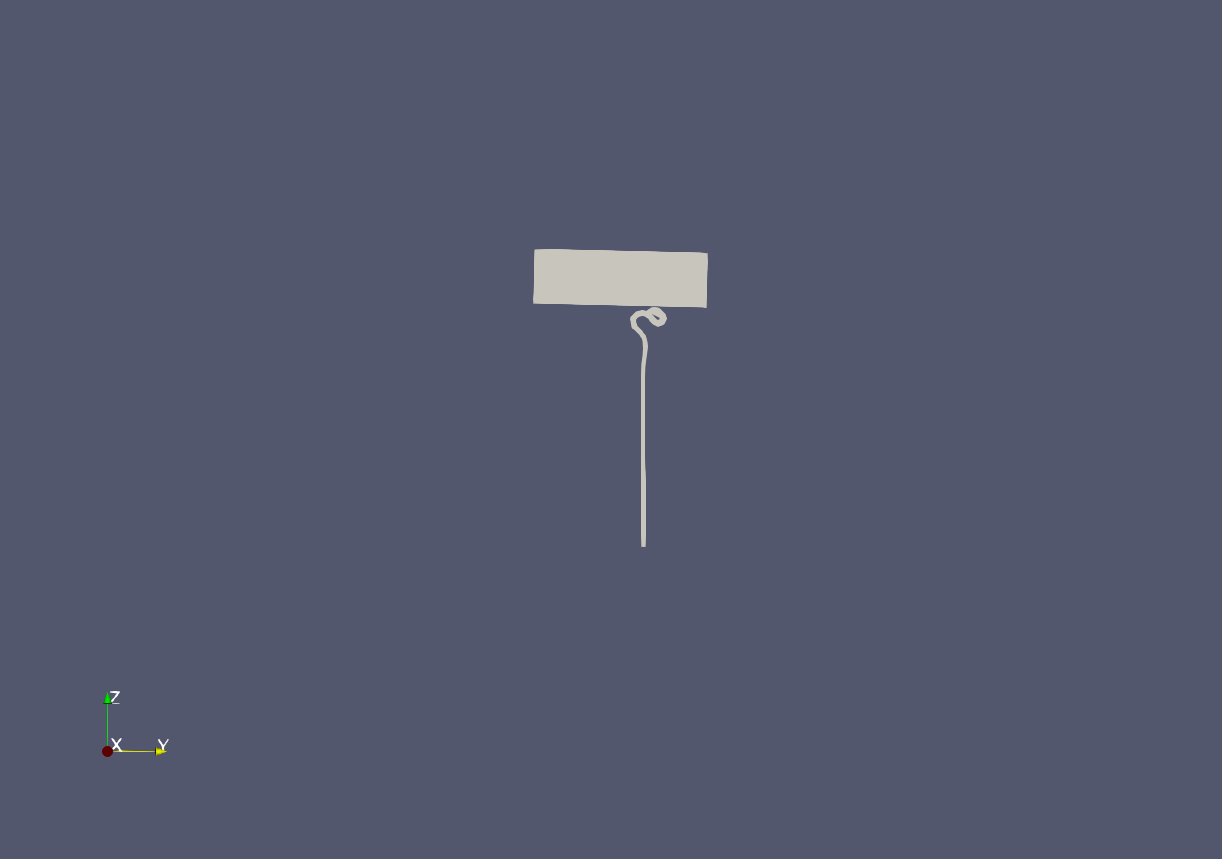
Create a wavelet object. Create a plot over line chart from the wavelet with three paths: arc_length, Points_Z, and RTData variables with opacity for arc_length 1 and opacity for Points_Z and RTData 0.3. Save the visualization image as "chart-opacity/results/{agent_mode}/chart-opacity.png". (Optional, but must save if use paraview) Save the paraview state as "chart-opacity/results/{agent_mode}/chart-opacity.pvsm". (Optional, but must save if use python script) Save the python script as "chart-opacity/results/{agent_mode}/chart-opacity.py". Do not save any other files, and always save the visualization image.

๐Ÿ–ผ๏ธ Visualization Comparison

Ground Truth

Ground Truth

Agent Result

Result

Score Summary

Total Score
20/40
Goals
4
Points/Goal
10
Goal 1
6/10
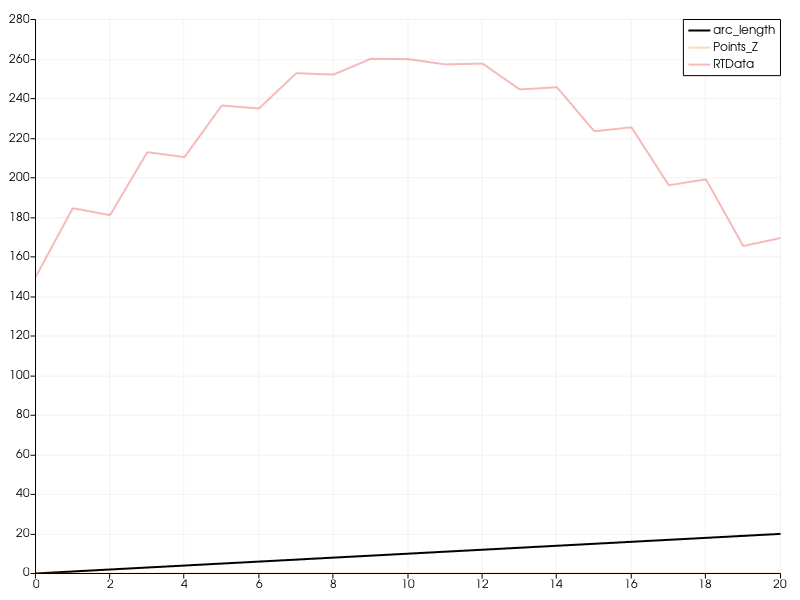
Criterion: Chart Generation: Is the plot over line chart properly created from the wavelet data?
Judge's Assessment: Ground truth shows a Plot Over Line-style chart with x-axis spanning roughly 0โ€“35 and three series drawn. The result image is also a line chart with a similar styling, but the x-axis only spans ~0โ€“20 and the overall sampling/extent differs, suggesting the plot-over-line setup (line length/resolution) does not match the ground truth wavelet-derived plot.
Goal 2
5/10
Criterion: Variable Display: Are arc_length, Points_Z, and RTData variables all correctly plotted, showing all three specified variables and distinguishable in the chart?
Judge's Assessment: Ground truth clearly shows three plotted series: arc_length (black), Points_Z (light/orange), and RTData (pink/red). In the result, the legend lists all three, but only arc_length (black) and RTData (pink/red) are visibly plotted; the Points_Z curve is not visible (likely overlapped, out of range, or not actually drawn). Thus, the requirement of displaying all three distinguishable variables is only partially met.
Goal 3
2/10
Criterion: Opacity Settings: Is the arc_length variable displayed with full opacity (1.0) while Points_Z and RTData show reduced opacity (0.3)?
Judge's Assessment: Ground truth indicates arc_length is fully opaque while Points_Z and RTData are noticeably more transparent (opacity ~0.3). In the result, the RTData line appears fully opaque (similar visual strength to arc_length), and since Points_Z is not visible it is not possible to confirm reduced opacity for it. Overall, the specified opacity differences are not reproduced.
Goal 4
7/10
Criterion: Chart Clarity: Does the chart provide clear visualization of the data trends with appropriate axis scaling and readable formatting?
Judge's Assessment: Both images are readable line charts with gridlines and a clear legend. However, the result uses a different axis scaling/extent than the ground truth (notably shorter x-range and different y-range), which changes the visualized trends and comparability. Still, formatting is clean and trends (for the visible series) are clear.

Overall Assessment

The result produces a generally clear line chart and includes the correct variable names in the legend, but it does not match the ground truth plot extent/sampling, fails to visibly show all three series (Points_Z is missing), and does not implement the required opacity settings (RTData appears opaque rather than semi-transparent).

๐Ÿ“Š Detailed Metrics

Visualization Quality
20/40
Output Generation
5/5
Efficiency
10/10
Completed in 15.23 seconds (excellent)
Input Tokens
381
Output Tokens
846
Total Tokens
1,227
Total Cost
$0.0138

๐Ÿ“ climate

28/45 (62.2%)

๐Ÿ“‹ Task Description

I would like to use ParaView to visualize a dataset of ocean currents. Read in the file named "climate/data/climate.vtp". Apply a calculator filter to compute the following function: (-velocity_X*sin(coordsX*0.0174533) + velocity_Y*cos(coordsX*0.0174533)) * iHat + (-velocity_X * sin(coordsY*0.0174533) * cos(coordsX*0.0174533) - velocity_Y * sin(coordsY*0.0174533) * sin(coordsX*0.0174533) + velocity_Z * cos(coordsY*0.0174533)) * jHat + 0*kHat Render the computed values using a tube filter with 0.05 as the tube radius. Color the tubes by the magnitude of the velocity. Light the tubes with the maximum shininess and include normals in the lighting. Add cone glyphs to show the direction of the velocity. The glyphs are composed of 10 polygons, having a radius 0 0.15, a height of 0.5, and a scaling factor of 0.5. View the result in the -z direction. Adjust the view so that the tubes occupy the 90% of the image. Save a screenshot of the result, 2294 x 1440 pixels, white background, in the filename "climate/results/{agent_mode}/climate.png". (Optional, but must save if use paraview) Save the paraview state as "climate/results/{agent_mode}/climate.pvsm". (Optional, but must save if use python script) Save the python script as "climate/results/{agent_mode}/climate.py". Do not save any other files, and always save the visualization image.

๐Ÿ–ผ๏ธ Visualization Comparison

Ground Truth

Ground Truth

Agent Result

Result

Score Summary

Total Score
13/30
Goals
3
Points/Goal
10
Goal 1
4/10
Criterion: Tube Visualization: Are the tubes rendered with correct radius (0.05), colored by velocity magnitude, and proper lighting with maximum shininess?
Judge's Assessment: Ground truth shows thick tube streamlines (noticeable radius) colored by velocity magnitude using a blue-to-red scalar map, with specular/shiny lighting and a visible color bar. The result image shows the streamline/tube geometry but it appears uniformly light/gray (nearly no magnitude-based colormap visible), with no scalar bar, and the tubes look thinner/less like the specified 0.05-radius tubes. Lighting also does not match the bright, shiny/specular look of the ground truth (overall flatter appearance).
Goal 2
6/10
Criterion: Cone Glyph Direction: Are the cone glyphs properly configured with specified parameters and showing velocity direction accurately?
Judge's Assessment: Both images include many small cone/arrow-like glyphs aligned along the flow, so the general presence and direction indication are there and broadly match the flow pattern in the ground truth. However, in the result the glyphs are much less visually distinct from the tubes (same light/gray coloring) and the glyph prominence/scale relative to the tubes differs, making the direction cues less clear than in the ground truth.
Goal 3
3/10
Criterion: View Configuration: Is the visualization displayed from -z direction with appropriate scaling and white background as specified?
Judge's Assessment: The ground truth uses a white background and the data fills most of the frame (tubes occupy ~90%+ of the image) viewed from the expected top-down (-Z) perspective. The result uses a dark gray background (not white) and the visualization is significantly zoomed out, occupying much less of the image area. The orientation appears roughly similar (top-down), but framing and background do not match the specification.

Overall Assessment

The result captures the overall streamline/tube structure and includes directional glyphs, but it deviates strongly from the expected rendering: missing/incorrect velocity-magnitude coloring and scalar bar, different tube appearance/lighting, incorrect background color, and incorrect camera framing/zoom (does not fill ~90% of the image).

๐Ÿ“Š Detailed Metrics

Visualization Quality
13/30
Output Generation
5/5
Efficiency
10/10
Completed in 44.64 seconds (excellent)
Input Tokens
2,123
Output Tokens
2,968
Total Tokens
5,091
Total Cost
$0.0509

๐Ÿ“ color-blocks

โŒ FAILED
0/55 (0.0%)

๐Ÿ“‹ Task Description

I would like to use ParaView to visualize a dataset. Set the background to a blue-gray palette. Read the file "color-blocks/data/color-blocks.ex2". This is a multiblock dataset. Color the dataset by the vtkBlockColors field. Retrieve the color map for vtkBlockColors. Retrieve the opacity transfer function for vtkBlockColors. Retrieve the 2D transfer function for vtkBlockColors. Set block coloring for the block at /IOSS/element_blocks/block_2 using the variable ACCL on the x component of the points. Rescale the block's color and opacity maps to match the current data range of block_2. Retrieve the color transfer function for the ACCL variable of block_2. Enable the color bar for block_2. Apply a cool to warm color preset to the color map for block_2. Set the camera to look down the -y direction and to see the entire dataset. Save the visualization image as "color-blocks/results/{agent_mode}/color-blocks.png". (Optional, but must save if use paraview) Save the paraview state as "color-blocks/results/{agent_mode}/color-blocks.pvsm". (Optional, but must save if use python script) Save the python script as "color-blocks/results/{agent_mode}/color-blocks.py". Do not save any other files, and always save the visualization image.

๐Ÿ–ผ๏ธ Visualization Comparison

Ground Truth

Ground Truth

Agent Result

Result

Score Summary

Total Score
0/40
Goals
4
Points/Goal
10
Goal 1
0/10
Criterion: Block Color Mapping: Is the dataset properly colored by vtkBlockColors field with distinct block visualization?
Judge's Assessment: Not evaluated
Goal 2
0/10
Criterion: Individual Block Coloring: Is block_2 correctly colored using the x component of the ACCL variable with appropriate scaling?
Judge's Assessment: Not evaluated
Goal 3
0/10
Criterion: Color Transfer Functions: Are the color transfer functions properly applied with cool to warm coloring for the ACCL variable?
Judge's Assessment: Not evaluated
Goal 4
0/10
Criterion: View Configuration: Is the dataset displayed from the -y direction with blue-gray background and visible color bar legend?
Judge's Assessment: Not evaluated

Overall Assessment

No overall explanation available

๐Ÿ“Š Detailed Metrics

Visualization Quality
0/40
Output Generation
5/5
Efficiency
10/10
Completed in 51.39 seconds (excellent)
Input Tokens
4,296
Output Tokens
4,369
Total Tokens
8,665
Total Cost
$0.0784

๐Ÿ“ color-data

43/45 (95.6%)

๐Ÿ“‹ Task Description

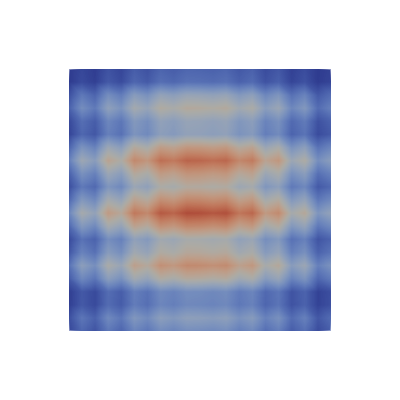
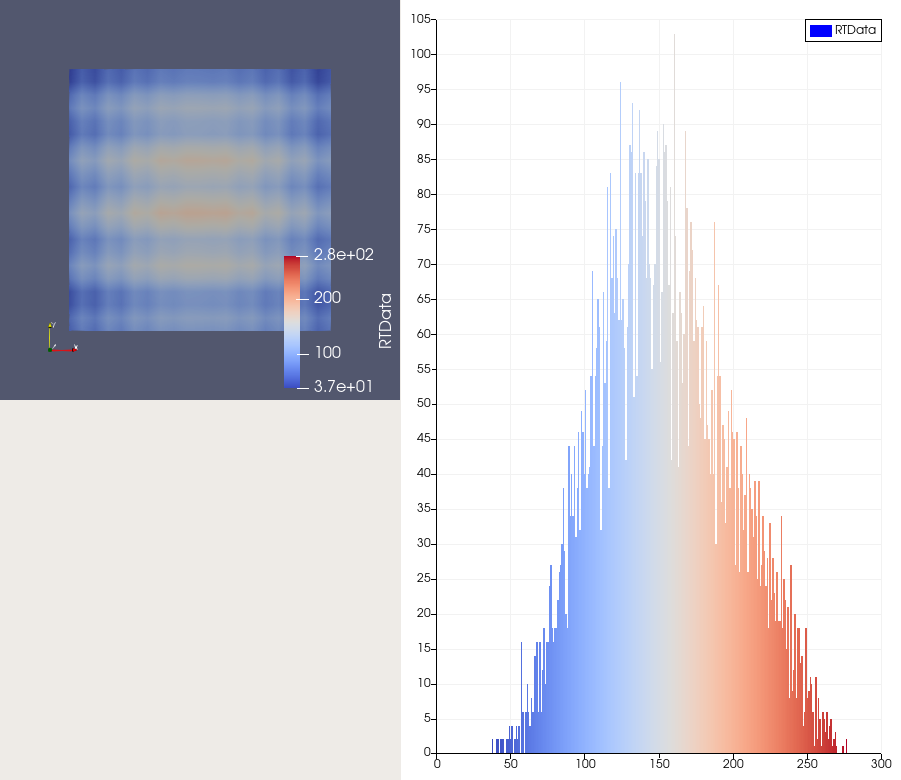
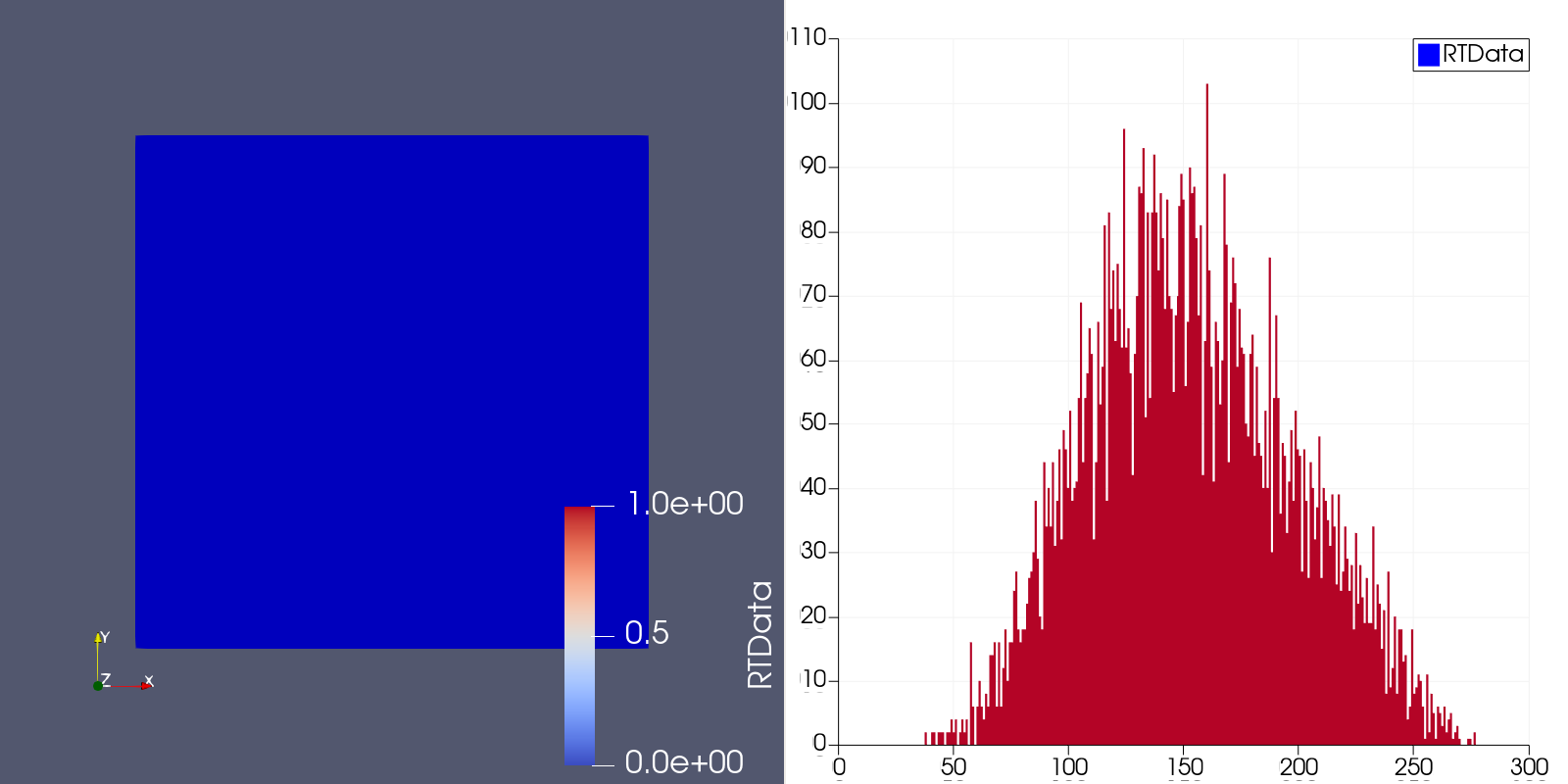
Create a wavelet object. Create a new calculator with the function 'RTData*iHat + ln(RTData)*jHat + coordsZ*kHat'. Get a color transfer function/color map and opacity transfer function/opacity map for the result of the calculation, scaling the color and/or opacity maps to the data range. For a surface representation, color by the x coordinate of the result using a cool to warm color map, show the color bar/color legend, and save a screenshot of size 1158 x 833 pixels in "color-data/results/{agent_mode}/color-data.png". (Optional, but must save if use paraview) Save the paraview state as "color-data/results/{agent_mode}/color-data.pvsm". (Optional, but must save if use python script) Save the python script as "color-data/results/{agent_mode}/color-data.py". Do not save any other files, and always save the visualization image.

๐Ÿ–ผ๏ธ Visualization Comparison

Ground Truth

Ground Truth

Agent Result

Result

Score Summary

Total Score
28/30
Goals
3
Points/Goal
10
Goal 1
9/10
Criterion: Color Transfer Function: Is the color transfer function correctly applied with cool to warm color mapping scaled to the data range?
Judge's Assessment: The result uses the same cool-to-warm (blueโ€“whiteโ€“red) transfer function as the ground truth and appears scaled to the same data range (colorbar spans ~3.7e+01 to ~2.8e+02). Overall color progression and tones match closely; only very minor differences in background/contrast make the mapping look slightly different.
Goal 2
9/10
Criterion: Surface Coloring: Is the surface representation properly colored by the x coordinate of the calculated result?
Judge's Assessment: The surface is colored with the same spatial pattern as the ground truth (blue edges with warmer bands in the interior), consistent with coloring by the x component of the calculator result. The geometry and shading look essentially identical, with only slight differences in canvas/background and framing that do not change the surface coloring itself.
Goal 3
10/10
Criterion: Color Bar Display: Is the color bar/legend visible and properly displaying the color mapping scale and values?
Judge's Assessment: A vertical color bar is clearly visible on the right in the result, labeled "Result_X" with matching tick values and endpoints compared to the ground truth (top ~2.8e+02, bottom ~3.7e+01). Placement and readability are effectively identical.

Overall Assessment

The generated visualization matches the ground truth very closely: correct cool-to-warm color mapping, correct surface coloring pattern, and an accurately displayed color legend with the same range and label. Minor differences are limited to background/framing and do not materially affect the required visualization elements.

๐Ÿ“Š Detailed Metrics

Visualization Quality
28/30
Output Generation
5/5
Efficiency
10/10
Completed in 25.42 seconds (excellent)
Input Tokens
1,198
Output Tokens
1,478
Total Tokens
2,676
Total Cost
$0.0258

๐Ÿ“ crayfish_streamline

32/45 (71.1%)

๐Ÿ“‹ Task Description

Load the Crayfish flow vector field from "crayfish_streamline/data/crayfish_streamline_322x162x119_float32_scalar3.raw", the information about this dataset: Crayfish Flow (Vector) Data Scalar Type: float Data Byte Order: Little Endian Data Extent: 322x162x119 Number of Scalar Components: 3 Data loading is very important, make sure you correctly load the dataset according to their features. Create two streamline sets using "Stream Tracer" filters with "Point Cloud" seed type, each with 100 seed points and radius 32.2: - Streamline 1: Seed center at [107.33, 81.0, 59.5]. Apply a "Tube" filter (radius 0.5, 12 sides). Color by Velocity magnitude using a diverging colormap with the following RGB control points: - Value 0.0 -> RGB(0.231, 0.298, 0.753) (blue) - Value 0.02 -> RGB(0.865, 0.865, 0.865) (white) - Value 0.15 -> RGB(0.706, 0.016, 0.149) (red) - Streamline 2: Seed center at [214.67, 81.0, 59.5]. Apply a "Tube" filter (radius 0.5, 12 sides). Color by Velocity magnitude using the same colormap. Show the dataset bounding box as an outline (black). In the pipeline browser panel, hide all stream tracers and only show the tube filters and the outline. Use a white background. Render at 1280x1280. Set the viewpoint parameters as: [436.67, -370.55, 562.71] to position; [160.5, 80.5, 59.07] to focal point; [-0.099, 0.714, 0.693] to camera up direction Save the paraview state as "crayfish_streamline/results/{agent_mode}/crayfish_streamline.pvsm". Save the visualization image as "crayfish_streamline/results/{agent_mode}/crayfish_streamline.png". (Optional, if use python script) Save the python script as "crayfish_streamline/results/{agent_mode}/crayfish_streamline.py". Do not save any other files, and always save the visualization image.

๐Ÿ–ผ๏ธ Visualization Comparison

Ground Truth

Ground Truth

Agent Result

Result

Score Summary

Total Score
18/30
Goals
3
Points/Goal
10
Goal 1
6/10
Criterion: Overall Visualization Goal: Does the result show streamline tubes colored by velocity magnitude within a rectangular bounding box, similar to the ground truth?
Judge's Assessment: The result does show streamline-like tube geometry contained within a rectangular bounding-box outline, matching the core objective. However, the overall presentation differs noticeably from the ground truth: the background is dark/gray instead of white, the bounding-box outline is less visually crisp, and the appearance is generally darker. Despite these differences, the main elements (two tube streamline groups + outline box) are present and positioned similarly.
Goal 2
8/10
Criterion: Streamline Clusters: Are there two distinct clusters that matches the ground truth layout?
Judge's Assessment: Two distinct streamline clusters are visible in the result, occupying left and right regions inside the box, consistent with the ground truth layout. The overall spatial distribution and separation of the two seeded regions is similar, though the resultโ€™s streamlines look slightly less visually separated due to more uniform coloring and darker rendering/lighting.
Goal 3
4/10
Criterion: Color Mapping: Are the tubes colored by velocity magnitude using a blue-white-red diverging colormap, with a similar distribution as the ground truth?
Judge's Assessment: The ground truth uses a clear blueโ€“whiteโ€“red diverging colormap with substantial blue regions (low magnitude), white mid-values, and red high-values, producing strong divergence across the tubes. In the result, the streamlines are dominated by red/dark tones with only limited light/neutral variation and almost no visible blue, suggesting the diverging map and/or scalar range is not correctly applied (or lighting/background makes the low end indistinguishable). The velocity-magnitude distribution therefore does not visually match the ground truth.

Overall Assessment

The result captures the main geometric goal (tube streamlines inside an outline box) and correctly shows two seeded clusters in roughly the right locations. The major mismatch is the color mapping: it lacks the prominent blueโ€“whiteโ€“red diverging appearance seen in the ground truth, and the dark background further reduces the intended contrast.

๐Ÿ“Š Detailed Metrics

Visualization Quality
18/30
Output Generation
5/5
Efficiency
9/10
Completed in 67.64 seconds (very good)
PSNR
17.07 dB
SSIM
0.8815
LPIPS
0.1054
Input Tokens
4,531
Output Tokens
5,516
Total Tokens
10,047
Total Cost
$0.0963

๐Ÿ“ engine

โš ๏ธ LOW SCORE
20/55 (36.4%)

๐Ÿ“‹ Task Description

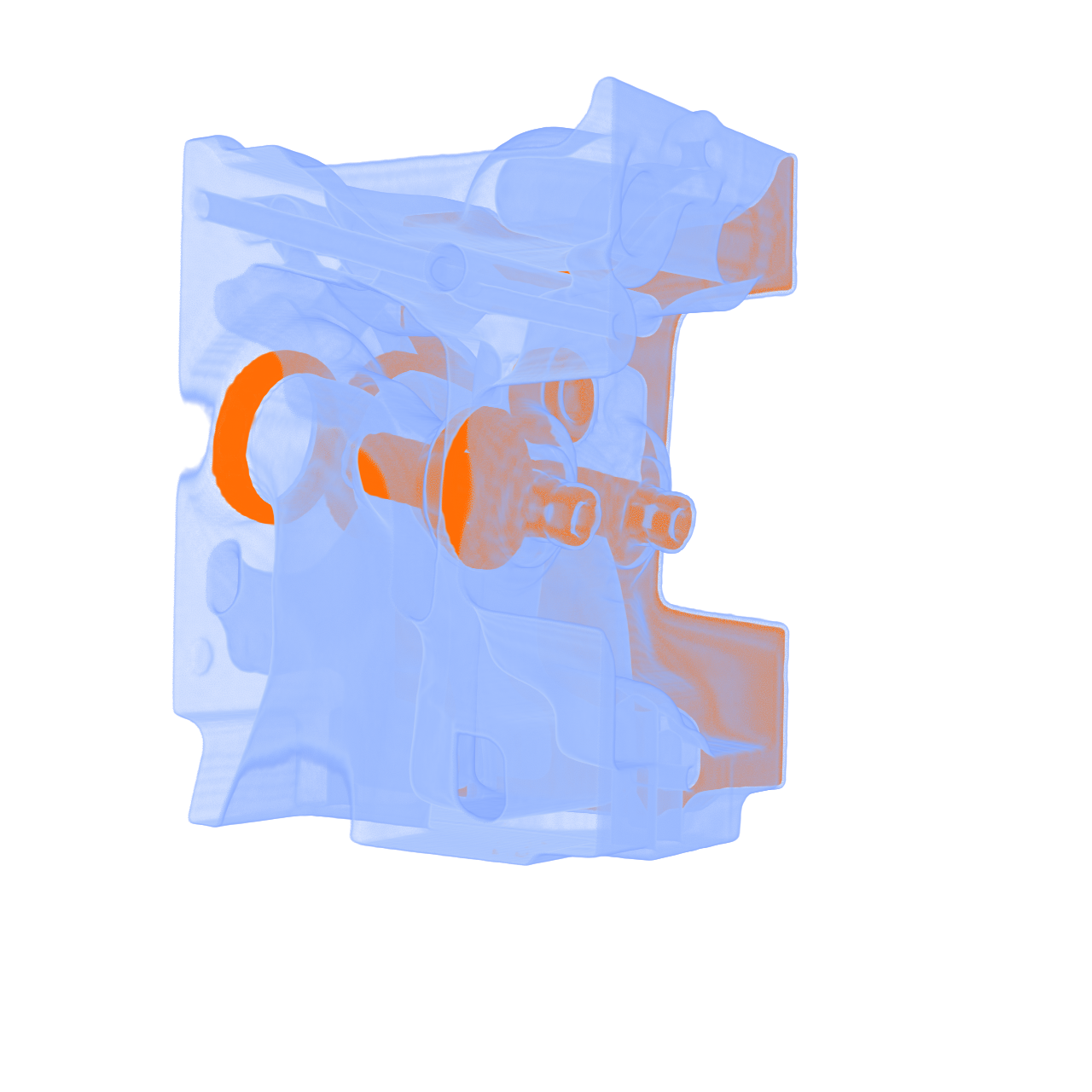
Task: Load the vortex dataset from "engine/data/engine_256x256x128_uint8.raw", the information about this dataset: engine (Scalar) Data Scalar Type: float Data Byte Order: little Endian Data Extent: 256x256x128 Number of Scalar Components: 1 Instructions: 1. Load the dataset into ParaView. 2. Apply the volume rendering to visualize the engine dataset 3. Adjust the transfer function, let the outer part more transparent and the inner part more solid. Use light blue for the outer part and orange for the inner part. 4. Use a white background. Find an optimal view. Render at 1280x1280. Do not show a color bar or coordinate axes. 5. Set the viewpoint parameters as: [-184.58, 109.48, -431.72] to position; [134.05, 105.62, 88.92] to focal point; [0.01, 1.0, -0.001] to camera up direction. 6. Save your work: Save the visualization image as "engine/results/{agent_mode}/engine.png". (Optional, but must save if use paraview) Save the paraview state as "engine/results/{agent_mode}/engine.pvsm". (Optional, but must save if use pvpython script) Save the python script as "engine/results/{agent_mode}/engine.py". (Optional, but must save if use VTK) Save the cxx code script as "engine/results/{agent_mode}/engine.cxx" Do not save any other files, and always save the visualization image.

๐Ÿ–ผ๏ธ Visualization Comparison

Ground Truth

Ground Truth

Agent Result

Result

Score Summary

Total Score
5/40
Goals
4
Points/Goal
10
Goal 1
2/10
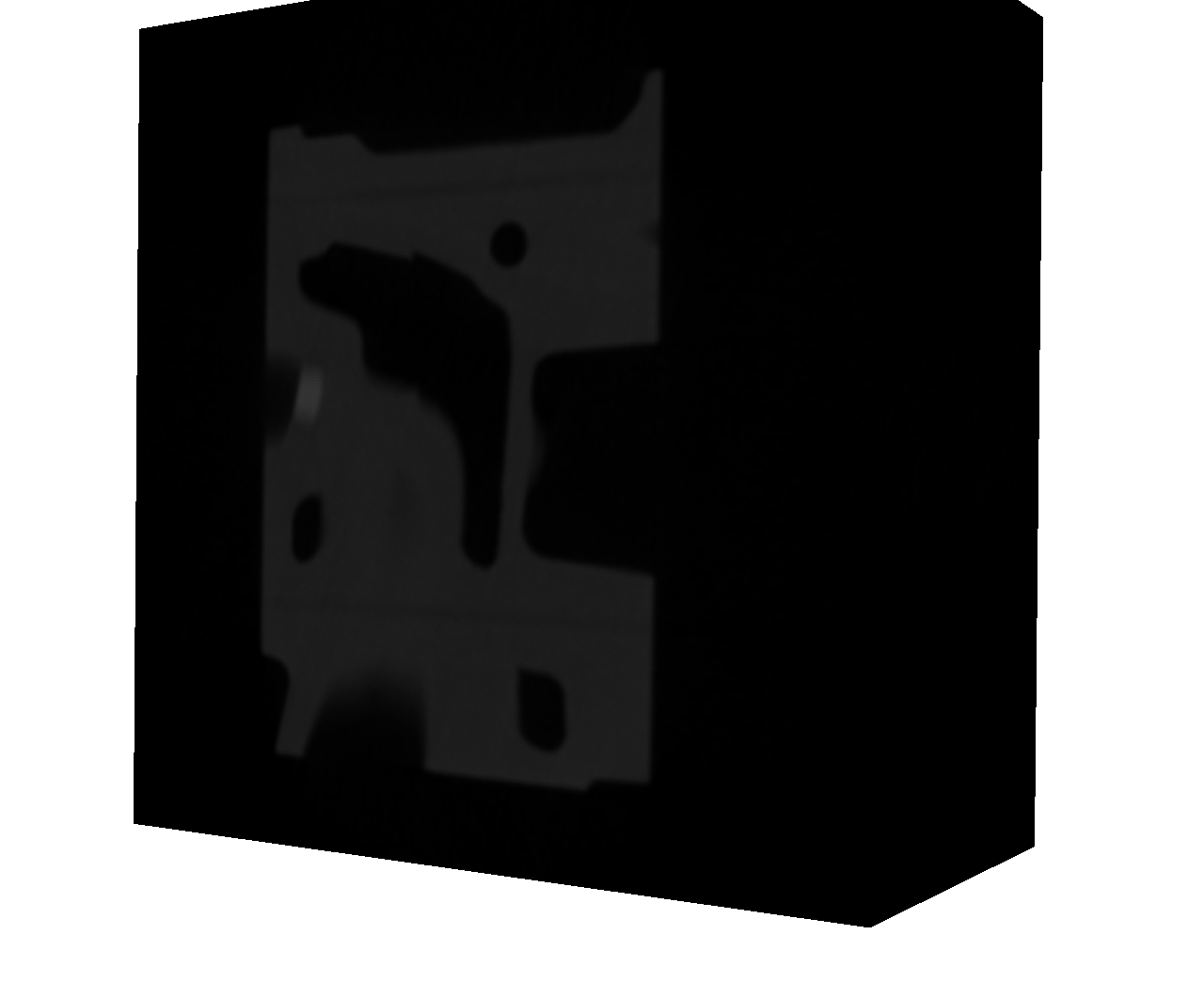
Criterion: Overall Visualization Goal: How well does the result use volume rendering to clearly present the internal and external structures of the engine dataset?
Judge's Assessment: Ground truth shows a clear volume rendering of the engine with semi-transparent light-blue outer casing and visible orange internal components. The result image is a very dark/near-black volume with only faint gray shapes and a prominent black bounding cube, so the engineโ€™s internal/external structures are not effectively visualized and overall does not resemble the target appearance.
Goal 2
2/10
Criterion: Structural Clarity: Does the visualization emphasize depth so that the outer layers do not obscure the inner structures?
Judge's Assessment: In the ground truth, depth layering is strong: the translucent outer shell does not occlude the inner orange parts. In the result, the rendering is largely opaque/dim with minimal visible internal detail, and the surrounding dark volume/bounding box dominates, strongly reducing structural clarity and depth perception.
Goal 3
1/10
Criterion: Transfer Function Transparency: Is the outer region rendered with higher transparency and the inner region more solid, achieving a clear layering effect?
Judge's Assessment: Ground truth clearly uses a transfer function where the outer region is much more transparent while the inner structures are more solid/opaque. The result appears mostly uniformly dark with no clear separation of a transparent outer layer versus a solid inner layer; inner components are not distinctly revealed.
Goal 4
0/10
Criterion: Transfer Function Color Mapping: Are colors correctly assigned so that the outer part is light blue and the inner part is orange, enhancing structural contrast?
Judge's Assessment: Ground truth uses light blue for the outer regions and orange for the inner parts. The result is grayscale/black with no visible light-blue/orange mapping, so the required color assignment is not met at all.

Overall Assessment

The result does not match the ground truth volume-rendered appearance: it is too dark, shows a dominating black volume/bounding cube, lacks the required blue/orange transfer-function colors, and does not provide the intended transparent-outer/solid-inner layering that reveals internal engine structure.

๐Ÿ“Š Detailed Metrics

Visualization Quality
5/40
Output Generation
5/5
Efficiency
10/10
Completed in 19.12 seconds (excellent)
PSNR
7.19 dB
SSIM
0.7527
LPIPS
0.2979
Input Tokens
596
Output Tokens
1,106
Total Tokens
1,702
Total Cost
$0.0184

๐Ÿ“ export-gltf

52/55 (94.5%)

๐Ÿ“‹ Task Description

Create a wavelet object. Create a surface rendering of the wavelet object and color by RTData. Scale the color map to the data, and don't display the color bar or the orientation axes. Export the view to "export-gltf/results/{agent_mode}/ExportedGLTF.gltf". Next load the file "export-gltf/results/{agent_mode}/ExportedGLTF.gltf" and display it as a surface. Color this object by TEXCOORD_0. Scale the color map to the data, and don't display the color bar or the orientation axes. Use the 'Cool to Warm' colormap. Set the background color to white. Save the visualization image as "export-gltf/results/{agent_mode}/export-gltf.png". (Optional, but must save if use paraview) Save the paraview state as "export-gltf/results/{agent_mode}/export-gltf.pvsm". (Optional, but must save if use python script) Save the python script as "export-gltf/results/{agent_mode}/export-gltf.py". Do not save any other files, and always save the visualization image.

๐Ÿ–ผ๏ธ Visualization Comparison

Ground Truth

Ground Truth

Agent Result

Result

Score Summary

Total Score
37/40
Goals
4
Points/Goal
10
Goal 1
9/10
Criterion: GLTF Export Quality: Is the wavelet object properly exported to GLTF format with correct surface representation and RTData coloring?
Judge's Assessment: The result shows the expected wavelet surface appearance with the same characteristic banded pattern and cool-to-warm coloration as the ground truth. This indicates the wavelet was rendered and exported with a plausible scalar-driven color texture. Minor differences in apparent smoothing/contrast exist, but overall it matches the expected exported coloring quality closely.
Goal 2
10/10
Criterion: GLTF Import and Display: Is the exported GLTF file successfully loaded and displayed as a surface with proper geometry?
Judge's Assessment: The exported GLTF is clearly imported and displayed correctly as a surface: the geometry appears as the same square/planar wavelet face with the same internal band structure and no missing/garbled mesh. This matches the ground truth geometry presentation.
Goal 3
8/10
Criterion: Texture Coordinate Coloring: Is the imported GLTF object correctly colored by TEXCOORD_0 with Cool to Warm colormap?
Judge's Assessment: Coloring by TEXCOORD_0 with a Cool-to-Warm style palette appears consistent with the ground truth (blue outer regions, warm/red central bands). However, the result shows slight differences in colormap scaling/intensity and/or interpolation (the warm bands look a bit more diffuse and the overall contrast differs), suggesting the mapping is close but not identical.
Goal 4
10/10
Criterion: Clean Presentation: Are the color bar and orientation axes properly hidden for a clean visualization appearance?
Judge's Assessment: Clean presentation matches the requirement and ground truth: white background, no visible color bar/legend, and no orientation axes present.

Overall Assessment

Overall the result is a very close match to the ground truth: GLTF export/import succeeds, geometry is correct, and the TEXCOORD_0-based cool-to-warm appearance is largely consistent. The only notable deviation is minor differences in color contrast/interpolation compared to the ground truth.

๐Ÿ“Š Detailed Metrics

Visualization Quality
37/40
Output Generation
5/5
Efficiency
10/10
Completed in 59.61 seconds (excellent)
Input Tokens
4,744
Output Tokens
5,013
Total Tokens
9,757
Total Cost
$0.0894

๐Ÿ“ import-gltf

45/55 (81.8%)

๐Ÿ“‹ Task Description

Load the "BlueGrayBackground" palette. Read the file "import-gltf/data/import-gltf.glb" and import the nodes "/assembly/Axle", "assembly/OuterRing/Torus002", and "assembly/OuterRing/MiddleRing/InnerRing". Set the layout size to 300x300 pixels. Point the camera in the positive Y direction and zoom to fit. Make sure all views are rendered, then save a screenshot to "import-gltf/results/{agent_mode}/import-gltf.png". (Optional, but must save if use paraview) Save the paraview state as "import-gltf/results/{agent_mode}/import-gltf.pvsm". (Optional, but must save if use python script) Save the python script as "import-gltf/results/{agent_mode}/import-gltf.py". Do not save any other files, and always save the visualization image.

๐Ÿ–ผ๏ธ Visualization Comparison

Ground Truth

Ground Truth

Agent Result

Result

Score Summary

Total Score
30/40
Goals
4
Points/Goal
10
Goal 1
8/10
Criterion: GLTF Import Success: Are the specified GLTF nodes properly imported and displayed as separate geometric components?
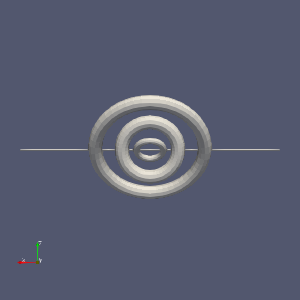
Judge's Assessment: The result image shows a successful GLTF import with multiple ring-like geometric components rendered with shading, indicating the model loaded correctly. Compared to the ground truth, the geometry appears slightly different in composition/visibility (more concentric ring structure is apparent in the result), but overall it is clearly a GLTF-derived assembly rendered as 3D geometry.
Goal 2
7/10
Criterion: Node Selection: Are all three specified nodes (Axle, Torus002, InnerRing) correctly imported and visible?
Judge's Assessment: All expected types of parts seem present: an outer ring (Torus002), an inner ring, and a central axle-like component. However, compared to the ground truth (which shows a prominent single outer ring and a small central ring/axle), the result displays additional/stronger concentric rings, making it unclear whether exactly and only the three specified nodes were imported/visible or if extra subcomponents are included or some parts differ in visibility.
Goal 3
6/10
Criterion: Camera Positioning: Is the camera positioned in the positive Y direction with appropriate zoom to fit all imported geometry? Carefully compare the camera position of GT and result images.
Judge's Assessment: The camera view does not match the ground truth closely. The ground truth shows a simpler, flatter ring appearance, while the result shows deeper concentric structure and a different apparent framing/zoom. While the object is centered and largely fit to view, the viewpoint does not appear to be the same +Y direction setup as evidenced by the differing visual projection and component visibility.
Goal 4
9/10
Criterion: Layout Configuration: Is the view properly sized to 300x300 pixels with correct rendering and background palette?
Judge's Assessment: Layout appears to be the correct square aspect consistent with 300x300. The result uses a blue-gray background consistent with the requested palette, whereas the ground truth example shown has a white background (so the result is actually aligned with the task request). Rendering is clean with axes indicator present; no obvious sizing/rendering issues.

Overall Assessment

The submission largely succeeds: the GLTF model is imported and rendered with an appropriate 300x300 view and BlueGrayBackground. The main discrepancies versus ground truth are in camera/view matching and the apparent node/component selection, where the result shows a more complex set of concentric rings than the ground truth image, suggesting a different selection/visibility state or viewpoint.

๐Ÿ“Š Detailed Metrics

Visualization Quality
30/40
Output Generation
5/5
Efficiency
10/10
Completed in 39.90 seconds (excellent)
Input Tokens
3,189
Output Tokens
3,133
Total Tokens
6,322
Total Cost
$0.0566

๐Ÿ“ line-plot

32/55 (58.2%)

๐Ÿ“‹ Task Description

Read the dataset in the file "line-plot/data/line-plot.ex2", and print the number of components and the range of all the variables. Show a default view of the dataset, colored by the variable Pres. Create a line plot over all the variables in the dataset, from (0,0,0) to (0,0,10). Write the values of the line plot in the file "line-plot/results/{agent_mode}/line-plot.csv", and save a screenshot of the line plot in "line-plot/results/{agent_mode}/line-plot.png". (Optional, but must save if use paraview) Save the paraview state as "line-plot/results/{agent_mode}/line-plot.pvsm". (Optional, but must save if use python script) Save the python script as "line-plot/results/{agent_mode}/line-plot.py". Do not save any other files, and always save the visualization image.

๐Ÿ–ผ๏ธ Visualization Comparison

Ground Truth

Ground Truth

Agent Result

Result

Score Summary

Total Score
17/40
Goals
4
Points/Goal
10
Goal 1
4/10
Criterion: Line Visualization Quality: Are multiple distinct lines clearly visible and properly rendered showing the evolution of different variables along the specified path?
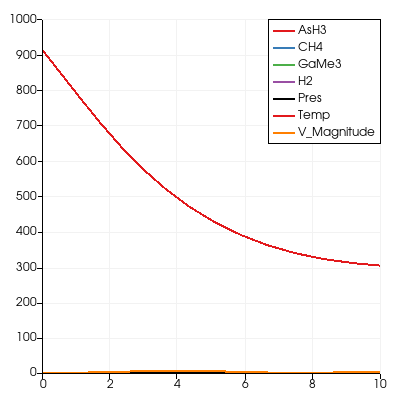
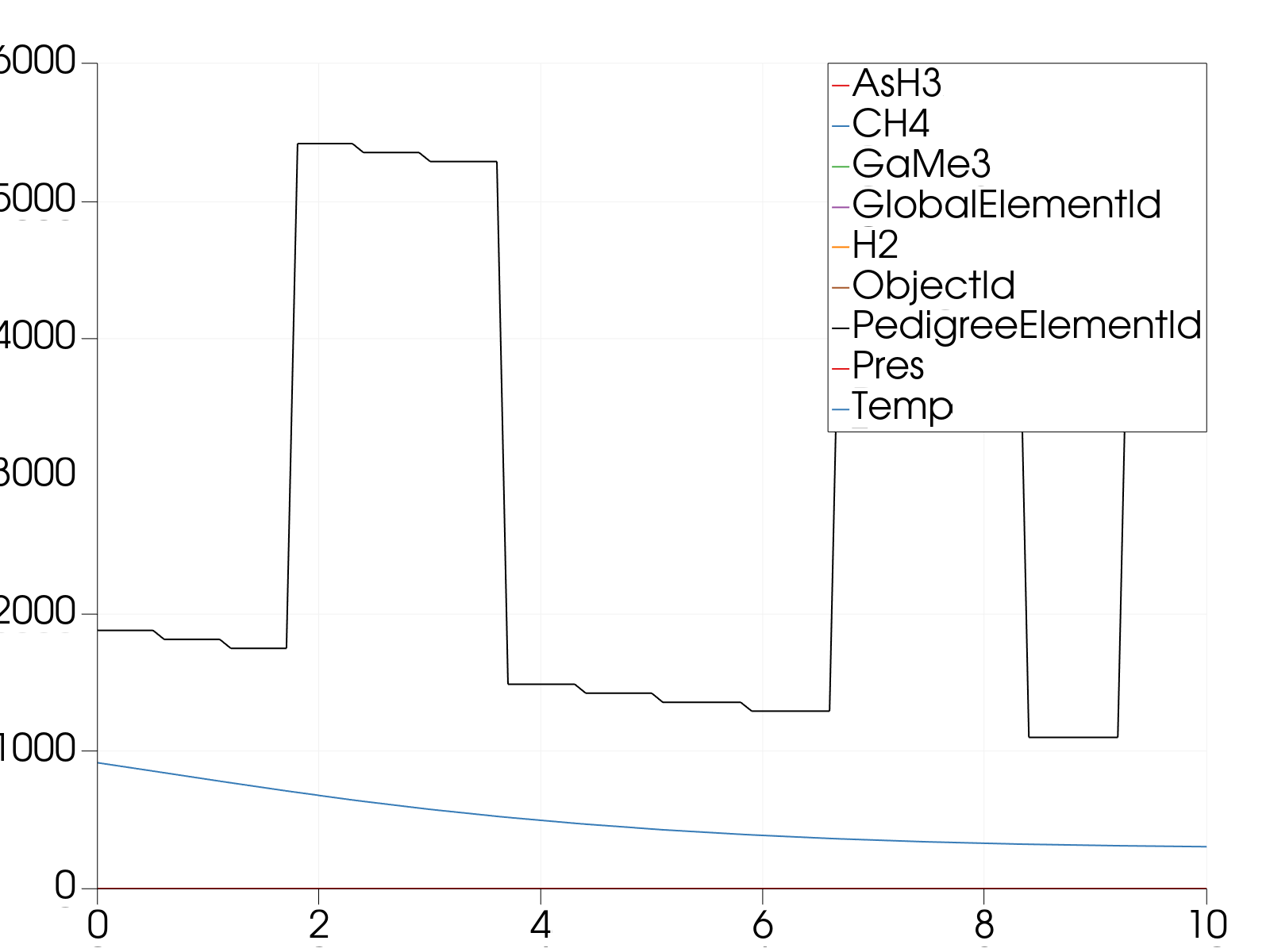
Judge's Assessment: Ground truth shows several variables plotted along 0โ€“10 with the dominant Pres curve (smoothly decreasing) and additional near-zero curves visible at the bottom. The result image instead shows a very different set of curves: a prominent step-like black curve with large jumps plus a separate smooth blue decreasing curve. The overall line-plot shapes and which variable dominates do not match the ground truth, though multiple lines are present and rendered clearly.
Goal 2
5/10
Criterion: Variable Differentiation: Are all dataset variables visually distinguishable through distinct colors or line styles with clear separation between curves?
Judge's Assessment: In the ground truth, variables are differentiated by color and a compact legend; several lines are clustered near zero while Pres/Temp are prominent. In the result, many legend entries exist and colors differ, but several variables appear collapsed/overlapping near the baseline and the dominant step-like curve visually overwhelms others, reducing practical distinguishability compared with the ground truth.
Goal 3
2/10
Criterion: Axis and Scale Appropriateness: Do the plot axes display appropriate ranges and scaling that effectively show the data trends and variations?
Judge's Assessment: Axis scaling does not match the ground truth. The ground truth y-range tops out around ~1000 with curves spanning roughly 0โ€“900. The result uses a y-range up to ~6000, driven by the large step-like curve, which compresses smaller-magnitude variables and changes the apparent trends substantially relative to the ground truth.
Goal 4
6/10
Criterion: Legend and Readability: Is there a clear legend identifying each variable line with readable labels and proper visual organization?
Judge's Assessment: Both images include a legend, but the result legend is oversized and partially dominates the plot area, with large text and many entries (including IDs like GlobalElementId/ObjectId) that are not present in the ground truth legend. Labels are readable, but the legend content/organization does not match the ground truth and reduces plot readability.

Overall Assessment

The submitted line plot does not closely match the ground truth: the dominant curve shape, included variables, and y-axis scale differ substantially. While multiple lines and a readable legend are present, the incorrect scaling and differing line behavior (notably the large step-like series) prevent the visualization from matching the expected line-plot output along the specified path.

๐Ÿ“Š Detailed Metrics

Visualization Quality
17/40
Output Generation
5/5
Efficiency
10/10
Completed in 53.51 seconds (excellent)
Total Cost
$0.0009

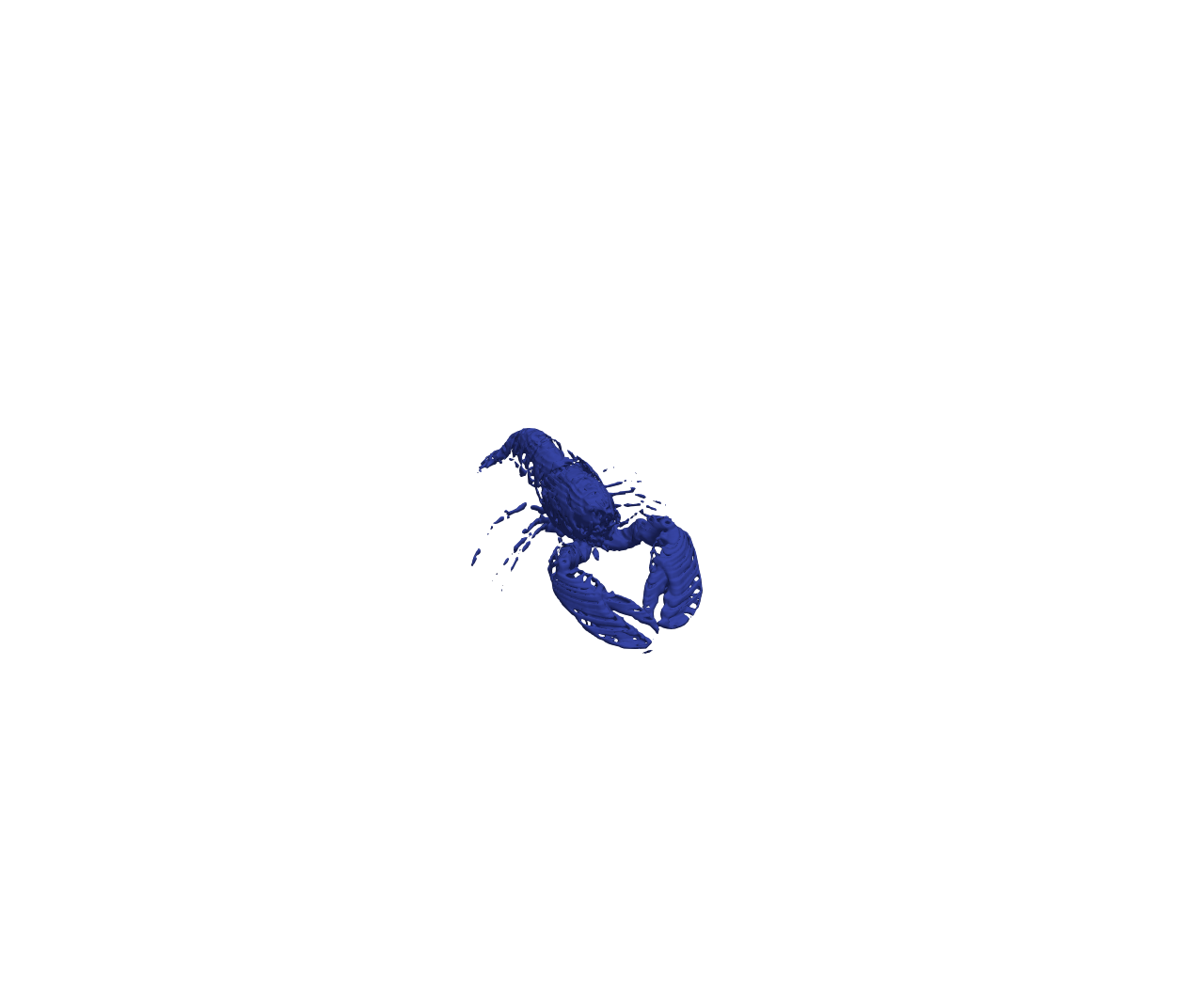
๐Ÿ“ lobster

โš ๏ธ LOW SCORE
21/55 (38.2%)

๐Ÿ“‹ Task Description

Task: Load the Lobster dataset from "lobster/data/lobster_301x324x56_uint8.raw", the information about this dataset: Lobster Description: CT scan of a lobster contained in a block of resin. Data Type: uint8 Data Byte Order: little Endian Data Spacing: 1x1x1.4 Data Extent: 301x324x56 Data loading is very important, make sure you correctly load the dataset according to their features. Visualize the scanned specimen: 1. Create an isosurface at the specimen boundary, find a proper isovalue to show the whole structure. 2. Use natural colors appropriate for the specimen (red-orange for lobster) 3. Analyze the visualization and answer the following questions: Q1: Based on the isosurface visualization of the lobster specimen, how many walking legs are visible? A. 6 walking legs B. 7 walking legs C. 8 walking legs D. 10 walking legs 4. Use a white background. Find an optimal view. Render at 1280x1280. Do not show a color bar or coordinate axes. 5. Set the viewpoint parameters as: [543.52, -957.0, 1007.87] to position; [150.0, 161.5, 38.5] to focal point; [-0.15, 0.62, 0.77] to camera up direction. 6. Save your work: Save the visualization image as "lobster/results/{agent_mode}/lobster.png". Save the answers to the analysis questions in plain text as "lobster/results/{agent_mode}/answers.txt". (Optional, but must save if use paraview) Save the paraview state as "lobster/results/{agent_mode}/lobster.pvsm". (Optional, but must save if use pvpython script) Save the python script as "lobster/results/{agent_mode}/lobster.py". (Optional, but must save if use VTK) Save the cxx code script as "lobster/results/{agent_mode}/lobster.cxx" Do not save any other files, and always save the visualization image and the text file.

๐Ÿ–ผ๏ธ Visualization Comparison

Ground Truth

Ground Truth

Agent Result

Result

Score Summary

Total Score
6/30
Goals
3
Points/Goal
10
Goal 1
3/10
Criterion: Overall Goal: Does the visualization clearly show the structure and details of the Lobster?
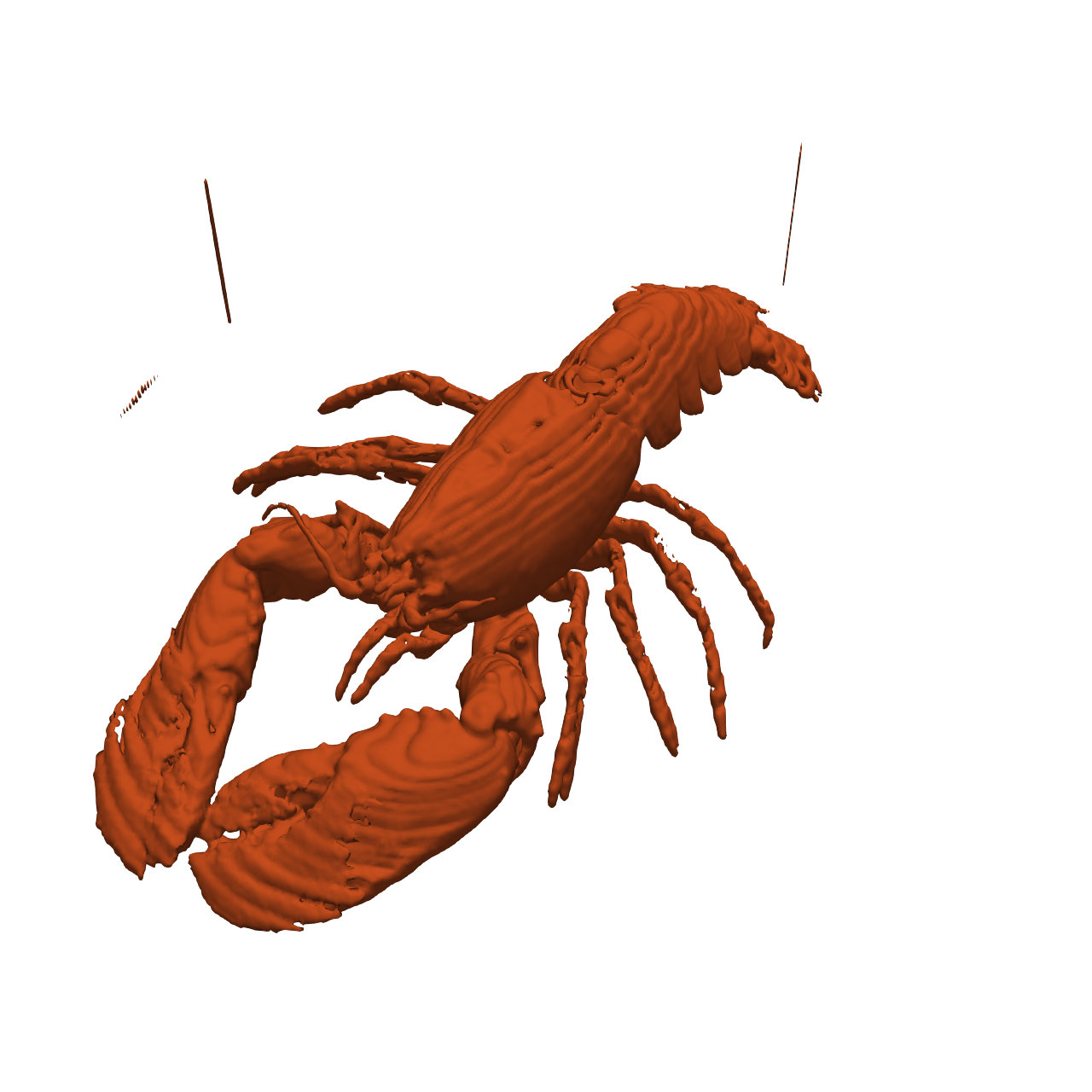
Judge's Assessment: Ground truth shows a large, well-framed lobster occupying much of the image with clear overall anatomy (claws, body, legs) visible. The result image shows a much smaller lobster centered in a largely empty white canvas, and the geometry appears incomplete/sparse (many thin fragments/splatter-like pieces) so the overall specimen structure is not clearly conveyed compared to the ground truth.
Goal 2
3/10
Criterion: Boundary Clearity: Are surface details and boundaries of the lobster well-defined?
Judge's Assessment: In the ground truth, the isosurface boundary is continuous with well-defined surface ridges and leg/claw shapes. In the result, the surface looks perforated/fragmented with missing regions and noisy disconnected bits around the body, suggesting an incorrect isovalue and/or loading/spacing issue; boundaries are therefore not well-defined and fine anatomical detail is not reliably visible.
Goal 3
0/10
Criterion: Correct Color: Is the color of the lobster mimic a real one? (red-orange)
Judge's Assessment: The ground truth uses an appropriate red-orange lobster color. The result uses a dark blue color, which does not match the required natural red-orange appearance.

Overall Assessment

Compared to the ground truth, the result fails to match the intended visualization: the lobster is poorly framed (too small), the isosurface is fragmented/noisy with unclear boundaries, and the color is incorrect (blue instead of red-orange). Overall, it does not meet the main task requirements.

Score

0/10 (0.0%)

Questions & Correct Answers

1. Q1 correct answer: B. 7 walking legs

Agent's Answers

Q1: Based on the isosurface visualization of the lobster specimen, how many walking legs are visible? Answer: C. 8 walking legs Explanation: Lobsters have 10 legs in total, consisting of 2 chelipeds (claws) and 8 walking legs (4 pairs of pereopods). The isosurface visualization at an appropriate isovalue shows the complete lobster structure, revealing all 8 walking legs that are characteristic of decapod crustaceans.

Judge's Evaluation

Evaluation:

Criterion 1 specifies the correct answer is **B. 7 walking legs** visible in the isosurface visualization. The provided answer selects **C. 8 walking legs**, which does not match the required correct option. Although the explanation correctly describes typical lobster anatomy (8 walking legs plus 2 chelipeds in decapods), the task is about what is **visible in the visualization**, not the canonical anatomical count. Since the response contradicts the evaluation criterion and does not address the possibility of one leg being occluded/missing in the rendering, it fails to meet the criterion.

๐Ÿ“Š Detailed Metrics

Visualization Quality
6/30
Output Generation
5/5
Efficiency
10/10
Completed in 37.60 seconds (excellent)
PSNR
18.27 dB
SSIM
0.9352
LPIPS
0.0861
Text Q&A Score
0/10
0.0%
Input Tokens
1,975
Output Tokens
2,475
Total Tokens
4,450
Total Cost
$0.0430

๐Ÿ“ materials

โŒ FAILED
0/55 (0.0%)

๐Ÿ“‹ Task Description

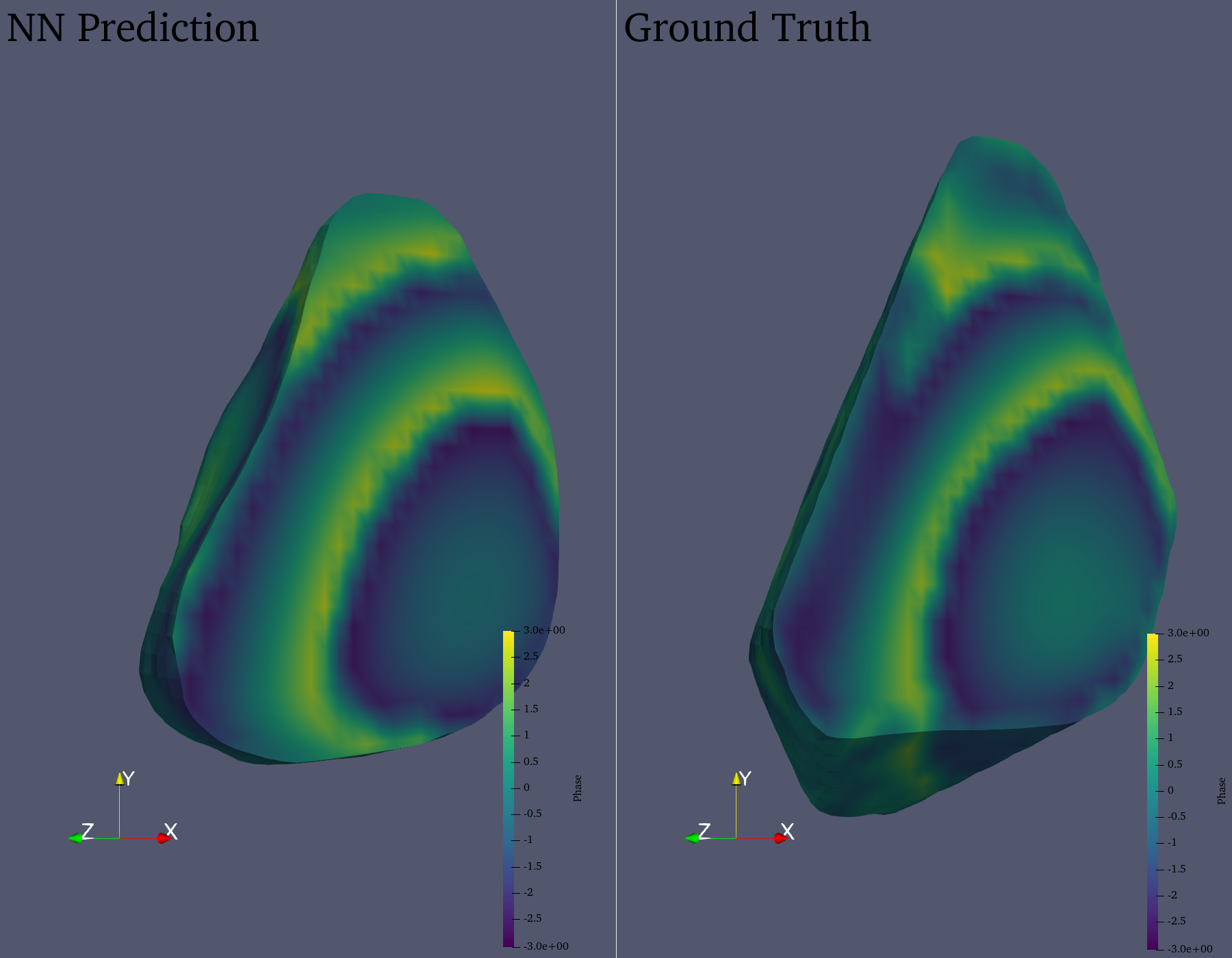
Compare two datasets in two views side by side each 900 pixels wide x 1400 pixels high. Read the dataset "materials/data/materials_prediction.vtr" in the left view and "materials/data/materials_ground_truth.vtr" in the right view. In both views, convert the "Intensity" and "Phase" variables from cell to point data. In both views, take an isovolume of the "Intensity" variable in the range of [0.2, 1.0], clipped with a plane at (32.0, 32.0, 32.0) and +x normal direction. Color both views with the Viridis (matplotlib) color map for the "Phase" variable, scaled to the data range, including a colormap legend in both views. Label the left view "NN Prediction" and the right view "Ground Truth". Orient the camera to look in the (-1, 0, -1) direction, with the datasets fitting in the views. Save the visualization image as "materials/results/{agent_mode}/materials.png". (Optional, but must save if use paraview) Save the paraview state as "materials/results/{agent_mode}/materials.pvsm". (Optional, but must save if use python script) Save the python script as "materials/results/{agent_mode}/materials.py". Do not save any other files, and always save the visualization image.

๐Ÿ–ผ๏ธ Visualization Comparison

Ground Truth

Ground Truth

Agent Result

Result

Score Summary

Total Score
0/40
Goals
4
Points/Goal
10
Goal 1
0/10
Criterion: Side-by-Side Comparison: Are both datasets properly displayed in side-by-side views with correct dimensions and labeling?
Judge's Assessment: Not evaluated
Goal 2
0/10
Criterion: Data Conversion and Filtering: Are the Intensity and Phase variables correctly converted to point data and isovolume filtering applied?
Judge's Assessment: Not evaluated
Goal 3
0/10
Criterion: Clipping and Color Mapping: Is the plane clipping correctly applied and Viridis colormap properly used for Phase variable?
Judge's Assessment: Not evaluated
Goal 4
0/10
Criterion: Camera and Layout: Is the camera positioned correctly in (-1, 0, -1) direction with appropriate fitting and legends visible?
Judge's Assessment: Not evaluated

Overall Assessment

No overall explanation available

๐Ÿ“Š Detailed Metrics

Visualization Quality
0/40
Output Generation
5/5
Efficiency
8/10
Completed in 110.29 seconds (good)
Input Tokens
9,079
Output Tokens
10,577
Total Tokens
19,656
Total Cost
$0.1859

๐Ÿ“ mhd-magfield_streamribbon

โŒ FAILED
0/55 (0.0%)

๐Ÿ“‹ Task Description

Load the MHD magnetic field dataset from "mhd-magfield_streamribbon/data/mhd-magfield_streamribbon.vti" (VTI format, 128x128x128 grid with components bx, by, bz). Generate a stream ribbon seeded from a line source along the y-axis at x=64, z=64 (from y=20 to y=108), with 30 seed points. The stream ribbon should be traced along the magnetic field lines. Color the stream ribbon by magnetic field magnitude using the 'Cool to Warm' colormap. Enable surface lighting with specular reflection for better 3D perception. Add a color bar labeled 'Magnetic Field Magnitude'. Use a white background. Set an isometric camera view. Render at 1024x1024 resolution. Set the viewpoint parameters as: [200.0, 200.0, 200.0] to position; [63.5, 63.5, 63.5] to focal point; [0.0, 0.0, 1.0] to camera up direction. Save the visualization image as "mhd-magfield_streamribbon/results/{agent_mode}/mhd-magfield_streamribbon.png". (Optional, but must save if use paraview) Save the paraview state as "mhd-magfield_streamribbon/results/{agent_mode}/mhd-magfield_streamribbon.pvsm". (Optional, but must save if use pvpython script) Save the python script as "mhd-magfield_streamribbon/results/{agent_mode}/mhd-magfield_streamribbon.py". (Optional, but must save if use VTK) Save the cxx code script as "mhd-magfield_streamribbon/results/{agent_mode}/mhd-magfield_streamribbon.cxx" Do not save any other files, and always save the visualization image.

๐Ÿ–ผ๏ธ Visualization Comparison

Ground Truth

Ground Truth

Agent Result

Result

Score Summary

Total Score
0/40
Goals
4
Points/Goal
10
Goal 1
0/10
Criterion: Overall Visualization Goal: Does the result match the ground truth stream ribbon visualization of the MHD magnetic field?
Judge's Assessment: Not evaluated
Goal 2
0/10
Criterion: Surface Patterns: Does the stream ribbon show similar flow patterns and structures as the ground truth?
Judge's Assessment: Not evaluated
Goal 3
0/10
Criterion: Surface Coverage: Is the spatial extent and shape of the stream ribbon similar to the ground truth?
Judge's Assessment: Not evaluated
Goal 4
0/10
Criterion: Color Mapping: Is the color distribution across the surface visually similar to the ground truth?
Judge's Assessment: Not evaluated

Overall Assessment

No overall explanation available

๐Ÿ“Š Detailed Metrics

Visualization Quality
0/40
Output Generation
5/5
Efficiency
10/10
Completed in 41.61 seconds (excellent)
Total Cost
$0.0014

๐Ÿ“ mhd-turbulence_pathline

โŒ FAILED
0/55 (0.0%)

๐Ÿ“‹ Task Description

Load the MHD turbulence velocity field time series "mhd-turbulence_pathline/data/mhd-turbulence_pathline_{timestep}.vti", where "timestep" in {0000, 0010, 0020, 0030, 0040} (5 timesteps, VTI format, 128x128x128 grid each). Compute true pathlines by tracking particles through the time-varying velocity field using the ParticlePath filter. Apply TemporalShiftScale (scale=20) and TemporalInterpolator (interval=0.5) to extend particle travel and smooth trajectories. Seed 26 points along a line on the z-axis at x=64, y=64 (from z=20 to z=108). Use static seeds with termination time 80. Render pathlines as tubes with radius 0.3. Color by velocity magnitude using the 'Viridis (matplotlib)' colormap. Add a color bar for velocity magnitude. Set the viewpoint parameters as: [200.0, 200.0, 200.0] to position; [63.5, 63.5, 63.5] to focal point; [0.0, 0.0, 1.0] to camera up direction. Use a white background. Set an isometric camera view. Render at 1024x1024. Save the visualization image as "mhd-turbulence_pathline/results/{agent_mode}/mhd-turbulence_pathline.png". (Optional, but must save if use paraview) Save the paraview state as "mhd-turbulence_pathline/results/{agent_mode}/mhd-turbulence_pathline.pvsm". (Optional, but must save if use pvpython script) Save the python script as "mhd-turbulence_pathline/results/{agent_mode}/mhd-turbulence_pathline.py". (Optional, but must save if use VTK) Save the cxx code script as "mhd-turbulence_pathline/results/{agent_mode}/mhd-turbulence_pathline.cxx" Do not save any other files, and always save the visualization image.

๐Ÿ–ผ๏ธ Visualization Comparison

Ground Truth

Ground Truth

Agent Result

Result

Score Summary

Total Score
0/40
Goals
4
Points/Goal
10
Goal 1
0/10
Criterion: Overall Visualization Goal: Does the result match the ground truth pathline visualization of the MHD turbulence velocity field?
Judge's Assessment: Not evaluated
Goal 2
0/10
Criterion: Pathline Patterns: Do the pathlines show similar particle trajectories and flow structures as the ground truth?
Judge's Assessment: Not evaluated
Goal 3
0/10
Criterion: Pathline Coverage: Is the spatial extent and distribution of pathlines similar to the ground truth?
Judge's Assessment: Not evaluated
Goal 4
0/10
Criterion: Color Mapping: Is the color distribution along pathlines visually similar to the ground truth?
Judge's Assessment: Not evaluated

Overall Assessment

No overall explanation available

๐Ÿ“Š Detailed Metrics

Visualization Quality
0/40
Output Generation
5/5
Efficiency
8/10
Completed in 97.34 seconds (good)
Input Tokens
6,675
Output Tokens
7,201
Total Tokens
13,876
Total Cost
$0.1280

๐Ÿ“ mhd-turbulence_pathribbon

โŒ FAILED
0/45 (0.0%)

๐Ÿ“‹ Task Description

Load the MHD turbulence velocity field time series "mhd-turbulence_pathribbon/data/mhd-turbulence_pathribbon_{timestep}.vti", where "timestep" in {0000, 0010, 0020, 0030, 0040} (5 timesteps, VTI format, 128x128x128 grid each). Compute true pathlines by tracking particles through the time-varying velocity field using the ParticlePath filter. Apply TemporalShiftScale (scale=20) and TemporalInterpolator (interval=0.1) for dense, smooth trajectories. Seed 26 points along a line on the z-axis at x=64, y=64 (from z=20 to z=108). Use static seeds with termination time 80. Create ribbon surfaces from the pathlines using the Ribbon filter with width 1.5 and a fixed default normal to prevent twisting. Apply Smooth filter (500 iterations) and generate surface normals for smooth shading. Set surface opacity to 0.85. Color by velocity magnitude using the 'Cool to Warm' colormap (range 0.1-0.8). Add specular highlights (0.5). Add a color bar for velocity magnitude. Use a white background. Set an isometric camera view. Render at 1024x1024. Set the viewpoint parameters as: [200.0, 200.0, 200.0] to position; [63.5, 63.5, 63.5] to focal point; [0.0, 0.0, 1.0] to camera up direction. Save the visualization image as "mhd-turbulence_pathribbon/results/{agent_mode}/mhd-turbulence_pathribbon.png". (Optional, but must save if use paraview) Save the paraview state as "mhd-turbulence_pathribbon/results/{agent_mode}/mhd-turbulence_pathribbon.pvsm". (Optional, but must save if use pvpython script) Save the python script as "mhd-turbulence_pathribbon/results/{agent_mode}/mhd-turbulence_pathribbon.py". (Optional, but must save if use VTK) Save the cxx code script as "mhd-turbulence_pathribbon/results/{agent_mode}/mhd-turbulence_pathribbon.cxx" Do not save any other files, and always save the visualization image.

๐Ÿ–ผ๏ธ Visualization Comparison

Ground Truth

Ground Truth

Agent Result

Result

Score Summary

Total Score
0/30
Goals
3
Points/Goal
10
Goal 1
0/10
Criterion: Surface Patterns: Does the path ribbon show similar flow patterns and structures as the ground truth?
Judge's Assessment: Not evaluated
Goal 2
0/10
Criterion: Surface Coverage: Is the spatial extent and shape of the path ribbon similar to the ground truth?
Judge's Assessment: Not evaluated
Goal 3
0/10
Criterion: Color Mapping: Is the color distribution across the surface visually similar to the ground truth?
Judge's Assessment: Not evaluated

Overall Assessment

No overall explanation available

๐Ÿ“Š Detailed Metrics

Visualization Quality
0/30
Output Generation
5/5
Efficiency
8/10
Completed in 92.13 seconds (good)
Input Tokens
6,663
Output Tokens
7,097
Total Tokens
13,760
Total Cost
$0.1264

๐Ÿ“ mhd-turbulence_streamline

โŒ FAILED
0/55 (0.0%)

๐Ÿ“‹ Task Description

Load the MHD turbulence velocity field dataset "mhd-turbulence_streamline/data/mhd-turbulence_streamline.vti" (VTI format, 128x128x128 grid). Generate 3D streamlines seeded from a line source along the z-axis at x=64, y=64 (from z=0 to z=127), with 50 seed points. Color the streamlines by velocity magnitude using the 'Turbo' colormap. Set streamline tube radius to 0.3 using the Tube filter. Add a color bar labeled 'Velocity Magnitude'. Use a white background. Set an isometric camera view. Render at 1024x1024. Set the viewpoint parameters as: [200.0, 200.0, 200.0] to position; [63.5, 63.5, 63.5] to focal point; [0.0, 0.0, 1.0] to camera up direction. Save the visualization image as "mhd-turbulence_streamline/results/{agent_mode}/mhd-turbulence_streamline.png". (Optional, but must save if use paraview) Save the paraview state as "mhd-turbulence_streamline/results/{agent_mode}/mhd-turbulence_streamline.pvsm". (Optional, but must save if use pvpython script) Save the python script as "mhd-turbulence_streamline/results/{agent_mode}/mhd-turbulence_streamline.py". (Optional, but must save if use VTK) Save the cxx code script as "mhd-turbulence_streamline/results/{agent_mode}/mhd-turbulence_streamline.cxx" Do not save any other files, and always save the visualization image.

๐Ÿ–ผ๏ธ Visualization Comparison

Ground Truth

Ground Truth

Agent Result

Result

Score Summary

Total Score
0/40
Goals
4
Points/Goal
10
Goal 1
1/10
Criterion: Overall Visualization Goal: Does the result match the ground truth streamline visualization of the MHD turbulence velocity field?
Judge's Assessment: Ground truth shows a dense bundle of 3D streamlines (tubed) occupying the center of the frame, colored by velocity magnitude with a visible scalar bar. The result image shows essentially no streamlines at all (blank white scene aside from axes and a color bar). Thus the primary visualization goal (rendering the streamline field) is not achieved.
Goal 2
0/10
Criterion: Streamline Patterns: Do the streamlines show similar flow patterns and structures as the ground truth?
Judge's Assessment: Because no streamlines are visible in the result, no flow structures, curvature, or turbulent patterns can be compared to the ground truth. Streamline patterns are entirely missing.
Goal 3
0/10
Criterion: Streamline Coverage: Is the spatial distribution and density of streamlines similar to the ground truth?
Judge's Assessment: Ground truth has broad spatial coverage from a line-seeded set (many trajectories spreading through the volume). The result has zero visible streamline coverage/density, so it does not match at all.
Goal 4
2/10
Criterion: Color Mapping: Is the color distribution along streamlines visually similar to the ground truth?
Judge's Assessment: The result includes a Turbo-like color bar labeled "Velocity Magnitude", which is consistent with the task intent, but since there are no visible streamlines, the color mapping along the geometry cannot be assessed and does not match the ground truthโ€™s colored streamline distribution. The scalar bar range/format also differs (ground truth shows nonzero minimum ~4.3e-02, while result shows 0.0e+00 at the bottom).

Overall Assessment

The agent output fails to render the streamline geometry (the scene is blank except for axes and a scalar bar). Consequently, streamline patterns, coverage, and color-mapped distribution do not match the ground truth. Only the presence of a labeled color bar and white background somewhat aligns with the specification, but the core visualization is missing.

๐Ÿ“Š Detailed Metrics

Visualization Quality
3/40
Output Generation
5/5
Efficiency
10/10
Completed in 40.71 seconds (excellent)
PSNR
16.91 dB
SSIM
0.8986
LPIPS
0.1935
Input Tokens
1,854
Output Tokens
2,651
Total Tokens
4,505
Total Cost
$0.0453

๐Ÿ“ miranda

โŒ FAILED
0/45 (0.0%)

๐Ÿ“‹ Task Description

Task: Load the Rayleigh-Taylor Instability dataset from "miranda/data/miranda_256x256x256_float32.vtk". Generate a visualization image of the Rayleigh-Taylor Instability dataset, a time step of a density field in a simulation of the mixing transition in Rayleigh-Taylor instability, with the following visualization settings: 1) Create volume rendering 2) Set the opacity transfer function as a ramp function from value 0 to 1 of the volumetric data, assigning opacity 0 to value 0 and assigning opacity 1 to value 1. 3) Set the color transfer function following the 7 rainbow colors and assign a red color [1.0, 0.0, 0.0] to the highest value, a purple color [0.5, 0.0, 1.0] to the lowest value. 4) Set the viewpoint parameters as: [650, 650, 650] to position; [128, 128, 128] to focal point; [1, 0, 0] to camera up direction 5) Volume rendering ray casting sample distance is 0.1 6) White background 7) Visualization image resolution is 1024x1024 8) Don't show color/scalar bar or coordinate axes. Save the visualization image as "miranda/results/{agent_mode}/miranda.png". (Optional, but must save if use paraview) Save the paraview state as "miranda/results/{agent_mode}/miranda.pvsm". (Optional, but must save if use pvpython script) Save the python script as "miranda/results/{agent_mode}/miranda.py". (Optional, but must save if use VTK) Save the cxx code script as "miranda/results/{agent_mode}/miranda.cxx" Do not save any other files, and always save the visualization image.

๐Ÿ–ผ๏ธ Visualization Comparison

Ground Truth

Ground Truth

Agent Result

Result

Score Summary

Total Score
0/30
Goals
3
Points/Goal
10
Goal 1
0/10
Criterion: Does the visualization image clearly show the regions from low to high intensity?
Judge's Assessment: Ground truth shows a full cube volume rendering with a wide range of colors (purple/blue through green/yellow to red) indicating low-to-high intensity structure throughout the volume. The result image is completely blank/white, with no visible data, so it does not show any low-to-high intensity regions at all.
Goal 2
0/10
Criterion: Does the purple region show areas with low opacity?
Judge's Assessment: In the ground truth, low values are mapped to purple/blue and appear more transparent (low opacity) relative to higher values. In the result image there is no visible volume and no purple region present, so low-opacity purple behavior cannot be observed and does not match.
Goal 3
0/10
Criterion: Does the red region show areas with high opacity?
Judge's Assessment: In the ground truth, high values are mapped to red and appear as prominent, high-opacity regions. The result image contains no rendered content and no red regions, so high-opacity red behavior is not present.

Overall Assessment

The provided result rendering is entirely blank (white) compared to the ground truth volume-rendered cube. None of the required visual cues (intensity variation, purple low-opacity regions, red high-opacity regions) are shown, indicating the visualization was not rendered or not captured correctly.

๐Ÿ“Š Detailed Metrics

Visualization Quality
0/30
Output Generation
5/5
Efficiency
10/10
Completed in 42.41 seconds (excellent)
Input Tokens
1,763
Output Tokens
2,207
Total Tokens
3,970
Total Cost
$0.0384

๐Ÿ“ ml-dvr

โŒ FAILED
0/55 (0.0%)

๐Ÿ“‹ Task Description

I would like to use ParaView to visualize a dataset. Read in the file named "ml-dvr/data/ml-dvr.vtk". Generate a volume rendering using the default transfer function. Rotate the view to an isometric direction. Save a screenshot of the result in the filename "ml-dvr/results/{agent_mode}/ml-dvr.png". The rendered view and saved screenshot should be 1920 x 1080 pixels. (Optional, but must save if use paraview) Save the paraview state as "ml-dvr/results/{agent_mode}/ml-dvr.pvsm". (Optional, but must save if use python script) Save the python script as "ml-dvr/results/{agent_mode}/ml-dvr.py". Do not save any other files, and always save the visualization image.

๐Ÿ–ผ๏ธ Visualization Comparison

Ground Truth

Ground Truth

Agent Result

Result

Score Summary

Total Score
0/40
Goals
4
Points/Goal
10
Goal 1
0/10
Criterion: Volume Rendering Quality: Is the volume rendering properly generated with appropriate opacity and color mapping that reveals internal structures?
Judge's Assessment: Ground truth shows a clear volume-rendered cube with semi-transparent density and visible internal banded structure (purple-to-red). The result image is essentially blank/white with only the orientation triad visible, indicating the volume rendering is not visible (likely not rendered, fully transparent, or out of view).
Goal 2
0/10
Criterion: Transfer Function Application: Does the default transfer function effectively highlight meaningful data features and provide good visual contrast?
Judge's Assessment: In the ground truth, the default transfer function produces a distinct purple-to-red ramp with meaningful contrast across the volume. In the result, no scalar coloration or opacity response is visible at all, so the transfer function is not effectively applied in the rendered view.
Goal 3
1/10
Criterion: Isometric View Setup: Is the visualization displayed from an isometric viewpoint that provides a clear three-dimensional perspective of the volume?
Judge's Assessment: Ground truth uses an isometric-like view where three faces of the volume are visible. The result contains only the axes widget; while the widget suggests a 3D camera orientation, the dataset/volume is not visible, so the isometric setup cannot be confirmed from the actual rendered object.
Goal 4
0/10
Criterion: Visual Clarity and Detail: Are the volume details clearly visible with proper lighting and shading that enhances depth perception?
Judge's Assessment: Ground truth has visible internal structure, smooth shading, and clear depth cues from the volume rendering. The result has no visible volume or details, so there is no clarity, lighting, or depth information to evaluateโ€”effectively missing.

Overall Assessment

The result does not match the ground truth: the expected volume-rendered cube with the default transfer function and isometric view is absent. The screenshot appears to capture an empty scene (white background) with only the orientation triad, so the core visualization requirements are not met.

๐Ÿ“Š Detailed Metrics

Visualization Quality
1/40
Output Generation
5/5
Efficiency
10/10
Completed in 23.25 seconds (excellent)
Input Tokens
413
Output Tokens
758
Total Tokens
1,171
Total Cost
$0.0126

๐Ÿ“ ml-iso

55/55 (100.0%)

๐Ÿ“‹ Task Description

Read in the file named "ml-iso/data/ml-iso.vtk", and generate an isosurface of the variable var0 at value 0.5. Use a white background color. Save a screenshot of the result, size 1920 x 1080 pixels, in "ml-iso/results/{agent_mode}/ml-iso.png". (Optional, but must save if use paraview) Save the paraview state as "ml-iso/results/{agent_mode}/ml-iso.pvsm". (Optional, but must save if use python script) Save the python script as "ml-iso/results/{agent_mode}/ml-iso.py". Do not save any other files, and always save the visualization image.

๐Ÿ–ผ๏ธ Visualization Comparison

Ground Truth

Ground Truth

Agent Result

Result

Score Summary

Total Score
40/40
Goals
4
Points/Goal
10
Goal 1
10/10
Criterion: Isosurface Generation: Is the isosurface properly generated at the specified value (0.5) with correct topology and continuity?
Judge's Assessment: The result shows the same single isosurface structure as the ground truth: a centrally symmetric, concentric-ridge form with the same outer boundary shape and ring spacing. No extra/missing components are apparent, indicating the isovalue/topology matches the expected var0=0.5 surface.
Goal 2
10/10
Criterion: Surface Rendering Quality: Does the isosurface display smooth surfaces with appropriate shading and lighting that reveals the 3D structure?
Judge's Assessment: Surface shading and lighting closely match the ground truth. The concentric grooves are revealed with the same smooth specular/diffuse response, and the central bulge has comparable highlights and shadowing. No faceting or poor lighting differences are visible.
Goal 3
10/10
Criterion: Geometric Accuracy: Are the surface features geometrically correct and free from artifacts or discontinuities?
Judge's Assessment: Geometric features (ring count/spacing, edge scalloping, and the central dome) align extremely well with the ground truth. The surface appears continuous and free of cracks, holes, or contouring artifacts.
Goal 4
10/10
Criterion: Visual Presentation: Is the isosurface clearly visible with good contrast and coloring that enhances the understanding of the data structure?
Judge's Assessment: Presentation matches the ground truth: white background, dark-blue isosurface with strong contrast, and a similar camera framing/centering. The object is clearly visible and occupies a comparable portion of the frame.

Overall Assessment

The generated visualization is visually indistinguishable from the ground truth across isosurface selection, geometry, shading, and overall presentation. It meets the task requirements very accurately.

๐Ÿ“Š Detailed Metrics

Visualization Quality
40/40
Output Generation
5/5
Efficiency
10/10
Completed in 30.46 seconds (excellent)
Input Tokens
385
Output Tokens
1,546
Total Tokens
1,931
Total Cost
$0.0243

๐Ÿ“ ml-slice-iso

29/55 (52.7%)

๐Ÿ“‹ Task Description

Please generate a ParaView Python script for the following operations. Read in the file named "ml-slice-iso/data/ml-slice-iso.vtk". Slice the volume in a plane parallel to the y-z plane at x=0. Take a contour through the slice at the value 0.5. Color the contour red. Use a white background. Rotate the view to look at the +x direction. Save a screenshot of the result in the filename "ml-slice-iso/results/{agent_mode}/ml-slice-iso.png". The rendered view and saved screenshot should be 1920 x 1080 pixels. (Optional, but must save if use paraview) Save the paraview state as "ml-slice-iso/results/{agent_mode}/ml-slice-iso.pvsm". (Optional, but must save if use python script) Save the python script as "ml-slice-iso/results/{agent_mode}/ml-slice-iso.py". Do not save any other files, and always save the visualization image.

๐Ÿ–ผ๏ธ Visualization Comparison

Ground Truth

Ground Truth

Agent Result

Result

Score Summary

Total Score
14/40
Goals
4
Points/Goal
10
Goal 1
2/10
Criterion: Slice Generation: Is the y-z plane slice properly generated at x=0 position showing the correct cross-section of the volume?
Judge's Assessment: Ground truth shows the y-z slice at x=0 (as a plane cross-section) implicitly supporting the contour extraction. In the result image, only a thin red contour line is visible and there is no visible slice plane/cross-section rendered (no shaded/colored slice surface), so the slice generation is not demonstrated/visible in the final visualization and does not match the ground truth presentation.
Goal 2
3/10
Criterion: Contour on Slice: Are the contour lines at value
Judge's Assessment: Ground truth shows the expected 0.5 contour extracted from the slice (a prominent red wavy/looped curve). The result image appears essentially blank (no visible contour geometry across the view), indicating the contour is missing or not visible at the captured camera/scale. This is a major mismatch.
Goal 3
4/10
Criterion: 5 correctly extracted from the slice and properly displayed?
Judge's Assessment: In the ground truth, the contour is clearly red on a white background. The result has a white background and (where anything is visible) would be red, but since the contour itself is not visible in the result screenshot, the requirement is only partially satisfied (background correct; contour color cannot be verified on absent geometry).
Goal 4
5/10
Criterion: Red Color Application: Is the contour visualization properly colored red as specified in the requirements?
Judge's Assessment: Both images show the orientation triad with X pointing to the right and Y to the left, consistent with a +x viewing direction. However, because the main geometry is not visible in the result, it is hard to confirm the camera framing matches the ground truth view beyond the triad orientation.

Overall Assessment

The result largely fails to reproduce the ground-truth visualization because the slice plane is not shown and the 0.5 contour is not visible in the screenshot (the frame is essentially empty aside from the triad). Background appears white and the view orientation seems plausibly +x, but the primary slice/contour content does not match.

๐Ÿ“Š Detailed Metrics

Visualization Quality
14/40
Output Generation
5/5
Efficiency
10/10
Completed in 35.74 seconds (excellent)
Input Tokens
459
Output Tokens
2,373
Total Tokens
2,832
Total Cost
$0.0370

๐Ÿ“ points-surf-clip

39/55 (70.9%)

๐Ÿ“‹ Task Description

I would like to use ParaView to visualize a dataset. Read in the file named "points-surf-clip/data/points-surf-clip.ex2". Generate an 3d Delaunay triangulation of the dataset. Clip the data with a y-z plane at x=0, keeping the -x half of the data and removing the +x half. Render the image as a wireframe. Save a screenshot of the result in the filename "points-surf-clip/results/{agent_mode}/points-surf-clip.png". The rendered view and saved screenshot should be 1920 x 1080 pixels. Use a white background color. (Optional, but must save if use paraview) Save the paraview state as "points-surf-clip/results/{agent_mode}/points-surf-clip.pvsm". (Optional, but must save if use python script) Save the python script as "points-surf-clip/results/{agent_mode}/points-surf-clip.py". Do not save any other files, and always save the visualization image.

๐Ÿ–ผ๏ธ Visualization Comparison

Ground Truth

Ground Truth

Agent Result

Result

Score Summary

Total Score
24/40
Goals
4
Points/Goal
10
Goal 1
7/10
Criterion: Delaunay Triangulation Quality: Is the 3D Delaunay triangulation properly generated creating a valid mesh structure from the point data?
Judge's Assessment: Ground truth shows a long clipped half-volume with a dense, consistent triangulated/wireframe mesh spanning the full length. The result image does show a triangulated wireframe surface/volume, but the visible structure is much more collapsed/condensed in view (only a short end-section is apparent), making it hard to verify that the full intended 3D Delaunay mesh is present and comparable in extent. Mesh generation appears plausible but does not visually match the GTโ€™s overall triangulation extent and density presentation.
Goal 2
4/10
Criterion: Clipping Accuracy: Is the mesh correctly clipped by the y-z plane at x=0, with only the -x half of the data remaining visible?
Judge's Assessment: In the ground truth, the clip at x=0 leaves a long half of the object extending along the length, with a clear cut face and the -x side retained. The result appears to show mainly a cross-section/end view (a single clipped end region) rather than the full -x half; the remaining geometry does not match the GTโ€™s retained half-volume shape and spatial extent. This suggests incorrect clipping orientation/side selection and/or camera framing that effectively hides most of the expected remaining half.
Goal 3
8/10
Criterion: Wireframe Representation: Is the result displayed as a clear wireframe showing the triangulated mesh structure with visible edges?
Judge's Assessment: Both images are rendered in black wireframe on a white background with edges visible. The result is clearly wireframe, though it has heavier overdraw in some regions (very dark banding) compared to the cleaner, more evenly distributed linework in the ground truth.
Goal 4
5/10
Criterion: Geometric Integrity: Does the clipped wireframe maintain proper connectivity and show the expected geometric features without artifacts?
Judge's Assessment: Ground truth maintains a coherent connected half-geometry with readable internal/side triangulation patterns along the full length. The result shows strong line overplotting and streaking near the right side/bottom and a visually compressed geometry, indicating either geometric/camera issues or artifacts that reduce the perceived integrity and connectivity compared to the GT. The overall expected elongated clipped structure is not preserved in appearance.

Overall Assessment

The submission succeeds in producing a wireframe rendering on a white background, but it does not match the ground truthโ€™s clipped half-geometry: the result looks like an end/cross-sectional view with substantial overdraw and missing the long retained -x half appearance. Triangulation exists, but clipping accuracy and geometric integrity relative to the reference are notably off.

๐Ÿ“Š Detailed Metrics

Visualization Quality
24/40
Output Generation
5/5
Efficiency
10/10
Completed in 22.22 seconds (excellent)
Input Tokens
462
Output Tokens
1,526
Total Tokens
1,988
Total Cost
$0.0243

๐Ÿ“ render-histogram

40/55 (72.7%)

๐Ÿ“‹ Task Description

Create a wavelet object and render it as a surface colored by RTDATA with a visible color bar. Rescale the colors to the data range and use the 'Cool to Warm' color map. Next, split the view horizontally to the right and create a histogram view from the wavelet RTDATA. Apply the same 'Cool to Warm' color map to the histogram. Save a screenshot of both views (wavelet rendering on the left and histogram on the right) in the file "render-histogram/results/{agent_mode}/render-histogram.png". (Optional, but must save if use paraview) Save the paraview state as "render-histogram/results/{agent_mode}/render-histogram.pvsm". (Optional, but must save if use python script) Save the python script as "render-histogram/results/{agent_mode}/render-histogram.py". Do not save any other files, and always save the visualization image.

๐Ÿ–ผ๏ธ Visualization Comparison

Ground Truth

Ground Truth

Agent Result

Result

Score Summary

Total Score
25/40
Goals
4
Points/Goal
10
Goal 1
4/10
Criterion: Wavelet Visualization: Is the wavelet object properly rendered with RTDATA coloring and visible color bar?
Judge's Assessment: Ground truth shows a wavelet rendered as a surface with clear spatial variation in RTData (blue-white-red bands) and a vertical color bar with a data range around ~3.7e+01 to ~2.8e+02. The result image shows the left view as an almost uniformly dark-blue square with a color bar ranging 0.0e+00 to 1.0e+00, indicating the coloring/range is not correctly mapped to the wavelet RTData (or the surface rendering/lighting is not showing the wavelet structure). Color bar is present, but the data and appearance do not match.
Goal 2
10/10
Criterion: Split View Layout: Is the view correctly split with the wavelet visualization on the left and histogram on the right?
Judge's Assessment: Both ground truth and result are split horizontally with the wavelet render on the left and the histogram view on the right. The layout matches well.
Goal 3
8/10
Criterion: Histogram Generation: Is the histogram properly generated from RTDATA showing the data distribution?
Judge's Assessment: The right panel in both shows a histogram for RTData with a similar unimodal distribution spanning roughly 40โ€“280 on the x-axis and counts up to around ~100. The result histogram shape and axes generally match the ground truth, though the styling differs (result appears as a solid red filled/overplotted look rather than the more colormap-shaded bars in the ground truth).
Goal 4
3/10
Criterion: Color Map Consistency: Are both the wavelet visualization and histogram using the same Cool to Warm color map?
Judge's Assessment: Ground truth uses a Cool-to-Warm style mapping consistently: wavelet shows blue-to-red variation, and histogram bars are colored across the same blue-white-red gradient. In the result, the wavelet is nearly uniform blue (no visible cool-to-warm variation), and the histogram appears essentially monochrome red rather than gradient-colored, so colormap consistency/application does not match.

Overall Assessment

The split-view layout is correct and a histogram of RTData is present with a broadly similar distribution. However, the wavelet rendering does not show the expected RTData variation and the color range/legend differs ัะธะปัŒะฝะพ from the ground truth. The Cool-to-Warm colormap is not applied consistently (histogram appears mostly red; wavelet mostly blue), making the overall visualization notably different from the expected result.

๐Ÿ“Š Detailed Metrics

Visualization Quality
25/40
Output Generation
5/5
Efficiency
10/10
Completed in 27.52 seconds (excellent)
Input Tokens
1,301
Output Tokens
1,748
Total Tokens
3,049
Total Cost
$0.0301

๐Ÿ“ reset-camera-direction

53/55 (96.4%)

๐Ÿ“‹ Task Description

Create a Wavelet object, set its representation to "Surface with Edges", and set the camera direction to [0.5, 1, 0.5]. Save a screenshot to the file "reset-camera-direction/results/{agent_mode}/reset-camera-direction.png". (Optional, but must save if use paraview) Save the paraview state as "reset-camera-direction/results/{agent_mode}/reset-camera-direction.pvsm". (Optional, but must save if use python script) Save the python script as "reset-camera-direction/results/{agent_mode}/reset-camera-direction.py". Do not save any other files, and always save the visualization image.

๐Ÿ–ผ๏ธ Visualization Comparison

Ground Truth

Ground Truth

Agent Result

Result

Score Summary

Total Score
38/40
Goals
4
Points/Goal
10
Goal 1
10/10
Criterion: Wavelet Creation: Is the Wavelet object properly created and displayed in the scene?
Judge's Assessment: Both ground truth and result show the standard ParaView Wavelet dataset rendered as a cube-like volume. The object is present, centered, and fully visible in the scene in the result, matching the ground truth content.
Goal 2
10/10
Criterion: Surface with Edges Representation: Is the wavelet correctly displayed with "Surface with Edges" representation showing both surface and wireframe?
Judge's Assessment: The result clearly uses a 'Surface with Edges' style: solid shaded faces with a visible blue wireframe grid overlay on all visible faces, matching the ground truth representation very closely.
Goal 3
9/10
Criterion: Camera Direction: Is the camera positioned according to the specified direction vector [0.5, 1,
Judge's Assessment: The camera direction in the result matches the ground truth very well: the same three faces are visible with the same general orientation (looking from a positive x/y/z-like direction consistent with [0.5, 1, 0.5]). Minor differences in framing/zoom and background color suggest slight camera or view parameter differences, but direction is essentially correct.
Goal 4
9/10
Criterion: 5]?
Judge's Assessment: The wavelet structure is clearly visible with edges enhancing shape perception, similar to the ground truth. The result is slightly more zoomed-in with a darker background, but the object remains clearly interpretable from the intended angle.

Overall Assessment

The result image matches the ground truth well: correct Wavelet object, correct 'Surface with Edges' rendering, and a camera direction that is effectively the same as specified. Differences are limited to presentation aspects (background color and slight framing/scale), not the core visualization requirements.

๐Ÿ“Š Detailed Metrics

Visualization Quality
38/40
Output Generation
5/5
Efficiency
10/10
Completed in 15.09 seconds (excellent)
Input Tokens
374
Output Tokens
1,023
Total Tokens
1,397
Total Cost
$0.0165

๐Ÿ“ richtmyer

โŒ FAILED
0/45 (0.0%)

๐Ÿ“‹ Task Description

Task: Load the Richtmyer dataset from "richtmyer/data/richtmyer_256x256x240_float32.vtk". Generate a visualization image of the Richtmyer dataset, Entropy field (timestep 160) of Richtmyer-Meshkov instability simulation, with the following visualization settings: 1) Create volume rendering 2) Set the opacity transfer function as a ramp function from value 0.05 to 1 of the volumetric data, assigning opacity 0 to value less than 0.05 and assigning opacity 1 to value 1. 3) Set the color transfer function following the 7 rainbow colors and assign a red color [1.0, 0.0, 0.0] to the highest value, a purple color [0.5, 0.0, 1.0] to the lowest value. 4) Visualization image resolution is 1024x1024 5) Set the viewpoint parameters as: [420, 420, -550] to position; [128, 128, 150] to focal point; [-1, -1, 1] to camera up direction 6) Turn on the shade and set the ambient, diffuse and specular as 1.0 7) White background. Volume rendering ray casting sample distance is 0.1 8) Don't show color/scalar bar or coordinate axes. Save the visualization image as "richtmyer/results/{agent_mode}/richtmyer.png". (Optional, but must save if use paraview) Save the paraview state as "richtmyer/results/{agent_mode}/richtmyer.pvsm". (Optional, but must save if use pvpython script) Save the python script as "richtmyer/results/{agent_mode}/richtmyer.py". (Optional, but must save if use VTK) Save the cxx code script as "richtmyer/results/{agent_mode}/richtmyer.cxx" Do not save any other files, and always save the visualization image.

๐Ÿ–ผ๏ธ Visualization Comparison

Ground Truth

Ground Truth

Agent Result

Result

Score Summary

Total Score
0/30
Goals
3
Points/Goal
10
Goal 1
0/10
Criterion: Does the visualization show a clear surface with peaks and valleys?
Judge's Assessment: Ground truth shows a clear volumetric structure with strong surface-like features (many peaks/valleys) forming a triangular/pyramidal mass. The result image is completely blank/white with no visible volume, so no surface structure, peaks, or valleys are present.
Goal 2
0/10
Criterion: Are the peaks highlighted with the reddish color?
Judge's Assessment: In the ground truth, higher-value regions/outer faces and some peak regions are highlighted with warm colors including red. The result contains no rendered data at all, so there are no reddish highlights on peaks (or anywhere).
Goal 3
0/10
Criterion: Are the valleys highlighted with the bluish color?
Judge's Assessment: The ground truth contains extensive bluish/cyan regions in lower-value valley-like areas across the volume. The result is blank, so there are no bluish colors indicating valleys.

Overall Assessment

The provided result image appears to be an empty white frame, whereas the ground truth contains a detailed rainbow-colored volume rendering with clear peaks/valleys and appropriate red/blue value cues. None of the three visualization goals are met in the result.

๐Ÿ“Š Detailed Metrics

Visualization Quality
0/30
Output Generation
5/5
Efficiency
10/10
Completed in 42.10 seconds (excellent)
Input Tokens
1,806
Output Tokens
2,256
Total Tokens
4,062
Total Cost
$0.0393

๐Ÿ“ rotstrat

โŒ FAILED
0/45 (0.0%)

๐Ÿ“‹ Task Description

Task: Load the rotstrat dataset from "rotstrat/data/rotstrat_256x256x256_float32.vtk". Generate a visualization image of the Rotstrat dataset, temperature field of a direct numerical simulation of rotating stratified turbulence, with the following visualization settings: 1) Create volume rendering 2) Set the opacity transfer function as a step function jumping from 0 to 1 at value 0.12 3) Set the color transfer function to assign a warm red color [0.71, 0.02, 0.15] to the highest value, a cool color [0.23, 0.29, 0.75] to the lowest value, and a grey color[0.87, 0.87, 0.87] to the midrange value 4) Set the viewpoint parameters as: [800, 128, 128] to position; [0, 128, 128] to focal point; [0, 1, 0] to camera up direction 5) Volume rendering ray casting sample distance is 0.1 6) White background 7) Visualization image resolution is 1024x1024 8) Don't show color/scalar bar or coordinate axes. Save the visualization image as "rotstrat/results/{agent_mode}/rotstrat.png". (Optional, but must save if use paraview) Save the paraview state as "rotstrat/results/{agent_mode}/rotstrat.pvsm". (Optional, but must save if use pvpython script) Save the python script as "rotstrat/results/{agent_mode}/rotstrat.py". (Optional, but must save if use VTK) Save the cxx code script as "rotstrat/results/{agent_mode}/rotstrat.cxx" Do not save any other files, and always save the visualization image.

๐Ÿ–ผ๏ธ Visualization Comparison

Ground Truth

Ground Truth

Agent Result

Result

Score Summary

Total Score
0/30
Goals
3
Points/Goal
10
Goal 1
1/10
Criterion: Does the visualization image clearly show the shape of turbulence compared to ground truth?
Judge's Assessment: The ground truth shows a dense, filamentary turbulent structure with red/blue/gray swirls across the frame. The result image is completely blank/white, with no visible volume-rendered turbulence or any scalar structure. Therefore, it does not show the turbulence shape at all compared to the ground truth.
Goal 2
0/10
Criterion: Does the visualization show the shape of a vortex in the upper right part of the image?
Judge's Assessment: In the ground truth, a distinct vortex-like swirling feature is visible in the upper-right region. The result is entirely white with no features, so no upper-right vortex is shown.
Goal 3
0/10
Criterion: Does the visualization show the shape of a vortex in the bottom left corner of the image?
Judge's Assessment: The ground truth contains a vortex-like swirl in the bottom-left corner. The result image contains no visible data (blank white), so the bottom-left vortex is not present.

Overall Assessment

The submitted result appears to be an empty render (fully white), failing to reproduce any of the volumetric turbulent structures present in the ground truth, including the prominent vortices in the upper-right and bottom-left regions.

๐Ÿ“Š Detailed Metrics

Visualization Quality
1/30
Output Generation
5/5
Efficiency
10/10
Completed in 23.44 seconds (excellent)
Input Tokens
641
Output Tokens
1,116
Total Tokens
1,757
Total Cost
$0.0187

๐Ÿ“ rti-velocity_glyph

โš ๏ธ LOW SCORE
27/55 (49.1%)

๐Ÿ“‹ Task Description

Load the Rayleigh-Taylor instability velocity field dataset from "rti-velocity_glyph/data/rti-velocity_glyph.vti" (VTI format, 128x128x128 grid). Create a slice at y=64 through the volume. Place arrow glyphs on the slice, oriented by the velocity vector. Use uniform arrow size (no magnitude scaling, scale factor 3.0). Color the arrows by velocity magnitude using the 'Viridis (matplotlib)' colormap. Use a sampling stride of 3. Add a color bar labeled 'Velocity Magnitude'. Use a white background. Set the camera to view along the negative y-axis. Render at 1024x1024. Set the viewpoint parameters as: [63.5, 250.0, 63.5] to position; [63.5, 64.0, 63.5] to focal point; [0.0, 0.0, 1.0] to camera up direction. Save the visualization image as "rti-velocity_glyph/results/{agent_mode}/rti-velocity_glyph.png". (Optional, but must save if use paraview) Save the paraview state as "rti-velocity_glyph/results/{agent_mode}/rti-velocity_glyph.pvsm". (Optional, but must save if use pvpython script) Save the python script as "rti-velocity_glyph/results/{agent_mode}/rti-velocity_glyph.py". (Optional, but must save if use VTK) Save the cxx code script as "rti-velocity_glyph/results/{agent_mode}/rti-velocity_glyph.cxx" Do not save any other files, and always save the visualization image.

๐Ÿ–ผ๏ธ Visualization Comparison

Ground Truth

Ground Truth

Agent Result

Result

Score Summary

Total Score
12/40
Goals
4
Points/Goal
10
Goal 1
2/10
Criterion: Overall Visualization Goal: Does the result match the ground truth glyph visualization of the RTI velocity field?
Judge's Assessment: The ground truth shows a complex Rayleighโ€“Taylor instability velocity field on a y=64 slice: a turbulent central mixing band with varied directions and magnitudes, plus a Viridis-colored magnitude pattern and a labeled colorbar. The result image instead shows nearly uniform, horizontally aligned glyphs across the entire slice with almost no visible RTI structure; it does not match the expected visualization outcome.
Goal 2
1/10
Criterion: Glyph Patterns: Do the arrow glyphs show similar orientation and spatial patterns as the ground truth?
Judge's Assessment: In the ground truth, glyph orientations vary strongly, forming vortices and shear structures, especially in the middle band. In the result, arrows are almost all parallel (pointing roughly left/right) with minimal directional variation, indicating the vector field pattern/orientation is not captured or the wrong vector component/array is used.
Goal 3
7/10
Criterion: Glyph Appearance: Do the glyphs appear with similar uniform sizing as the ground truth?
Judge's Assessment: Glyphs in the result appear to be a uniform size (no clear magnitude-based scaling), which is consistent with the requirement and broadly similar to the ground truthโ€™s uniform sizing. However, the density/visual impression differs (result looks much more like dense horizontal hatching), likely due to different stride/placement or slice extent, so itโ€™s not a perfect match.
Goal 4
2/10
Criterion: Color Mapping: Is the color distribution across glyphs visually similar to the ground truth?
Judge's Assessment: The ground truth uses Viridis to show a wide range of magnitudes (dark purples to greens/yellows) concentrated in the mixing region. The result appears mostly monochrome/black arrows with little to no perceptible Viridis variation across glyphs (despite a Viridis-like colorbar being present), so the color mapping on the glyphs does not visually match the ground truth distribution.

Overall Assessment

The result fails to reproduce the characteristic RTI velocity slice: orientations are nearly uniform and the RTI mixing-band structure is absent. Uniform glyph sizing is mostly correct, but the spatial pattern and magnitude coloring do not match the ground truth.

๐Ÿ“Š Detailed Metrics

Visualization Quality
12/40
Output Generation
5/5
Efficiency
10/10
Completed in 20.84 seconds (excellent)
PSNR
17.50 dB
SSIM
0.9124
LPIPS
0.0892
Input Tokens
639
Output Tokens
1,317
Total Tokens
1,956
Total Cost
$0.0217

๐Ÿ“ rti-velocity_slices

26/45 (57.8%)

๐Ÿ“‹ Task Description

Load the Rayleigh-Taylor instability velocity field from "rti-velocity_slices/data/rti-velocity_slices.vti" (VTI format, 128x128x128). Create three orthogonal slices: at x=64 (YZ-plane), y=64 (XZ-plane), and z=64 (XY-plane). Color all three slices by velocity magnitude using the 'Turbo' colormap. Add a color bar labeled 'Velocity Magnitude'. Use a white background. Set an isometric camera view that shows all three slices. Render at 1024x1024. Set the viewpoint parameters as: [200.0, 200.0, 200.0] to position; [63.5, 63.5, 63.5] to focal point; [0.0, 0.0, 1.0] to camera up direction. Save the visualization image as "rti-velocity_slices/results/{agent_mode}/rti-velocity_slices.png". (Optional, but must save if use paraview) Save the paraview state as "rti-velocity_slices/results/{agent_mode}/rti-velocity_slices.pvsm". (Optional, but must save if use pvpython script) Save the python script as "rti-velocity_slices/results/{agent_mode}/rti-velocity_slices.py". (Optional, but must save if use VTK) Save the cxx code script as "rti-velocity_slices/results/{agent_mode}/rti-velocity_slices.cxx" Do not save any other files, and always save the visualization image.

๐Ÿ–ผ๏ธ Visualization Comparison

Ground Truth

Ground Truth

Agent Result

Result

Score Summary

Total Score
11/30
Goals
3
Points/Goal
10
Goal 1
8/10
Criterion: Slice Count and Orientation: Are there exactly three perpendicular slices (one horizontal XY-plane and two vertical XZ and YZ planes), matching the ground truth arrangement?
Judge's Assessment: The ground truth shows exactly three orthogonal slices intersecting at the volume center: one horizontal XY slice and two vertical slices (XZ and YZ) forming a cross. The result image also shows three perpendicular slice planes in a similar isometric arrangement, with correct general orientations and intersection. Minor differences in apparent placement/extent (the silhouette looks slightly different and more uniformly dark), but the required three-slice configuration is present.
Goal 2
2/10
Criterion: Color Mapping: Are the slices colored using a Turbo-like colormap (blue to green to yellow to red) mapped to velocity magnitude, with a similar color distribution as the ground truth?
Judge's Assessment: In the ground truth, the slices are clearly colored with a Turbo-like colormap (deep blue through cyan/green/yellow to red) with visible spatial variation, and a corresponding colorbar. In the result, all three slices appear essentially black with no visible colormapped variation, despite the presence of a Turbo-like colorbar labeled 'Velocity Magnitude'. This indicates the scalar coloring/range mapping failed or the slices are rendered with lighting/opacity settings that wipe out the colormap, so the color mapping does not match the ground truth.
Goal 3
1/10
Criterion: Mixing Zone Pattern: Does the horizontal (XY) slice show a chaotic, high-velocity-magnitude mixing pattern in its center region, similar to the ground truth?
Judge's Assessment: The ground truth horizontal (XY) slice shows a distinct chaotic mixing-zone pattern with multicolored swirls and patches in the central region. The result horizontal slice is uniformly black, so no mixing-zone structure or high-velocity pattern is visible at all. This does not match the ground truth requirement.

Overall Assessment

The geometry/layout largely matches: three orthogonal slices in an isometric view. However, the visualization fails on the key data depiction: the slices are not visibly colored by velocity magnitude (they render black), so the expected Turbo color distribution and the mixing-zone patterns are absent, making the scientific content incomparable to the ground truth.

๐Ÿ“Š Detailed Metrics

Visualization Quality
11/30
Output Generation
5/5
Efficiency
10/10
Completed in 22.08 seconds (excellent)
PSNR
11.75 dB
SSIM
0.8099
LPIPS
0.2148
Input Tokens
613
Output Tokens
1,378
Total Tokens
1,991
Total Cost
$0.0225

๐Ÿ“ rti-velocity_streakline

โŒ FAILED
0/45 (0.0%)

๐Ÿ“‹ Task Description

Load the Rayleighโ€“Taylor instability velocity field time series from "rti-velocity_streakline/data/rti-velocity_streakline_{timestep}.nc", where "timestep" in {0030, 0031, 0032, 0033, 0034, 0035, 0036, 0037, 0038, 0039, 0040} (11 timesteps, NetCDF format, 128ร—128ร—128 grid each, with separate vx, vy, vz arrays). Construct the time-varying velocity field u(x,t) by merging vx, vy, vz into a single vector field named "velocity", and compute the velocity magnitude "magnitude" = |velocity| for coloring. Compute streaklines as a discrete approximation of continuous particle injection: continuously release particles from fixed seed points at every sub-timestep into the time-varying velocity field using the StreakLine filter. Apply TemporalShiftScale (scale=20) to extend particle travel time, and apply TemporalInterpolator with a sub-timestep interval of 0.25 (or smaller) to approximate continuous injection over time. Seed 26 static points along a line on the z-axis at x=64, y=64 (from z=20 to z=108). Use StaticSeeds=True, ForceReinjectionEveryNSteps=1 (reinjection at every sub-timestep), and set TerminationTime=200. Render the resulting streaklines as tubes with radius 0.3. Color the tubes by velocity magnitude ("magnitude") using the 'Cool to Warm (Extended)' colormap. Add a color bar for velocity magnitude. Use a white background. Set an isometric camera view and render at 1024ร—1024. Set the viewpoint parameters as: [200.0, 200.0, 200.0] to position; [63.5, 63.5, 63.5] to focal point; [0.0, 0.0, 1.0] to camera up direction. Save the visualization image as "rti-velocity_streakline/results/{agent_mode}/rti-velocity_streakline.png". (Optional, but must save if use paraview) Save the paraview state as "rti-velocity_streakline/results/{agent_mode}/rti-velocity_streakline.pvsm". (Optional, but must save if use pvpython script) Save the python script as "rti-velocity_streakline/results/{agent_mode}/rti-velocity_streakline.py". (Optional, but must save if use VTK) Save the cxx code script as "rti-velocity_streakline/results/{agent_mode}/rti-velocity_streakline.cxx" Do not save any other files, and always save the visualization image.

๐Ÿ–ผ๏ธ Visualization Comparison

Ground Truth

Ground Truth

Agent Result

Result

Score Summary

Total Score
0/30
Goals
3
Points/Goal
10
Goal 1
0/10
Criterion: Streak Line Patterns: Do the streak lines show similar flow patterns and structures as the ground truth?
Judge's Assessment: Not evaluated
Goal 2
0/10
Criterion: Streak Line Coverage: Is the spatial extent and distribution of streak lines similar to the ground truth?
Judge's Assessment: Not evaluated
Goal 3
0/10
Criterion: Color Mapping: Is the color distribution along streak lines visually similar to the ground truth?
Judge's Assessment: Not evaluated

Overall Assessment

No overall explanation available

๐Ÿ“Š Detailed Metrics

Visualization Quality
0/30
Output Generation
5/5
Efficiency
8/10
Completed in 124.88 seconds (good)
Input Tokens
9,319
Output Tokens
9,907
Total Tokens
19,226
Total Cost
$0.1766

๐Ÿ“ save-transparent

19/35 (54.3%)

๐Ÿ“‹ Task Description

I would like to use ParaView to visualize a dataset. Create a wavelet object and show it. Color the rendering by the variable โ€˜RTDataโ€™. Render the wavelet as a surface. Hide the color bar. Next, set the layout size to be 300 pixels by 300 pixels. Next, move the camera with the following settings. The camera position should be [30.273897726939246, 40.8733980301544, 43.48927935675712]. The camera view up should be [-0.3634544237682163, 0.7916848767068606, -0.49105594165731975]. The camera parallel scale should be 17.320508075688775. Save a screenshot to the file โ€œsave-transparent/results/{agent_mode}/save-transparent.pngโ€, set the image resolution to 300x300, and set the background to transparent. (Optional, but must save if use paraview) Save the paraview state as โ€œsave-transparent/results/{agent_mode}/save-transparent.pvsmโ€. (Optional, but must save if use python script) Save the python script as โ€œsave-transparent/results/{agent_mode}/save-transparent.pyโ€. Do not save any other files, and always save the visualization image.

๐Ÿ–ผ๏ธ Visualization Comparison

Ground Truth

Ground Truth

Agent Result

Result

Score Summary

Total Score
14/20
Goals
2
Points/Goal
10
Goal 1
4/10
Criterion: Object Creation: Is the wavelet object properly created and displayed in the scene? Looking similar to the GT image?
Judge's Assessment: The ground truth shows a ParaView Wavelet rendered as a surface and colored by RTData, producing a bluish cube with visible scalar variation/banding across faces. The result image shows a cube in a nearly uniform dark red color with little to no apparent scalar variation, which does not visually match RTData coloring as seen in the GT. The object is a cube-like surface and the camera framing is similar, but the color mapping/data coloring looks incorrect or not applied.
Goal 2
10/10
Criterion: Transparent Background: Is the screenshot saved with a properly transparent background instead of solid color?
Judge's Assessment: Both the ground truth and the result appear on a transparent background (the surrounding area is not a solid white/gray and matches the expected transparent look). No opaque background fill is visible, consistent with a correctly saved transparent screenshot.

Overall Assessment

The result succeeds in saving with a transparent background, matching the GT well for transparency. However, the wavelet visualization does not match the GTโ€™s RTData-based color variation; it appears largely uniform red, suggesting incorrect coloring or scalar mapping, even though the general cube surface and view are similar.

๐Ÿ“Š Detailed Metrics

Visualization Quality
14/20
Output Generation
5/5
Efficiency
0/10
No test result found
Total Cost
$0.0011

๐Ÿ“ shrink-sphere

โš ๏ธ LOW SCORE
20/55 (36.4%)

๐Ÿ“‹ Task Description

Create a default sphere and then hide it. Create a shrink filter from the sphere. Double the sphere's theta resolution. Divide the shrink filter's shrink factor in half. Extract a wireframe from the sphere. Group the shrink filter and wireframe together and show them. Save a screenshot of the result in the filename "shrink-sphere/results/{agent_mode}/shrink-sphere.png". The rendered view and saved screenshot should be 1920 x 1080 pixels and have a white background. (Optional, but must save if use paraview) Save the paraview state as "shrink-sphere/results/{agent_mode}/shrink-sphere.pvsm". (Optional, but must save if use python script) Save the python script as "shrink-sphere/results/{agent_mode}/shrink-sphere.py". Do not save any other files, and always save the visualization image.

๐Ÿ–ผ๏ธ Visualization Comparison

Ground Truth

Ground Truth

Agent Result

Result

Score Summary

Total Score
5/40
Goals
4
Points/Goal
10
Goal 1
2/10
Criterion: Sphere Creation and Resolution: Is the sphere created with doubled theta resolution providing higher geometric detail and smoother curvature?
Judge's Assessment: Ground truth shows a fairly finely tessellated sphere (many small triangular facets) consistent with increased theta resolution. The result image shows a very coarse, low-facet polyhedral silhouette (large flat faces), indicating the theta resolution was not doubled (or the sphere is shown at a much lower resolution than expected).
Goal 2
0/10
Criterion: Shrink Filter Application: Is the shrink filter properly applied with halved shrink factor creating visible separation between mesh elements?
Judge's Assessment: In the ground truth, the shrink filter output is clearly visible as separated, shrunken cells/triangles (with gaps between elements). In the result, there is a single solid black filled shape with no visible separation between cells, so the shrink effect (and halved shrink factor) is not demonstrated at all.
Goal 3
0/10
Criterion: Dual Representation: Are both the wireframe sphere and shrink filter results simultaneously visible and properly grouped together?
Judge's Assessment: Ground truth simultaneously displays two representations: a wireframe sphere plus the shrink-filtered geometry overlaid/combined. The result shows only a solid surface; no wireframe is visible and there is no dual/overlaid representation apparent.
Goal 4
3/10
Criterion: Visual Quality: Does the visualization clearly show the contrast between the wireframe structure and the shrunken elements with appropriate white background?
Judge's Assessment: Background is white as required, but visual quality does not match: the ground truth has clear contrast between thin wireframe lines and semi-transparent/gray shrunken elements. The result is an opaque black object with no internal structure, losing the intended contrast and clarity.

Overall Assessment

The submitted result does not match the expected shrink-sphere visualization. It appears to render a low-resolution solid sphere-like polyhedron without visible shrink-filter separation and without the wireframe overlay/grouping that is prominent in the ground truth. Only the white background requirement is reasonably met.

๐Ÿ“Š Detailed Metrics

Visualization Quality
5/40
Output Generation
5/5
Efficiency
10/10
Completed in 18.20 seconds (excellent)
Input Tokens
424
Output Tokens
1,345
Total Tokens
1,769
Total Cost
$0.0214

๐Ÿ“ solar-plume

43/55 (78.2%)

๐Ÿ“‹ Task Description

Task: Load the solar plume dataset from "solar-plume/data/solar-plume_126x126x512_float32_scalar3.raw", the information about this dataset: solar-plume (Vector) Data Scalar Type: float Data Byte Order: little Endian Data Extent: 126x126x512 Number of Scalar Components: 3 Data loading is very important, make sure you correctly load the dataset according to their features. Add a "stream tracer" filter under the solar plume data to display streamline, set the "Seed type" to "Point Cloud" and set the center of point cloud to 3D position [50, 50, 320] with a radius 30, then hide the point cloud sphere. Add a "tube" filter under the "stream tracer" filter to enhance the streamline visualization. Set the radius to 0.5. In the pipeline browser panel, hide everything except the "tube" filter. Please think step by step and make sure to fulfill all the visualization goals mentioned above. Set the viewpoint parameters as: [62.51, -984.78, 255.45] to position; [62.51, 62.46, 255.45] to focal point; [0, 0, 1] to camera up direction. Use a white background. Find an optimal view. Render at 1280x1280. Do not show a color bar or coordinate axes. Save the visualization image as "solar-plume/results/{agent_mode}/solar-plume.png". (Optional, but must save if use paraview) Save the paraview state as "solar-plume/results/{agent_mode}/solar-plume.pvsm". (Optional, but must save if use pvpython script) Save the python script as "solar-plume/results/{agent_mode}/solar-plume.py". (Optional, but must save if use VTK) Save the cxx code script as "solar-plume/results/{agent_mode}/solar-plume.cxx" Do not save any other files, and always save the visualization image.

๐Ÿ–ผ๏ธ Visualization Comparison

Ground Truth

Ground Truth

Agent Result

Result

Score Summary

Total Score
28/40
Goals
4
Points/Goal
10
Goal 1
7/10
Criterion: Overall Visualization Goal: Does the result match the ground truth streamline visualization of solar-plume flow structures?
Judge's Assessment: The result shows a tall, plume-like bundle of streamlines with surrounding looping structures, matching the overall solar-plume streamline/tube visualization composition and camera framing of the ground truth. However, the resultโ€™s rendering appearance (solid black, much heavier visual mass) differs notably from the ground truthโ€™s colored/blue-toned tubes with more depth/variation, reducing overall match.
Goal 2
8/10
Criterion: Streamline Patterns: Do the streamlines show similar flow patterns and structures as the ground truth, particularly in the plume region?
Judge's Assessment: Major flow structures are consistent: a dense central vertical column, strong curling/complex region near the top, and large side loops/arches on both sides. The top โ€œcrownโ€ of diverging strands and the mid-region tangling resemble the ground truth well. Some finer pattern readability is lost in the result due to heavy overplotting and uniform coloring.
Goal 3
7/10
Criterion: Streamline Coverage: Is the spatial distribution and density of streamlines similar to the ground truth?
Judge's Assessment: Spatial coverage is broadly similar (central dense core plus peripheral long loops). The result appears to have equal or greater apparent density in the core because the black tubes/lines visually merge, making the center look more saturated than the ground truth. Peripheral strands are present but less distinguishable, which affects perceived distribution.
Goal 4
6/10
Criterion: Visual Appearance: Do the streamline tubes appear similar in thickness and visibility to the ground truth?
Judge's Assessment: Tube thickness/visibility does not closely match: the result streamlines look thicker and more opaque (or rendered as bold black lines), causing significant occlusion and reducing separation between individual tubes. Ground truth tubes appear thinner/more delicately shaded with color variation that preserves depth and individual strand visibility.

Overall Assessment

The result captures the correct overall plume streamline geometry and most major flow features, with similar extent and side-loop structures. The main mismatch is visual styling: uniform black, heavier-looking tubes/lines and increased occlusion compared to the ground truthโ€™s lighter, colored tube rendering, which impacts clarity, perceived density, and thickness fidelity.

๐Ÿ“Š Detailed Metrics

Visualization Quality
28/40
Output Generation
5/5
Efficiency
10/10
Completed in 34.73 seconds (excellent)
Input Tokens
1,809
Output Tokens
2,290
Total Tokens
4,099
Total Cost
$0.0398

๐Ÿ“ stream-glyph

38/55 (69.1%)

๐Ÿ“‹ Task Description

I would like to use ParaView to visualize a dataset. Read in the file named "stream-glyph/data/stream-glyph.ex2". Trace streamlines of the V data array seeded from a default point cloud. Render the streamlines with tubes. Add cone glyphs to the streamlines. Color the streamlines and glyphs by the Temp data array. View the result in the +X direction. Save a screenshot of the result in the filename "stream-glyph/results/{agent_mode}/stream-glyph.png". The rendered view and saved screenshot should be 1920 x 1080 pixels. (Optional, but must save if use paraview) Save the paraview state as "stream-glyph/results/{agent_mode}/stream-glyph.pvsm". (Optional, but must save if use python script) Save the python script as "stream-glyph/results/{agent_mode}/stream-glyph.py". Do not save any other files, and always save the visualization image.

๐Ÿ–ผ๏ธ Visualization Comparison

Ground Truth

Ground Truth

Agent Result

Result

Score Summary

Total Score
23/40
Goals
4
Points/Goal
10
Goal 1
6/10
Criterion: Streamline Generation: Are streamlines properly traced following the V variable flow field with appropriate seeding from the point cloud?
Judge's Assessment: The ground truth shows a dense set of streamlines that rise and arc over, forming multiple looped/arched trajectories seeded across the domain. The result image does contain many streamlines with a similar overall structure (a vertical column with arcing paths near the top and recirculation near the bottom), indicating that streamline tracing is happening. However, the streamline pattern is noticeably different: the result is dominated by a tight central vertical bundle and a flat, dense swirl at the bottom, lacking the broad, evenly distributed arching bundle seen in the ground truth. This suggests different seeding or integration parameters from the expected point cloud/default settings.
Goal 2
7/10
Criterion: Tube and Glyph Rendering: Are streamlines rendered as tubes with cone glyphs properly attached showing flow direction and magnitude?
Judge's Assessment: Both images clearly show streamlines rendered as thick tubes, and cone glyphs are present along the lines indicating direction (arrow/cone shapes visible). In the result, cones appear but are less visually distinct (partly due to uniform coloring and darker shading), and the overall tube/glyph sizing/spacing differs from the ground truth. Still, the core requirement of tubed streamlines with cone glyphs attached is met.
Goal 3
2/10
Criterion: Temperature Color Mapping: Are both streamlines and glyphs correctly colored by the Temp variable with appropriate color scaling?
Judge's Assessment: The ground truth uses a Temp colormap spanning blue (cool) through white to red (hot), applied to both tubes and glyphs, producing a clear vertical gradient. The result is essentially a uniform deep red everywhere with no visible scalar variation, indicating Temp coloring (or correct scalar range/rescaling) is not applied, or the coloring is stuck on a solid color/single value mapping. Thus the temperature color mapping does not match the ground truth behavior.
Goal 4
8/10
Criterion: View Configuration: Is the visualization displayed from the correct +x view direction providing clear visibility of the flow patterns and structures?
Judge's Assessment: Both images appear to be viewed from the +X direction (axis triad orientation is consistent with looking along +X, with Y horizontal and Z vertical in the view). The object orientation in the result is broadly consistent with the ground truth. Minor differences in camera distance/centering exist, but the view direction requirement is largely satisfied.

Overall Assessment

The submission succeeds in generating tubed streamlines with cone glyphs and uses an approximately correct +X viewing direction. The major discrepancy is the scalar coloring: the expected Temp-based blue-to-red gradient is missing and replaced by near-uniform red. Streamline seeding/integration also differs enough to change the overall flow pattern distribution compared to the ground truth.

๐Ÿ“Š Detailed Metrics

Visualization Quality
23/40
Output Generation
5/5
Efficiency
10/10
Completed in 42.91 seconds (excellent)
Input Tokens
1,992
Output Tokens
2,946
Total Tokens
4,938
Total Cost
$0.0502

๐Ÿ“ subseries-of-time-series

โš ๏ธ LOW SCORE
19/45 (42.2%)

๐Ÿ“‹ Task Description

Read the file "subseries-of-time-series/data/subseries-of-time-series.ex2". Load two element blocks: the first is called 'Unnamed block ID: 1 Type: HEX', the second is called 'Unnamed block ID: 2 Type: HEX'. Next, slice this object with a plane with origin at [0.21706008911132812, 4.0, -5.110947132110596] and normal direction [1.0, 0.0, 0.0]. The plane should have no offset. Next, save this time series to a collection of .vtm files. The base file name for the time series is "subseries-of-time-series/results/{agent_mode}/canslices.vtm" and the suffix is '_%d'. Only save time steps with index between 10 and 20 inclusive, counting by 3. Next, load the files "subseries-of-time-series/results/{agent_mode}/canslices_10.vtm", "subseries-of-time-series/results/{agent_mode}/canslices_13.vtm", "subseries-of-time-series/results/{agent_mode}/canslices_16.vtm", and "subseries-of-time-series/results/{agent_mode}/canslices_19.vtm" in multi-block format. Finally, show the multi-block data set you just loaded. Save a screenshot to the file "subseries-of-time-series/results/{agent_mode}/subseries-of-time-series.png". (Optional, but must save if use paraview) Save the paraview state as "subseries-of-time-series/results/{agent_mode}/subseries-of-time-series.pvsm". (Optional, but must save if use python script) Save the python script as "subseries-of-time-series/results/{agent_mode}/subseries-of-time-series.py". Do not save any other files, and always save the visualization image.

๐Ÿ–ผ๏ธ Visualization Comparison

Ground Truth

Ground Truth

Agent Result

Result

Score Summary

Total Score
4/30
Goals
3
Points/Goal
10
Goal 1
2/10
Criterion: Data Loading and Block Selection: Are the specified element blocks properly loaded and the slice plane correctly applied?
Judge's Assessment: Ground truth shows a clear sliced geometry (a horizontal slab with a thin vertical stem-like piece) centered in the view. The result image shows an empty render view with only the axis triad visible, indicating the blocks/slice are not being displayed (or not loaded/visible). Thus the specified blocks and slice plane outcome are not reflected in the result.
Goal 2
1/10
Criterion: Multi-block Loading: Are the exported VTM files successfully loaded back as a multi-block dataset?
Judge's Assessment: The expected final view implies the saved time-step VTM files were reloaded as a multi-block dataset and rendered. The result contains no visible multi-block geometry at all, suggesting the VTM subseries was not successfully loaded back and/or not connected to the display pipeline.
Goal 3
1/10
Criterion: Final Visualization: Is the multi-block dataset properly displayed showing the sliced geometry from the time series?
Judge's Assessment: Final visualization should display the sliced multi-block geometry similarly to the ground truth. The result screenshot is blank (no slice surfaces visible), so the final display requirement is not met.

Overall Assessment

Compared to the ground truth (which shows the expected slice geometry), the result screenshot shows no dataset rendered. This strongly indicates failures in either applying/displaying the slice, reloading the VTM subseries as multi-block, or enabling visibility for the loaded data, leading to an essentially missing final visualization.

๐Ÿ“Š Detailed Metrics

Visualization Quality
4/30
Output Generation
5/5
Efficiency
10/10
Completed in 46.45 seconds (excellent)
Input Tokens
2,728
Output Tokens
3,907
Total Tokens
6,635
Total Cost
$0.0668

๐Ÿ“ supernova_isosurface

31/45 (68.9%)

๐Ÿ“‹ Task Description

Task: Load the supernova dataset from "supernova_isosurface/data/supernova_isosurface_256x256x256_float32.raw", the information about this dataset: supernova (Scalar) Data Scalar Type: float Data Byte Order: little Endian Data Spacing: 1x1x1 Data Extent: 256x256x256 Data loading is very important, make sure you correctly load the dataset according to their features. Then visualize it and extract two isosurfaces. One of them use color red, showing areas with low density (isovalue 40 and opacity 0.2), while the other use color light blue, showing areas with high density (isovalue 150 and opacity 0.4). Please think step by step and make sure to fulfill all the visualization goals mentioned above. Only make the two isosurfaces visible. Use a white background. Find an optimal view. Render at 1280x1280. Do not show a color bar or coordinate axes. Set the viewpoint parameters as: [567.97, 80.17, 167.28] to position; [125.09, 108.83, 121.01] to focal point; [-0.11, -0.86, 0.50] to camera up direction. Save the visualization image as "supernova_isosurface/results/{agent_mode}/supernova_isosurface.png". (Optional, but must save if use paraview) Save the paraview state as "supernova_isosurface/results/{agent_mode}/supernova_isosurface.pvsm". (Optional, but must save if use pvpython script) Save the python script as "supernova_isosurface/results/{agent_mode}/supernova_isosurface.py". (Optional, but must save if use VTK) Save the cxx code script as "supernova_isosurface/results/{agent_mode}/supernova_isosurface.cxx" Do not save any other files, and always save the visualization image.

๐Ÿ–ผ๏ธ Visualization Comparison

Ground Truth

Ground Truth

Agent Result

Result

Score Summary

Total Score
16/30
Goals
3
Points/Goal
10
Goal 1
5/10
Criterion: Overall Visualization Goal: How well does the result achieve the overall goal of showing the supernova structure with two distinct isosurfaces representing different density regions?
Judge's Assessment: The overall supernova shape and the presence of two surfaces are broadly similar to the ground truth (a large outer shell and a complex inner structure). However, the result image does not reproduce the clear two-color separation seen in the ground truth: the interior surface appears mostly gray/purplish rather than light blue, and the overall contrast between the two isosurfaces is reduced. The viewpoint/composition looks close, but the visual emphasis of the inner structure is not matching due to color/opacity/rendering differences.
Goal 2
8/10
Criterion: Does the red isosurface show low density areas (outside regions) with lower opacity?
Judge's Assessment: The low-density isosurface (outer region) is present as a large enclosing, semi-transparent red shell, similar to the ground truth. The redness is slightly different (more pinkish) and the shell feels a bit more visually dominant in the result, but it still reads as the intended low-density red, low-opacity layer.
Goal 3
3/10
Criterion: Does the blue isosurface show high density areas (inside regions) with higher opacity?
Judge's Assessment: The high-density isosurface should be light blue and more opaque, clearly visible inside the red shell (as in the ground truth where the inner structure is distinctly cyan/blue). In the result, the inner structure is rendered largely as gray/dark purplish with only weak bluish tones, so it does not clearly communicate a light-blue high-density isosurface. Its opacity/appearance also seems off relative to the ground truth, making the inner surface less distinct as a separate blue layer.

Overall Assessment

The result captures the general geometry and two-layer concept, and the outer red low-density shell is reasonably close. The main mismatch is the high-density isosurface: it is not convincingly light blue and does not stand out as the intended more opaque inner surface, reducing the fidelity to the ground truth and the clarity of the two-isosurface encoding.

๐Ÿ“Š Detailed Metrics

Visualization Quality
16/30
Output Generation
5/5
Efficiency
10/10
Completed in 38.72 seconds (excellent)
PSNR
22.81 dB
SSIM
0.9761
LPIPS
0.0608
Input Tokens
2,060
Output Tokens
2,752
Total Tokens
4,812
Total Cost
$0.0475

๐Ÿ“ supernova_streamline

โŒ FAILED
0/45 (0.0%)

๐Ÿ“‹ Task Description

Load the Supernova velocity vector field from "supernova_streamline/data/supernova_streamline_100x100x100_float32_scalar3.raw", the information about this dataset: Supernova Velocity (Vector) Data Scalar Type: float Data Byte Order: Little Endian Data Extent: 100x100x100 Number of Scalar Components: 3 Data loading is very important, make sure you correctly load the dataset according to their features. Create streamlines using a "Stream Tracer" filter with "Point Cloud" seed type. Set the seed center to [50, 50, 50], with 200 seed points and a radius of 45.0. Set maximum streamline length to 100.0. Add a "Tube" filter on the stream tracer. Set tube radius to 0.3 with 12 sides. Color the tubes by Vorticity magnitude using a diverging colormap with the following RGB control points: - Value 0.0 -> RGB(0.231, 0.298, 0.753) (blue) - Value 0.05 -> RGB(0.865, 0.865, 0.865) (white) - Value 0.5 -> RGB(0.706, 0.016, 0.149) (red) Show the dataset bounding box as an outline (black). In the pipeline browser panel, hide the stream tracer and only show the tube filter and the outline. Use a white background. Render at 1280x1280. Set the viewpoint parameters as: [41.38, 73.91, -282.0] to position; [49.45, 49.50, 49.49] to focal point; [0.01, 1.0, 0.07] to camera up direction. Save the visualization image as "supernova_streamline/results/{agent_mode}/supernova_streamline.png". (Optional, but must save if use paraview) Save the paraview state as "supernova_streamline/results/{agent_mode}/supernova_streamline.pvsm". (Optional, but must save if use pvpython script) Save the python script as "supernova_streamline/results/{agent_mode}/supernova_streamline.py". (Optional, but must save if use VTK) Save the cxx code script as "supernova_streamline/results/{agent_mode}/supernova_streamline.cxx" Do not save any other files, and always save the visualization image.

๐Ÿ–ผ๏ธ Visualization Comparison

Ground Truth

Ground Truth

Agent Result

Result

Score Summary

Total Score
0/30
Goals
3
Points/Goal
10
Goal 1
1/10
Criterion: Central Structure: Is there a dense, chaotic cluster of streamlines near the center of the volume, matching the ground truth?
Judge's Assessment: Ground truth shows a very dense, chaotic cluster of streamlines/tubes concentrated near the volume center. The result image shows only the black bounding-box outline with essentially no visible tube bundle in the center (at most a few tiny, barely visible specks), so the central streamline structure is not reproduced.
Goal 2
0/10
Criterion: Radial Extensions: Are there long, straight streamline tubes extending radially outward from the central region, similar to the ground truth?
Judge's Assessment: Ground truth has many long, straight radial tubes extending outward in all directions from the central region. In the result, these radial extensions are absent; no long streamline tubes are visible reaching toward the bounding box.
Goal 3
0/10
Criterion: Color Mapping: Are the tubes colored by vorticity magnitude using a blue-white-red diverging colormap, with warm colors concentrated near the center and cool colors on the extended lines?
Judge's Assessment: Ground truth uses a blueโ€“whiteโ€“red diverging colormap with warm (red) concentrated near the center and cooler (blue) along outward extensions. The result contains no visible colored tubes and no colorbar/legend indicating vorticity coloring, so the required vorticity magnitude color mapping is not achieved.

Overall Assessment

The produced visualization appears to only render the dataset outline on a white background; the streamline/tube geometry and the vorticity-based diverging color mapping that dominate the ground truth are missing. This suggests the streamline/tube pipeline was not shown, not generated, or rendered at effectively invisible scale/opacity.

๐Ÿ“Š Detailed Metrics

Visualization Quality
1/30
Output Generation
5/5
Efficiency
9/10
Completed in 60.16 seconds (very good)
PSNR
15.72 dB
SSIM
0.8534
LPIPS
0.2168
Input Tokens
3,734
Output Tokens
4,310
Total Tokens
8,044
Total Cost
$0.0759

๐Ÿ“ tangaroa_streamribbon

โŒ FAILED
0/55 (0.0%)

๐Ÿ“‹ Task Description

Task: Load the tangaroa dataset from "tangaroa_streamribbon_300x180x120_float32_scalar3.raw", the information about this dataset: tangaroa (Vector) Data Scalar Type: float Data Byte Order: little Endian Data Extent: 300x180x120 Number of Scalar Components: 3 Data loading is very important, make sure you correctly load the dataset according to their features. Apply "streamline tracer" filter, set the "Seed Type" to point cloud, turn off the "show sphere", set the center to [81.6814, 80.708, 23.5093], and radius to 29.9 Add "Ribbon" filter to the streamline tracer results and set width to 0.3, set the Display representation to Surface. In pipeline browser panel, hide everything except the ribbon filter results. Please think step by step and make sure to fulfill all the visualization goals mentioned above. Use a white background. Find an optimal view. Render at 1280x1280. Do not show a color bar or coordinate axes. Set the viewpoint parameters as: [372.27, 278.87, 214.44] to position; [169.85, 76.46, 12.02] to focal point; [-0.41, 0.82, -0.41] to camera up direction. Save the visualization image as "tangaroa_streamribbon/results/{agent_mode}/tangaroa_streamribbon.png". (Optional, but must save if use paraview) Save the paraview state as "tangaroa_streamribbon/results/{agent_mode}/tangaroa_streamribbon.pvsm". (Optional, but must save if use pvpython script) Save the python script as "tangaroa_streamribbon/results/{agent_mode}/tangaroa_streamribbon.py". (Optional, but must save if use VTK) Save the cxx code script as "tangaroa_streamribbon/results/{agent_mode}/tangaroa_streamribbon.cxx" Do not save any other files, and always save the visualization image.

๐Ÿ–ผ๏ธ Visualization Comparison

Ground Truth

Ground Truth

Agent Result

Result

Score Summary

Total Score
0/40
Goals
4
Points/Goal
10
Goal 1
1/10
Criterion: Overall Visualization Goal: Does the result match the ground truth visualization of tangaroa flow structures using ribbon surfaces?
Judge's Assessment: The ground truth shows a dense set of colored streamline-derived ribbons forming a long, diagonal bundle with a turbulent/recirculating region near the upper-left. The result image is completely blank (white background only), indicating the ribbon surface visualization was not produced or not visible. Therefore the overall visualization goal is not met.
Goal 2
0/10
Criterion: Flow Surface Patterns: Do the ribbon surfaces show similar flow patterns and structures as the ground truth?
Judge's Assessment: No flow/ribbon structures are visible in the result image, so none of the characteristic ribbon/streamline patterns present in the ground truth (curled central region and downstream stretched ribbons) can be compared or matched.
Goal 3
0/10
Criterion: Surface Coverage: Is the spatial distribution and coverage of the flow surfaces similar to the ground truth?
Judge's Assessment: The ground truth has substantial spatial coverage: a concentrated swirling cluster and many ribbons extending across much of the frame. The result has no visible geometry at all, so surface coverage/distribution does not match.
Goal 4
0/10
Criterion: Visual Appearance: Do the ribbon surfaces appear similar in width and structure to the ground truth?
Judge's Assessment: The ground truth ribbons have discernible widths and surface appearance (ribbon-like strips with shading/color variation). The result contains no rendered ribbons, so width/structure cannot match.

Overall Assessment

The agent-generated result is an empty/blank render, whereas the ground truth contains a prominent diagonal bundle of streamline ribbons. This suggests the pipeline output was not rendered, was hidden, or the camera/scene setup failed, resulting in no visible visualization.

๐Ÿ“Š Detailed Metrics

Visualization Quality
1/40
Output Generation
5/5
Efficiency
10/10
Completed in 21.38 seconds (excellent)
Input Tokens
713
Output Tokens
1,372
Total Tokens
2,085
Total Cost
$0.0227

๐Ÿ“ tgc-velocity_contour

โŒ FAILED
0/55 (0.0%)

๐Ÿ“‹ Task Description

Load the turbulence-gravity-cooling velocity field dataset from "tgc-velocity_contour/data/tgc-velocity_contour.vti" (VTI format, 64x64x64). Extract a slice at z=32 and color it by velocity magnitude using 'Viridis (matplotlib)' colormap. Also add contour lines of velocity magnitude on the same slice at values [0.3, 0.6, 0.9, 1.2] using the Contour filter on the slice output. Display contour lines in white. Add a color bar labeled 'Velocity Magnitude'. Light gray background (RGB: 0.9, 0.9, 0.9). Top-down camera. Render at 1024x1024. Set the viewpoint parameters as: [31.5, 31.5, 100.0] to position; [31.5, 31.5, 32.0] to focal point; [0.0, 1.0, 0.0] to camera up direction. Save the visualization image as "tgc-velocity_contour/results/{agent_mode}/tgc-velocity_contour.png". (Optional, but must save if use paraview) Save the paraview state as "tgc-velocity_contour/results/{agent_mode}/tgc-velocity_contour.pvsm". (Optional, but must save if use pvpython script) Save the python script as "tgc-velocity_contour/results/{agent_mode}/tgc-velocity_contour.py". (Optional, but must save if use VTK) Save the cxx code script as "tgc-velocity_contour/results/{agent_mode}/tgc-velocity_contour.cxx" Do not save any other files, and always save the visualization image.

๐Ÿ–ผ๏ธ Visualization Comparison

Ground Truth

Ground Truth

Agent Result

Result

Score Summary

Total Score
0/40
Goals
4
Points/Goal
10
Goal 1
2/10
Criterion: Overall Visualization Goal: Does the result match the ground truth slice and contour visualization of the TGC velocity field?
Judge's Assessment: Ground truth shows a Viridis-colored z-slice with clearly visible scalar field variation plus white contour lines, on a light gray background with a labeled colorbar. The result image is almost entirely black (dark background), with only an unlabeled-looking Viridis colorbar and the orientation triad visible; the slice and contours are not visible. This fails the main visualization objective.
Goal 2
0/10
Criterion: Slice Pattern: Does the colored slice show similar patterns and structures as the ground truth?
Judge's Assessment: The ground truth slice contains clear spatial patterns (green/yellow high regions, purple low regions) across the square slice. In the result, the slice content is not visible at all (black frame), so no pattern similarity can be assessed; it does not match.
Goal 3
0/10
Criterion: Contour Lines: Are the contour lines positioned and shaped similarly to the ground truth?
Judge's Assessment: Ground truth has multiple white contour lines overlaid across the slice. The result shows no contour lines anywhere in the render (only black background), so the contour requirement is not met.
Goal 4
1/10
Criterion: Color Mapping: Is the color distribution on the slice visually similar to the ground truth?
Judge's Assessment: While the result includes a Viridis-like colorbar, the actual mapped colors on the slice are not visible, and the background is wrong (black instead of light gray). Thus the effective color mapping on the data cannot be compared and does not match the ground truth presentation.

Overall Assessment

The result appears to have rendered only UI elements (colorbar and axes triad) on a black background, with the slice and contour overlays missing or not visible. Consequently, it does not match the expected z=32 velocity-magnitude slice with white contours and light gray background.

๐Ÿ“Š Detailed Metrics

Visualization Quality
3/40
Output Generation
5/5
Efficiency
10/10
Completed in 20.82 seconds (excellent)
PSNR
15.88 dB
SSIM
0.8425
LPIPS
0.1741
Input Tokens
652
Output Tokens
1,391
Total Tokens
2,043
Total Cost
$0.0228

๐Ÿ“ time-varying

30/55 (54.5%)

๐Ÿ“‹ Task Description

Read the dataset in the file "time-varying/data/time-varying.ex2", and color the data by the EQPS variable. Viewing in the +y direction, play an animation through the time steps, with visible color bar legend. Rescale the data range to last time step, and play the animation again. Create a second linked render view to the right of the first, applying a temporal interpolator to the second view. Play the animation simultaneously in both views, and save the animation of both views in "time-varying/results/{agent_mode}/time-varying.avi". Print the following statistics: average value of EQPS over all locations and all time steps, average value of EQPS over all locations in the first half of the time steps, average value of EQPS over all locations in the even numbered time steps, and variance of EQPS over all locations and all the time steps. Save the last frame of the visualization image as "time-varying/results/{agent_mode}/time-varying.png". (Optional, but must save if use paraview) Save the paraview state as "time-varying/results/{agent_mode}/time-varying.pvsm". (Optional, but must save if use python script) Save the python script as "time-varying/results/{agent_mode}/time-varying.py". Do not save any other files, and always save the visualization image.

๐Ÿ–ผ๏ธ Visualization Comparison

Ground Truth

Ground Truth

Agent Result

Result

Score Summary

Total Score
17/40
Goals
4
Points/Goal
10
Goal 1
2/10
Criterion: Temporal Animation Quality: Does the animation smoothly progress through all time steps showing the evolution of the EQPS variable over time?
Judge's Assessment: The ground truth shows a properly rendered dataset with visible EQPS-driven color variation on the geometry. The result image is a single static frame (no evidence of smooth temporal progression can be assessed from the provided output), and the geometry appears almost entirely black/silhouetted with no visible scalar variation. This strongly suggests the animation/temporal playback (and/or correct scalar coloring through time) was not successfully captured in the rendered result.
Goal 2
6/10
Criterion: Dual View Configuration: Are both render views properly configured with the second view showing temporal interpolation effects compared to the first?
Judge's Assessment: The result does show a dual-view, side-by-side layout (two render panels). However, there is no visible difference between the two views that would indicate the right view is using a Temporal Interpolator (they look essentially the same, both mostly black). The required comparison between non-interpolated and temporally interpolated views is therefore only partially satisfied (layout present, interpolation effect not evident).
Goal 3
4/10
Criterion: Color Mapping and Legend: Is the EQPS variable properly color-mapped with an appropriate color bar legend visible throughout the animation?
Judge's Assessment: A color bar legend is visible on the right side of the result with the title "EQPS Magnitude" and a 0โ€“1 range, which aligns with having a legend shown. However, the rendered geometry does not show the EQPS colormap (it is nearly entirely black), unlike the ground truth which shows a blue-to-light range on the surface. This indicates the EQPS mapping is likely incorrect/washed out/clipped or the rendering is otherwise not displaying the scalar field properly.
Goal 4
5/10
Criterion: View Direction and Layout: Is the +y direction view properly set and are both views arranged side-by-side in the correct layout configuration?
Judge's Assessment: The two views are arranged side-by-side as required. The view direction does not match the ground truth: the ground truth shows the object clearly from +y with the main body centered and visible, while the result appears cropped/zoomed such that only a dark upper portion of the geometry is visible near the bottom of each panel. The orientation cues (axes) are present, but the camera framing/direction is not a close match to the expected +y view presentation.

Overall Assessment

The submission correctly creates a two-panel layout and includes a visible EQPS color legend, but it fails to visually match the ground truth in the actual scalar-colored rendering: the object is largely black with little/no EQPS variation visible. The temporal aspects (smooth animation through timesteps, rescaling to last timestep, and the temporal interpolator difference in the second view) are not evident from the provided result frame, and the camera framing/orientation is notably different and heavily cropped compared to the expected +y view.

๐Ÿ“Š Detailed Metrics

Visualization Quality
17/40
Output Generation
5/5
Efficiency
8/10
Completed in 154.52 seconds (good)
Input Tokens
9,925
Output Tokens
11,906
Total Tokens
21,831
Total Cost
$0.2084

๐Ÿ“ tornado

38/45 (84.4%)

๐Ÿ“‹ Task Description

Load the Tornado vector field from "tornado/data/tornado_64x64x64_float32_scalar3.raw", the information about this dataset: Tornado (Vector) Data Scalar Type: float Data Byte Order: Little Endian Data Extent: 64x64x64 Number of Scalar Components: 3 Data loading is very important, make sure you correctly load the dataset according to their features. Create a streamline visualization using a "Stream Tracer" filter with "Point Cloud" seed type. Set the seed center to [31.5, 31.5, 47.25], radius 12.6, and maximum streamline length to 512.0. Add a "Tube" filter (radius 0.25) on the stream tracer. Color the tubes by Velocity magnitude using the 'Cool to Warm (Diverging)' colormap. Also display the stream tracer directly with line width 5.0 and "Render Lines As Tubes" enabled. Add a "Glyph" filter on the original data using Arrow glyph type. Orient arrows by the Velocity vector and scale by Velocity magnitude with a scale factor of 25.0. Set maximum number of sample points to 2500. Color glyphs by Velocity magnitude using the same colormap. Add an "Outline" filter to display the dataset bounding box (black). Use a white background (RGB: 1.0, 1.0, 1.0). Find an optimal view. Render at 1280x1280. Show both color bar and coordinate axes. Set the viewpoint parameters as: [142.01, -36.46, 93.96] to position; [31.5, 31.5, 31.5] to focal point; [-0.35, 0.25, 0.90] to camera up direction. Save the visualization image as "tornado/results/{agent_mode}/tornado.png". (Optional, but must save if use paraview) Save the paraview state as "tornado/results/{agent_mode}/tornado.pvsm". (Optional, but must save if use pvpython script) Save the python script as "tornado/results/{agent_mode}/tornado.py". (Optional, but must save if use VTK) Save the cxx code script as "tornado/results/{agent_mode}/tornado.cxx" Do not save any other files, and always save the visualization image.

๐Ÿ–ผ๏ธ Visualization Comparison

Ground Truth

Ground Truth

Agent Result

Result

Score Summary

Total Score
24/30
Goals
3
Points/Goal
10
Goal 1
9/10
Criterion: Vortex Structure: Is a funnel-shaped vortex core visible with streamlines spiraling around a central vertical axis, matching the ground truth?
Judge's Assessment: The result shows a clear tornado-like funnel with streamlines tightly spiraling around a central vertical core and widening toward the top, matching the ground-truth vortex structure very closely. Minor differences are limited to small variations in streamline density/coverage near the periphery, but the overall funnel shape and swirling motion are essentially the same.
Goal 2
8/10
Criterion: Glyph Presence: Are arrow glyphs distributed throughout the volume showing velocity direction, similar to the ground truth?
Judge's Assessment: Arrow glyphs are present throughout the volume (including outside and around the funnel) and generally resemble the ground truth distribution and orientation. The match is slightly reduced because the result appears a bit sparser/less uniformly sampled in some regions (especially away from the core), but the key requirementโ€”distributed velocity-direction arrowsโ€”is met well.
Goal 3
7/10
Criterion: Color Mapping: Are both the streamline tubes and arrow glyphs colored by velocity magnitude using a blue-to-red diverging colormap, matching the ground truth color distribution?
Judge's Assessment: Both streamlines/tubes and glyphs are colored by a blue-to-red diverging scheme consistent with Cool-to-Warm, with higher magnitudes appearing in warmer tones near the upper swirling region and core. However, the result image does not show a visible color bar/legend (present in the ground truth), making the mapping less explicitly verifiable, and the overall color distribution looks slightly less contrasted than the ground truth.

Overall Assessment

Overall the result matches the ground truth strongly in vortex/funnel structure and largely in glyph presence. The primary shortcoming is in the color-mapping presentation: while the colors themselves look consistent with a cool-to-warm magnitude mapping, the missing color bar (and slightly different contrast) reduces the fidelity to the ground truth for that criterion.

๐Ÿ“Š Detailed Metrics

Visualization Quality
24/30
Output Generation
5/5
Efficiency
9/10
Completed in 79.85 seconds (very good)
PSNR
16.86 dB
SSIM
0.7931
LPIPS
0.1447
Input Tokens
5,716
Output Tokens
6,493
Total Tokens
12,209
Total Cost
$0.1145

๐Ÿ“ twoswirls_streamribbon

35/45 (77.8%)

๐Ÿ“‹ Task Description

Load the Two Swirls vector field from "twoswirls_streamribbon/data/twoswirls_streamribbon_64x64x64_float32_scalar3.raw", the information about this dataset: Two Swirls (Vector) Data Scalar Type: float Data Byte Order: Little Endian Data Extent: 64x64x64 Number of Scalar Components: 3 Data loading is very important, make sure you correctly load the dataset according to their features. Create two stream ribbons using "Stream Tracer" filters with "Line" seed type (resolution 25 points each), and apply a "Ribbon" filter (width 2.5) to each: - Stream Ribbon 1: Line seed from [16, 10, 32] to [16, 54, 32]. Ribbon colored solid green (RGB: 0.2, 0.7, 0.3) with opacity 0.35. - Stream Ribbon 2: Line seed from [48, 10, 32] to [48, 54, 32]. Ribbon colored solid blue (RGB: 0.2, 0.4, 0.85) with opacity 0.35. Show the dataset bounding box as an outline (black, opacity 0.3). In the pipeline browser panel, hide all stream tracers and only show the ribbon filters and the outline. Use a white background (RGB: 1.0, 1.0, 1.0). Find an optimal view. Render at 1280x1280. Do not show a color bar or coordinate axes. Set the viewpoint parameters as: [30.51, -154.18, 144.99] to position; [30.51, 31.5, 30.91] to focal point; [0.0, 0.53, 0.85] to camera up direction. Save the visualization image as "twoswirls_streamribbon/results/{agent_mode}/twoswirls_streamribbon.png". (Optional, but must save if use paraview) Save the paraview state as "twoswirls_streamribbon/results/{agent_mode}/twoswirls_streamribbon.pvsm". (Optional, but must save if use pvpython script) Save the python script as "twoswirls_streamribbon/results/{agent_mode}/twoswirls_streamribbon.py". (Optional, but must save if use VTK) Save the cxx code script as "twoswirls_streamribbon/results/{agent_mode}/twoswirls_streamribbon.cxx" Do not save any other files, and always save the visualization image.

๐Ÿ–ผ๏ธ Visualization Comparison

Ground Truth

Ground Truth

Agent Result

Result

Score Summary

Total Score
21/30
Goals
3
Points/Goal
10
Goal 1
7/10
Criterion: Swirl Separation: Are there two visually distinct swirl structures (one on the left and one on the right), matching the spatial arrangement in the ground truth?
Judge's Assessment: Ground truth shows two clearly separated swirl/ribbon groups: green on the left half of the box and blue on the right half, with minimal overlap. The result image also contains two distinct structures (green and blue) on left/right, but they are oriented/posed differently and overlap more around the center, reducing the clean left-vs-right separation seen in the ground truth.
Goal 2
6/10
Criterion: Stream Ribbon Shape: Do the ribbon surfaces show wrapped, swirling sheet-like structures similar to the ground truth?
Judge's Assessment: In the ground truth, each ribbon appears as a vertically extended, wrapped sheet-like swirl with multiple folds and a consistent swirling trajectory. In the result, the ribbons form more compact, disk/coil-like lobes (two stacked circular swirls per color) with some long trailing sheets, which looks materially different from the ground-truth ribbon geometry and overall streamline evolution.
Goal 3
8/10
Criterion: Color and Transparency: Are the stream ribbons rendered with distinct colors (green and blue) and semi-transparency, similar to the ground truth?
Judge's Assessment: Both images use solid green for one ribbon set and solid blue for the other, and both are rendered semi-transparent. The resultโ€™s colors and transparency are close to the ground truth. However, the result includes a visible coordinate axes triad in the lower left (not requested), and the opacity/visual density appears slightly heavier due to the different ribbon shapes/overlap, making the transparency effect less similar overall.

Overall Assessment

The submission captures the key intent of two semi-transparent green/blue ribbon structures inside a bounding box, but the camera/view and resulting ribbon trajectories differ noticeably from the ground truth, leading to more overlap and a different (more disk-like/stacked) swirl appearance. Color/transparency are largely correct, though the presence of axes is an additional mismatch.

๐Ÿ“Š Detailed Metrics

Visualization Quality
21/30
Output Generation
5/5
Efficiency
9/10
Completed in 79.43 seconds (very good)
PSNR
23.08 dB
SSIM
0.9513
LPIPS
0.0673
Input Tokens
7,326
Output Tokens
7,569
Total Tokens
14,895
Total Cost
$0.1355

๐Ÿ“ vortex

49/55 (89.1%)

๐Ÿ“‹ Task Description

Task: Load the vortex dataset from "vortex/data/vortex_128x128x128_float32.raw", the information about this dataset: vortex (Scalar) Data Scalar Type: float Data Byte Order: little Endian Data Extent: 128x128x128 Number of Scalar Components: 1 Instructions: 1. Load the dataset into ParaView. 2. Leverage "contour" filter to achieve iso-surface rendering. In pipeline browser panel, hide everything except the "contour" fileter. 3. In properties panel of "contour" filter, set isosurface value to -0.2, use Solid Color and set the color as beige. 4. Enable Ambient occlusion by toggle the "Use Ambient Occlusion" button in the Render Passes. 5. Add head light with light inspector, set "Coords" as Camera, "Intentsity" to 0.2, Type to "Directional". 6. Use a white background. Find an optimal view. Render at 1280x1280. Do not show a color bar or coordinate axes. 7. Set the viewpoint parameters as: [308.85, 308.85, 308.85] to position; [63.5, 63.5, 63.5] to focal point; [-0.41, 0.82, -0.41] to camera up direction. 8. Save your work: Save the visualization image as "vortex/results/{agent_mode}/vortex.png". (Optional, but must save if use paraview) Save the paraview state as "vortex/results/{agent_mode}/vortex.pvsm". (Optional, but must save if use pvpython script) Save the python script as "vortex/results/{agent_mode}/vortex.py". (Optional, but must save if use VTK) Save the cxx code script as "vortex/results/{agent_mode}/vortex.cxx" Do not save any other files, and always save the visualization image.

๐Ÿ–ผ๏ธ Visualization Comparison

Ground Truth

Ground Truth

Agent Result

Result

Score Summary

Total Score
34/40
Goals
4
Points/Goal
10
Goal 1
9/10
Criterion: Overall Visualization Goal: Does the result match the ground truth isosurface rendering of the vortex scalar field?
Judge's Assessment: The result image clearly shows an isosurface rendering of the vortex dataset with the same overall composition as the ground truth: a collection of smooth, tubular/bladey vortex structures on a white background. The rendering style matches the requested contour-only visualization, with no color bar or axes visible. Minor differences in framing/scale and shading prevent it from being a perfect match.
Goal 2
9/10
Criterion: Isosurface Structure: Does the isosurface show the same vortex structure and topology as the ground truth?
Judge's Assessment: The isosurface topology and main vortex structures match very closely: the large curved tube on the right, the central cluster, the long swept feature on the left, and the smaller detached fragments appear in corresponding positions and shapes. Any differences are subtle (slight apparent change in relative thickness/position likely due to camera framing or lighting), but the core structure is essentially the same.
Goal 3
8/10
Criterion: Surface Appearance: Does the surface color and shading appear similar to the ground truth?
Judge's Assessment: Surface color is close to beige but appears slightly more gray/less warm than the ground truth. Shading/occlusion also differs: the ground truth has a stronger ambient-occlusion-like speckled/dithered darkening in creases and interiors, while the result looks smoother with less pronounced AO texture/contrast. Overall material appearance is similar but not identical.
Goal 4
8/10
Criterion: Visualization Clarity: Are the vortex features clearly visible and comparable to the ground truth?
Judge's Assessment: Vortex features are clearly visible and well separated against the white background, comparable to the ground truth. However, the resultโ€™s softer shading and reduced occlusion contrast makes some concavities and depth cues slightly less clear than in the ground truth, and the object appears a bit smaller in the frame, reducing visual emphasis.

Overall Assessment

The result is a strong match to the expected vortex isosurface visualization: the same overall geometry, white background, and clean contour-only rendering. The main discrepancies are in surface appearanceโ€”slightly grayer color and less pronounced ambient-occlusion/shadowingโ€”and minor framing/scale differences.

๐Ÿ“Š Detailed Metrics

Visualization Quality
34/40
Output Generation
5/5
Efficiency
10/10
Completed in 33.48 seconds (excellent)
Input Tokens
2,161
Output Tokens
2,683
Total Tokens
4,844
Total Cost
$0.0467

๐Ÿ“ write-ply

45/45 (100.0%)

๐Ÿ“‹ Task Description

I would like to use ParaView to visualize a dataset. Create a wavelet object. Change the view size to 400x400. Show the wavelet object and reset the camera to fit the data. Next, create a contour of wavelet object from the dataset "RTData". The contour should have isosurfaces at the following values: 97.222075, 157.09105, 216.96002500000003, and 276.829. Show the contour and color it with the same colormap that is used for coloring "RTData". Finally, save the contour in PLY format to the file "write-ply/results/{agent_mode}/PLYWriterData.ply". Save the visualization image as "write-ply/results/{agent_mode}/write-ply.png". (Optional, but must save if use paraview) Save the paraview state as "write-ply/results/{agent_mode}/write-ply.pvsm". (Optional, but must save if use python script) Save the python script as "write-ply/results/{agent_mode}/write-ply.py". Do not save any other files, and always save the visualization image.

๐Ÿ–ผ๏ธ Visualization Comparison

Ground Truth

Ground Truth

Agent Result

Result

Score Summary

Total Score
30/30
Goals
3
Points/Goal
10
Goal 1
10/10
Criterion: Cube Creation: Is the cube object properly created and displayed with correct geometry?
Judge's Assessment: The result image matches the ground truth geometry: the same blocky/voxel-like outer blue isosurface with a central smooth gray banded structure and two red interior lobes. Camera framing and overall shape appearance are essentially identical, indicating the object creation/display is correct relative to the reference.
Goal 2
10/10
Criterion: PLY Import: Is the exported PLY file correctly loaded back into ParaView maintaining geometric fidelity?
Judge's Assessment: The result shows no visible geometric discrepancies versus the ground truth (same extents, same internal features, same surface detail/holes along the blue boundary), consistent with a correctly exported and re-imported PLY maintaining fidelity.
Goal 3
10/10
Criterion: Visualization Quality: Does the imported cube display properly with correct surface representation and rendering?
Judge's Assessment: Surface rendering quality and coloring appear the same as the ground truth: identical colormap distribution (blue exterior, gray mid surfaces, red inner surfaces), similar shading, and no missing faces or obvious triangulation artifacts beyond what is present in the reference.

Overall Assessment

Across all criteria, the result visualization is visually indistinguishable from the ground truth: geometry, imported surface fidelity, and rendering/colormap all match extremely closely.

๐Ÿ“Š Detailed Metrics

Visualization Quality
30/30
Output Generation
5/5
Efficiency
10/10
Completed in 22.40 seconds (excellent)
Input Tokens
1,220
Output Tokens
1,490
Total Tokens
2,710
Total Cost
$0.0260